Foreign Exchange Reserves: Global Trends and Monetary Stability
In the complex world of global finance, foreign exchange reserves (often referred to as Forex reserves) serve as a critical safety net for nations. At their most basic level, these are foreign-currency deposits held by a country's monetary authorities and nationals. However, in broader economic terms, they encompass a wider array of assets known as official international reserves, including gold, Special Drawing Rights (SDRs), and positions held with the International Monetary Fund (IMF).
These assets are held by central banks in various reserve currencies—such as the U.S. dollar, euro, pound sterling, Japanese yen, Indian rupee, Swiss franc, and Chinese renminbi. These reserves act as a financial backing for a central bank's liabilities, including the local currency it issues and the reserves deposited by the government or other financial institutions.
Historically, before the collapse of the gold standard, gold was the primary preferred reserve asset. Today, the composition is more diversified, reflecting the shift toward a multi-currency global economy.
Key Facts
- Purpose: Used primarily to stabilize currency value and influence exchange rates.
- Composition: Includes foreign currencies, gold, SDRs, and IMF reserve positions.
- Market Influence: High reserves prevent speculative attacks and instill investor confidence.
- Dominant Currency: The U.S. Dollar (USD) remains the most held reserve currency globally.
- Top Holders: China, Japan, Switzerland, India, and Russia are among the largest holders of forex reserves.
The Strategic Role of Forex Reserves
Central banks utilize their reserves as a tool for market intervention. When a national currency depreciates rapidly, the central bank can sell its foreign currency reserves to buy back its own currency. This action increases demand for the local currency, helping to stabilize its value.
Beyond immediate stabilization, substantial reserves provide a psychological buffer. Market participants are less likely to engage in speculative attacks if they believe a country has the financial depth to support its currency. This stability is crucial during periods of economic uncertainty or high market volatility, as it allows central banks to smooth out exchange rate fluctuations and mitigate the impact of sudden capital outflows.
Furthermore, adequate reserves ensure that a nation can meet its international payment obligations. This prevents panic in the foreign exchange market and grants central banks the flexibility to implement monetary policies—such as maintaining specific interest rates—without the immediate fear of depleting their assets.
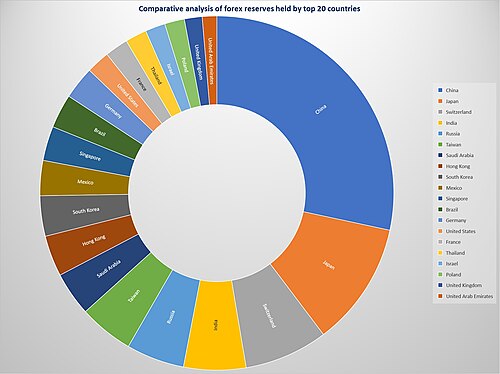
Global Distribution and Currency Composition
The distribution of reserves is heavily concentrated among a few global economic powers. The top five holders typically include China, Japan, Switzerland, India, and Russia.
![Foreign exchange reserves for the top 5 countries[203]](/images/77/7e/777e5d59a5bdbd5fb926285f4b53a50f9cff1a4f4e59cc451f7596b88721b51a.png)
The Currency Composition of Foreign Exchange Reserves (COFER) tracks how these assets are distributed across different currencies. While the U.S. dollar remains dominant, other currencies play significant roles in diversifying national portfolios.
The current share of claims in global reserves is distributed as follows:
| Currency | Share Percentage |
|---|---|
| U.S. Dollar (USD) | 60.8% |
| Euro (EUR) | 20.8% |
| Japanese Yen (JPY) | 5.90% |
| British Pound (GBP) | 5.00% |
| Canadian Dollar (CAD) | 2.70% |
| Chinese Renminbi (CNY) | 2.40% |
| Australian Dollar (AUD) | 2.20% |
| Swiss Franc (CHF) | 0.20% |
Trends in Reserve Composition
Data from 2019 through early 2025 shows a fluctuating but generally high reliance on the USD. For instance, in Q1 2019, USD claims stood at approximately 6,727.09 billion, rising to a peak of 7,087.77 billion by Q3 2021, before settling around 6,773.33 billion by Q2 2025. The Euro has maintained a steady second place, generally fluctuating between 2,000 and 2,500 billion USD.
Why Composition Matters
The specific mix of currencies in a reserve portfolio is vital for risk management. Diversification protects a country from the volatility of any single currency. If a central bank holds only one currency and that currency's value drops, the overall value of the nation's reserves declines. By spreading assets across the USD, EUR, JPY, and others, countries can maintain more stable purchasing power on the international stage.
Frequently Asked Questions
What is the difference between forex reserves and international reserves?
In a strict sense, forex reserves are specifically foreign-currency deposits. International reserves is a broader term that includes these deposits plus gold, Special Drawing Rights (SDRs), and IMF reserve positions.
How do central banks use reserves to stop currency depreciation?
When a currency loses value, the central bank sells its holdings of foreign currencies (like USD) and uses that money to buy its own local currency. This increases demand for the local currency, which helps push its value back up.
Which country holds the most foreign exchange reserves?
Based on the provided data, China is among the top holders of foreign exchange reserves globally.
Why is the U.S. Dollar the most common reserve currency?
While the source does not explicitly state the reason, the COFER data shows the USD holds a dominant 60.8% share, indicating its role as the primary global medium for international trade and financial stability.
What are Special Drawing Rights (SDRs)?
SDRs are international reserve assets created by the IMF to supplement the official reserves of member countries, providing them with additional liquidity.