Fordingbridge: A Comprehensive History of the Hampshire Town
Fordingbridge is a town with deep historical roots, stretching back to the early medieval period. Originally recorded as Forde in the Domesday Book of 1086, the settlement has evolved from a feudal manor into a hub of local industry and commerce, shaped by the families that governed it and the industries that sustained it.
The Feudal Era and Manorial Ownership
In the 11th century, the manor of Fordingbridge was held by Robert, who received it from Robert the son of Gerald. Prior to the Norman Conquest of 1066, the land had been held by Alwy under King Edward. By the early 13th century, ownership passed to Hugh de Linguire. Upon his death around 1231, the estate was inherited by his niece, Alice, and her husband, William de la Falaise.
The ownership of the manor saw several shifts throughout the 13th century. Following the deaths of Elias and William de la Falaise in 1254, the property eventually escheated—meaning it reverted to the Crown—due to a felony committed by William de la Falaise, the grandson of the original William. In 1277, the Crown granted the manor to Sir William le Brune, the king's chamberlain.
The Brune family maintained control of the manor for centuries. This stability lasted until 1769, when the male line became extinct upon the death of Charles Brune. Through his will, the estates passed to his grand-nephew, the Rev. Charles Prideaux-Brune of Prideaux Place in Padstow, Cornwall. The Prideaux-Brune family subsequently became the stewards of the manor.
Governance and Civic Life
Commerce was central to Fordingbridge's early development. Before 1273, the lord of the manor established a weekly market, which operated on Saturdays and later Fridays until the mid-19th century. Additionally, a fair was traditionally held every year on September 9.
The town's administration evolved over several centuries. Between the 13th and 15th centuries, Fordingbridge was governed by a bailiff. In later years, the town was managed by a constable, who was elected annually at the court leet (a manorial court) of the manor of Lower Burgate. This system of governance remained in place until 1878, when the Local District Council was established.
The town's physical landscape was significantly altered on May 23, 1702, when a devastating fire destroyed 43 dwelling houses. These homes were never rebuilt. A later addition to the town's architecture was the Fordingbridge Town Hall, constructed in 1877 near the center of the town.
Industrial Evolution and the Railway
Fordingbridge developed a strong manufacturing base over the centuries. In the 16th century, the town was known for cloth production. By the 19th century, this expanded into specialized factories for spinning flax and manufacturing canvas and sailcloth.
By 1900, the town's economy was diversified. While sailcloth and canvas remained primary industries, the town also produced bricks and tiles. Other local enterprises included an iron foundry, various flour mills, and the Neave's food works.
Transportation was revolutionized in 1866 with the opening of the Fordingbridge railway station. Part of the Salisbury and Dorset Junction Railway, the station linked the town to Salisbury in the north and Poole in the south.
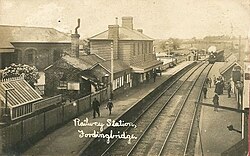
The station operated until 1964. Originally located just outside the town on the road to Sandleheath, the site is now occupied by an industrial park and a large mill. Although the station is gone, the road retains the name Station Road, and the nearby 'Railway Hotel' has recently reopened.
Key Facts
- Domesday Record: Listed as "Forde" in 1086.
- Long-term Ownership: Held by the Brune family from 1277 until 1769.
- Major Disaster: A fire in 1702 destroyed 43 houses.
- Key Industries: Sailcloth, canvas, flax spinning, brick and tile making.
- Railway Era: Station operated from 1866 to 1964.
| Period/Date | Event/Development | Significance |
|---|---|---|
| 1086 | Domesday Book Entry | First official record as "Forde" |
| 1277 | Grant to Sir William le Brune | Beginning of long-term Brune family ownership |
| 1702 | Town Fire | Loss of 43 dwelling houses |
| 1866 | Railway Station Opens | Connected town to Salisbury and Poole |
| 1877 | Town Hall Built | Established a civic center for the town |
| 1964 | Railway Station Closes | End of passenger rail service |
Frequently Asked Questions
What was Fordingbridge called in the Domesday Book?
In the Domesday Book of 1086, Fordingbridge was recorded under the name Forde.
Who owned the manor after the Brune family line ended?
After the male line of the Brune family became extinct in 1769 upon the death of Charles Brune, the estates devolved to his grand-nephew, the Rev. Charles Prideaux-Brune.
What were the primary industries in Fordingbridge around 1900?
The chief industries were the manufacture of canvas and sailcloth, as well as the production of bricks and tiles. The town also hosted an iron foundry, flour mills, and Neave's food works.
How was the town governed before the Local District Council?
From the 13th to the 15th century, the town was governed by a bailiff. Subsequently, it was managed by a constable chosen annually at the court leet of the manor of Lower Burgate until 1878.
Where is the Fordingbridge railway station located today?
The station site is now occupied by a large mill and industrial park on Station Road, situated next to the reopened Railway Hotel.