Football Ball Curl and Swerve: The Science and Art of Bending the Ball
In the world of association football, few sights are as mesmerizing as a ball that defies a straight line to curve into the top corner of the net. This phenomenon, commonly referred to as curl or bend, occurs when a player applies specific spin to the ball, forcing it to deviate from a linear path. While often used interchangeably, there is a subtle difference between curl—which is caused by spin—and swerve, where the ball moves in the air without a consistent spin.
The ability to manipulate the ball's flight is a critical skill for elite players, particularly during free kicks, crosses, and long-range shots. Historically, the equipment played a significant role in this evolution; traditional leather footballs were heavier and required immense effort to bend, whereas modern, lighter footballs allow for more pronounced curl and swerve.
Key Facts
- Curl is caused by the spin of the ball, while swerve can occur without spin.
- The Magnus effect is the physical principle that explains why a spinning ball curves.
- A trivela is a specialized technique where the ball is curled using the outside of the foot.
- The knuckleball (or folha seca) is a shot with little to no spin that wobbles unpredictably.
- An Olympic goal is a rare occurrence where a player scores directly from a corner kick.
The Nomenclature of Bending the Ball
Football has a rich vocabulary to describe the various ways a ball can move through the air. Shots that exhibit significant curvature are often called "curlers," and in extreme cases, they are known as banana shots. Depending on the axis of the spin, the effect changes:
- Trivela: A Portuguese term for curling the ball with the outside of the foot, a skill famously utilized by Ricardo Quaresma.
- Dip: A dipping shot occurs when a player applies topspin, causing the ball to curve downward rather than sideways.
- Knuckleball: This technique involves striking the ball with almost no spin. This causes the ball to dip or wobble unpredictably in the air. Originally known as folha seca ("dead leaf") by Brazilian star Didi in the 1950s, it has also been referred to as the "tomahawk" or the Italian maledetta ("accursed").
Practical Applications in the Game
Free Kicks
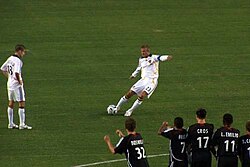
Free kicks are the most prominent showcase for curling techniques. Players use spin to navigate the ball around or over a defensive wall and out of the goalkeeper's reach. Depending on the positioning of the wall, a player may choose a finesse curl to go around the defenders or a powerful bend to force the ball into the goal.
While Didi and Giuseppe Meazza are early pioneers of the unpredictable knuckleball, modern masters like Juninho, Cristiano Ronaldo, Gareth Bale, and Andrea Pirlo have refined the art of the low-spin shot to deceive goalkeepers.
Corners and Passing
During corner kicks, players often employ an in-swinging corner, where the ball curves toward the goal. Alternatively, they may bend the ball toward the edge of the penalty area for a teammate to volley. In rare instances, a player may score directly from the corner, achieving an "Olympic goal."
Curling is equally vital in passing. Midfielders often use curl to bypass defenders or apply backspin to long cross-field passes. The trivela is particularly useful here, allowing a player to pass with their dominant foot even when facing sideways.
![Roberto Carlos' bending free kick for Brazil (yellow) against France (blue) in 1997 was struck with the outside of his left foot.[3]](/images/7f/54/7f5488491417b1b35abad63a8c0818334e839665d113a46c7824231e1710aee8.webp)
The Science: The Magnus Effect
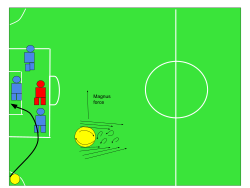
The physics behind a curving football is known as the Magnus effect, named after German physicist Heinrich Gustav Magnus who described it in 1852. However, Isaac Newton had previously observed and inferred the cause in 1672 after watching tennis players.
When a ball rotates, it creates a whirlpool of air around itself. On one side, the air moves in the same direction as the ball's travel, while on the opposite side, the air moves against the direction of travel. This creates a pressure differential; the ball is pushed away from the high-pressure area toward the low-pressure area, causing its flight path to curve.
Summary of Ball Flight Techniques
| Technique | Foot Part Used | Spin Type | Visual Effect |
|---|---|---|---|
| Standard Curl | Inside of foot | Side-spin | Curved path (Banana) |
| Trivela | Outside of foot | Side-spin | Outward curve |
| Dipping Shot | Top of foot/laces | Topspin | Rapid downward drop |
| Knuckleball | Laces/Center | Minimal/No spin | Unpredictable wobble |
Notable Masters of the Craft
Throughout history, numerous players have become legendary for their ability to manipulate the ball. Early masters included Pelé, Didi, Rivellino, Zico, and Giuseppe Meazza. This legacy continued with Diego Maradona, Michel Platini, Roberto Baggio, Zinedine Zidane, and David Beckham.
In the modern era, the art has been carried forward by specialists such as Roberto Carlos, Juninho, Andrea Pirlo, Ronaldinho, Lionel Messi, Cristiano Ronaldo, and Kevin De Bruyne, each contributing their own unique style to the physics of the game.
Frequently Asked Questions
What is the difference between curl and swerve?
Curl is the curved movement of the ball caused specifically by the spin applied to it. Swerve refers to the ball's deviation from a straight path, which can happen with or without the spin that characterizes a curl.
What is a trivela?
A trivela is a technique where a player strikes the ball with the outside of their foot to create a curve. This is often used for passing or shooting when the player's body position makes an inside-of-the-foot strike impractical.
How does the Magnus effect work in football?
The Magnus effect occurs when a spinning ball creates a difference in air pressure on opposite sides of the ball. The air moves faster on one side and slower on the other, forcing the ball to deviate from a straight line toward the area of lower pressure.
What is an Olympic goal?
An Olympic goal is a goal scored directly from a corner kick without any other player touching the ball. It requires exceptional technique to curve the ball from the corner arc directly into the net.
What is a knuckleball?
A knuckleball is a shot struck with very little or no spin. Because it lacks a consistent rotation, the ball interacts with the air unpredictably, causing it to wobble or dip suddenly, making it very difficult for goalkeepers to track.