Flowerpeckers: Small Specialists of the Tropical Canopy
The flowerpeckers, members of the family Dicaeidae, are a group of small passerine birds (perching birds) that have carved out a unique ecological niche across the tropics. These vibrant, stout birds are master specialists, possessing physiological adaptations that allow them to thrive on diets that would be challenging for other avian species.
Distributed throughout tropical southern Asia and Australasia—stretching from India east to the Philippines and south to Australia—flowerpeckers occupy a diverse array of environments. Their range extends from coastal sea-level forests to high-altitude montane habitats. While many are sedentary, some species, such as the Australian mistletoebird, are known to be highly nomadic.
Key Facts
- Family: Dicaeidae, comprising 56 species across three genera: Dicaeum, Prionochilus, and Pachyglossa.
- Size Range: From the tiny pygmy flowerpecker (10 cm, 5.7 g) to the larger mottled flowerpecker (18 cm, 12 g).
- Dietary Specialization: Highly adapted to consume mistletoe berries and nectar.
- Distribution: Tropical southern Asia and Australasia.
- Conservation: Most are resilient, but the Cebu flowerpecker is critically endangered due to habitat loss.
Physical Characteristics and Adaptations
Structurally, flowerpeckers are quite similar across the family. They are characterized by their stout bodies, short necks, and short legs. Their most distinctive features are their short, thick, curved bills and tubular tongues, which are essential for extracting nectar from flowers.
![The tongue tip is feathery in many species such as Dicaeum nigrilore[2]](/images/2b/33/2b333e3297a295cf16309a3ac5142438fdebe8d2c5631d7e764c8c2727385bcb.webp)
While many species exhibit dull coloration for camouflage, males of several species display striking plumage, ranging from glossy black to brilliant crimson. Beyond their appearance, their internal biology is equally specialized; their digestive systems have evolved to process mistletoe berries with high efficiency.
Diet and Foraging Behavior
While nectar is a primary food source, flowerpeckers maintain a varied diet that includes spiders, insects, and berries. They have a particularly strong relationship with mistletoes, with 21 species from 12 different genera identified as part of their diet. It is believed that all flowerpecker species possess adaptations to ingest these berries and dispose of the seeds quickly.
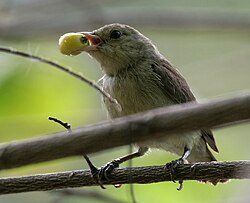
In the wild, these birds are social foragers. They are frequently found in mixed-species feeding flocks, sharing the canopy with white-eyes, sunbirds, and other flowerpecker species.
Breeding and Life Cycle
The breeding habits of Dicaeidae are less documented than their diet, but available data suggests they generally form monogamous pairs. However, the division of parental labor varies by species. For example, in scarlet-breasted flowerpeckers, both parents share the duties of nest building, incubation, and chick rearing. In contrast, the female mistletoebird handles nest construction and incubation alone.
Flowerpeckers typically lay between 1 and 4 eggs in a purse-like nest constructed from plant fibers and suspended from a shrub or small tree. The incubation period is brief, lasting between 10 and 12 days, with chicks usually fledging after 15 days.
Taxonomy and Classification
Historically, flowerpeckers have been grouped with other nectar-feeding birds, such as the sunbirds (Nectariniidae), berrypeckers (Melanocharitidae), and painted berrypeckers (Paramythiidae). Today, they are recognized as their own family.
| Category | Details |
|---|---|
| Scientific Family | Dicaeidae |
| Genera | Dicaeum, Prionochilus, Pachyglossa |
| Total Species | 56 |
| Primary Diet | Nectar, Mistletoe berries, Insects |
| Geographic Range | India, Philippines, Australia, and SE Asia |
Taxonomists traditionally separated the genera based on the length of the outermost primary feather—elongated in Prionochilus and reduced in most Dicaeum. However, recent molecular phylogeny (the study of evolutionary relationships through DNA) suggests these boundaries are blurred, and generic placements may be revised in the future.
Conservation Status
Most flowerpecker species are resilient and not currently threatened. However, habitat loss has taken a toll on a few specific populations. According to the IUCN, five species are near threatened and two are vulnerable. The Cebu flowerpecker is currently listed as critically endangered, while the status of the spectacled flowerpecker remains unknown.
Frequently Asked Questions
What do flowerpeckers eat?
Flowerpeckers primarily eat nectar and mistletoe berries, though they also supplement their diet with spiders and various insects.
How do flowerpeckers help mistletoe plants?
They have evolved digestive systems that allow them to process mistletoe berries and dispose of the seeds quickly, which aids in the dispersal of the plant.
What is the size difference between flowerpecker species?
There is a notable range in size, from the pygmy flowerpecker at 10 cm (5.7 g) to the mottled flowerpecker, which reaches 18 cm (12 g).
Where are flowerpeckers found?
They are distributed across tropical southern Asia and Australasia, including India, the Philippines, and Australia, inhabiting areas from sea level to mountains.
Are flowerpeckers endangered?
While most are not threatened, some are. The Cebu flowerpecker is critically endangered, and several others are listed as vulnerable or near threatened due to habitat loss.