Fish: The Diverse Vertebrates of Earth's Waters
Fish represent more than half of all vertebrate species on Earth, forming a massive and complex group of animals that have inhabited our planet's waters for hundreds of millions of years. From the ancient armored giants of the Devonian period to the highly specialized species in modern coral reefs, fish exhibit an extraordinary range of biological adaptations.

Key Facts
- Fish account for over 50% of all vertebrate species.
- There are over 32,000 described species of bony fish.
- More than 1,100 species of cartilaginous fish are known.
- Species are divided almost equally between freshwater and marine habitats.
- The fastest fish, such as salmon, can swim at 10–20 body lengths per second.
Biological Diversity and Classification
The classification of fish is vast. While they are often grouped together in common parlance, they belong to several distinct lineages. The most prominent include Osteichthyes (bony fish), Chondrichthyes (cartilaginous fish), and various groups of jawless fish such as hagfish and lampreys. Within the bony fish, two major classes exist: Actinopterygii (ray-finned fishes) and Sarcopterygii (lobe-finned fishes, which include the ancestors of tetrapods).
Diversity is staggering. While many families are large, about 64 families are monotypic, meaning they contain only a single species. The nine largest families—including Cyprinidae, Gobiidae, and Cichlidae—account for one-third of all fish species.
Speed and Locomotion
Movement in water requires specialized adaptations. Some species are built for incredible bursts of speed, such as the salmon, which can move at 10 to 20 body lengths per second. Conversely, others like the eel move much more slowly, at approximately 0.5 body lengths per second.
Global Habitats and Ecology
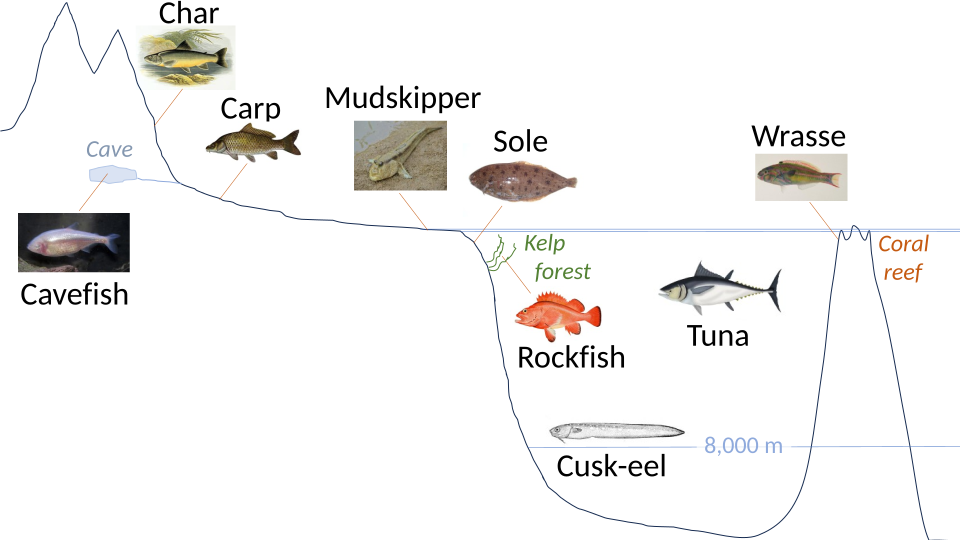
Fish inhabit nearly every aquatic environment on the planet. The distribution is remarkably balanced: there are approximately 15,200 freshwater species and 14,800 marine species. However, the centers of biodiversity differ significantly between these realms.
In the ocean, the Indo-Pacific coral reefs serve as the primary hub of marine fish diversity. In freshwater systems, the highest concentrations are found in the large river basins of tropical rainforests, specifically the Amazon, Congo, and Mekong basins. The Neotropical freshwaters alone host over 5,600 species, representing about 10% of all Earth's vertebrate species.
Predation and Social Behavior
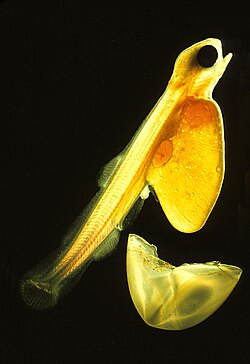
Ecology is driven by complex interactions between predators and prey. Some fish engage in shoaling or schooling—grouping together for safety from predators or to facilitate spawning. Other species have developed unique sensory tools, such as the elephantnose fish, which uses electrogenesis to create an electric field to locate objects in its environment.
![The elephantnose fish is a weakly electric fish which generates an electric field with its electric organ and then uses its electroreceptive organs to locate objects by the distortions they cause in its electric field.[80]](/images/c5/ef/c5ef9c4857e71404bc81694c61d824590c2ecaee226f13605eaca94d768d2431.webp)
![Fish such as these snipefishes school for safety from predators, and to spawn.[97]](/images/6f/6f/6f6f5dba79d7bea0179a73194eba283632c763b1f7b3d8482ec737c51887f9b0.jpg)
Anatomy and Physiology
The internal workings of a fish are highly specialized for life underwater. A typical fish possesses several key anatomical features, including a lateral line (a sensory organ used to detect movement and vibration), various fins for stability and propulsion, and gills for respiration.
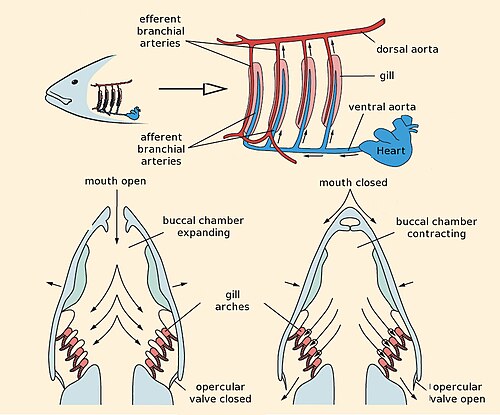
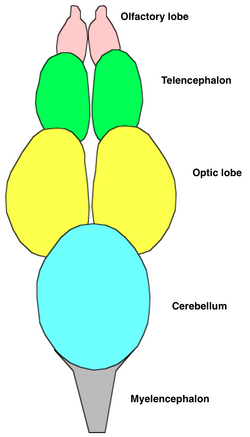
Respiration is primarily achieved through the gills, which extract dissolved oxygen from the water. Beyond breathing, fish exhibit a wide array of physiological traits, including complex brain structures and specialized sensory systems for sight, hearing, and even magnetoreception (the ability to detect magnetic fields).
Communication and Sound
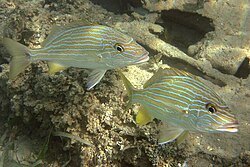
Fish are not silent inhabitants of the water. Some species, such as the French grunt fish, produce sounds by grinding their teeth, while others use various methods to communicate within their environment.
Conservation and Human Impact
Human activity has significant implications for fish populations. Overfishing remains a critical threat to many species and ecosystems. The collapse of major fisheries, such as the Atlantic northwest cod fishery, serves as a historical warning of the impact of unsustainable harvesting.
![The collapse of the Atlantic northwest cod fishery.[115]](/images/70/aa/70aa72e64fdc60f76c2f17e8470de1c2a2b8db61dbf8e722464666045b3fb9b8.png)
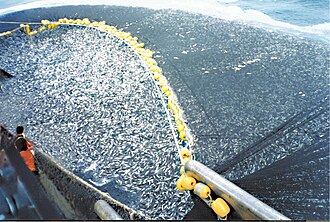
Modern industrial fishing, including methods like purse seining, can capture massive quantities of fish in a single operation, highlighting the scale of global commercial fishing efforts.
Summary of Fish Diversity and Characteristics
| Category | Key Details |
|---|---|
| Bony Fish | Over 32,000 described species |
| Cartilaginous Fish | Over 1,100 species |
| Freshwater Species | Approximately 15,200 species |
| Marine Species | Approximately 14,800 species |
| Fastest Speed | 10–20 body lengths/second (e.g., salmon) |
Frequently Asked Questions
What is the difference between bony fish and cartilaginous fish?
Bony fish (Osteichthyes) have skeletons made primarily of bone, whereas cartilaginous fish (Chondrichthyes) have skeletons made of cartilage.
Where is the highest concentration of fish diversity found?
Marine diversity is centered in the Indo-Pacific coral reefs, while freshwater diversity is highest in tropical river basins like the Amazon, Congo, and Mekong.
How do fish breathe underwater?
Most fish use gills to extract dissolved oxygen from the water as it passes over them.
What is schooling in fish?
Schooling is a behavior where fish swim together in a coordinated group, often to increase safety from predators or to assist in spawning.
Can fish make sounds?
Yes, some fish species can produce sounds through various methods, such as grinding their teeth.