Field Hockey: History, Rules, and Global Evolution
Field hockey is a dynamic team sport played with a round ball and specialized sticks. While it shares a name with other stick-and-ball games, field hockey is a distinct discipline characterized by its unique equipment, specific playing surfaces, and high-speed tactical play. Whether played on a traditional outdoor pitch or in a fast-paced indoor setting, the sport demands precision, agility, and teamwork.

Key Facts

- Governing Body: International Hockey Federation (FIH).
- Team Composition: 10 outfield players and 1 goalkeeper per side.
- Olympic Status: A mainstay of the Summer Olympics since 1928 (men) and 1980 (women).
- Origins: Modern rules emerged from 19th-century England.
- Variants: Includes indoor hockey and the fast-paced Hockey5s.
The History of the Game
The roots of modern field hockey can be traced back to 19th-century England. The first known club was established in 1849 at Blackheath in south-east London. However, the version of the game we recognize today was shaped by Middlesex cricket clubs, who played it as a winter activity. The Teddington Hockey Club played a pivotal role in modernizing the sport by introducing the striking circle and replacing the traditional rubber cube ball with a spherical one.
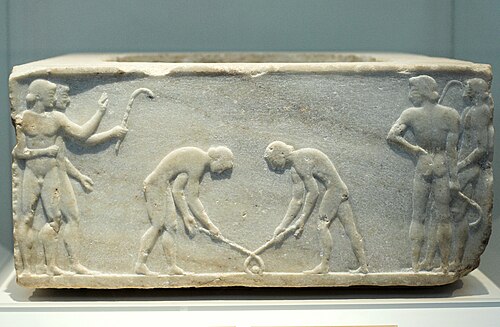
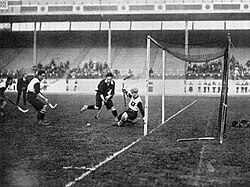
The sport's organizational history is marked by the founding of The Hockey Association in 1876 and the first international competition in 1895. Following its appearance in the 1908 and 1920 Olympics, the sport was briefly removed from the program. This led to the formation of the Fédération Internationale de Hockey sur Gazon (FIH) by seven European nations, ensuring the sport's reinstatement in the 1928 Olympic Games.
Dominance in the Olympic Arena
Historically, certain nations have demonstrated extraordinary dominance. In India, the sport saw legendary success; players like Dhyan Chand led the team to multiple gold medals, including a period of dominance from 1932 to 1956. Pakistan has also been a powerhouse, securing multiple Olympic medals, primarily in field hockey. In the women's game, since its Olympic debut in 1980, nations such as the Netherlands, Germany, Australia, and Argentina have emerged as consistent world leaders.
![Indian player Dhyan Chand won Olympic gold medals for his team in 1928, 1932 and 1936.[23] Photo shows him scoring a goal against Germany in the 1936 Olympics hockey final.](/images/b0/36/b0367a024301f5d8e88f0b645d89bfbab68389e8c170c9e9856922569dc5a245.jpg)
Equipment and Playing Field
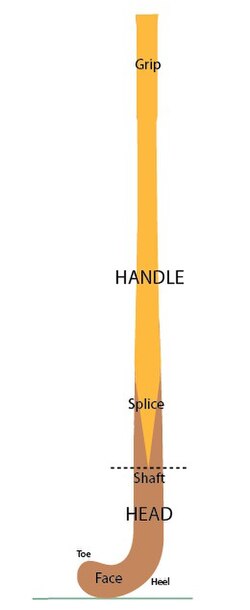
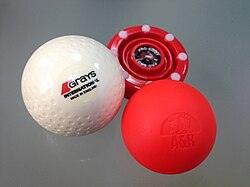
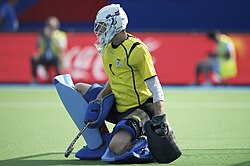
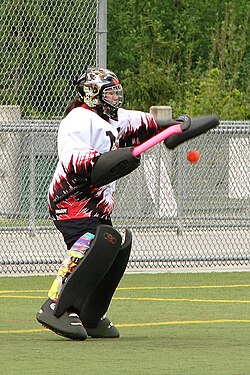
To compete safely and effectively, players use specialized gear. The primary tools are the hockey stick and a hard, spherical hockey ball. The ball is typically made of solid plastic and may feature indentations to prevent aquaplaning on wet surfaces. Players must also wear protective equipment, including mouthguards and shin guards. Goalkeepers, however, require much more extensive kits to protect against high-speed shots.

The Field and Goal Structure
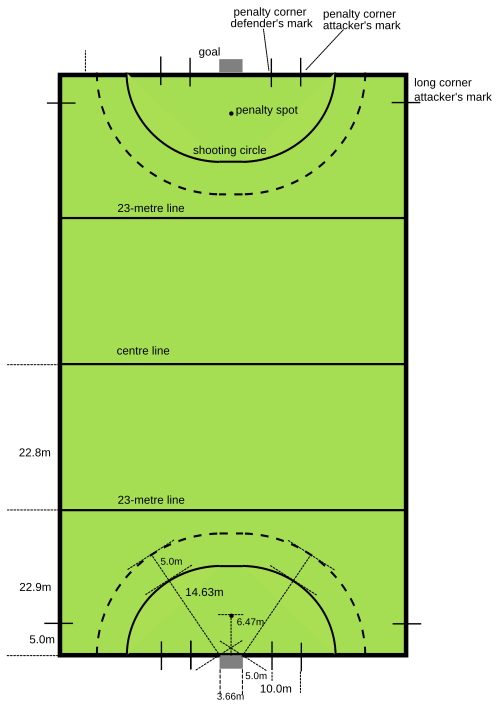
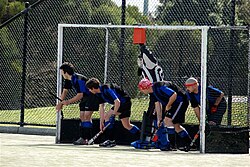
The field of play is defined by specific dimensions and structures. The goals consist of two upright posts and a horizontal crossbar, both of which must be white and rectangular. To assist in gameplay and safety, goals include sideboards and a backboard, which stand 50 cm from the ground.
Rules and Gameplay
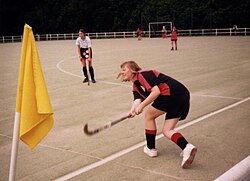
A standard match typically consists of two 35-minute periods, though modern international competitions often utilize four 15-minute quarters. The game involves various set plays, such as the penalty corner (or short corner), which is awarded for specific defensive offenses within the circle or the 23-meter area.
Discipline and Penalties
To maintain fair play, officials use a three-tier penalty card system to issue warnings and suspensions. This includes green cards for temporary suspensions. Players must also adhere to strict rules regarding dangerous play and the height of the ball to ensure athlete safety.


Sport Variants
Indoor Hockey
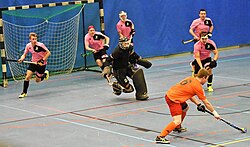
Indoor hockey is a popular 6-a-side variant played on a smaller pitch (approximately 40m x 20m). Unlike the outdoor game, players use pushes rather than hits to move the ball, and the sidelines are replaced by solid barriers that keep the ball in play.
Hockey5s
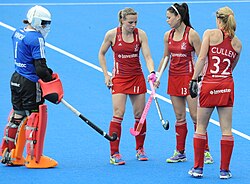
Hockey5s is a newer, faster variant designed for spectator engagement. It features five players per side on a pitch roughly half the size of a standard field. The rules are simplified, removing the penalty circle and replacing penalty strokes with a one-on-one "challenge."
Summary of Field Hockey Specifications
| Feature | Outdoor Field Hockey | Hockey5s |
|---|---|---|
| Players per side | 11 (10 outfield + 1 GK) | 5 (4 outfield + 1 GK) |
| Match Duration | Two 35-min periods or four 15-min quarters | Three 12-min periods |
| Field Size | Standard Pitch | 55m x 41.70m |
| Governing Body | FIH | FIH |
Frequently Asked Questions
What is the difference between field hockey and ice hockey?
Field hockey is played on grass or synthetic turf using a hard ball and sticks, whereas ice hockey is a contact sport played on ice using a puck.
What equipment is mandatory for players?
Players are required to wear mouthguards and shin guards. In many jurisdictions, such as US high schools, protective eyewear is also mandatory.
How is a penalty corner awarded?
A penalty corner can be awarded for defensive offenses within the circle, intentional offenses by a defender within the 23-meter area, or when a defender intentionally plays the ball over the back line.
Who governs international field hockey?
The International Hockey Federation (FIH) is the highest governing body for the sport.
What are the main differences in indoor hockey?
Indoor hockey is played with fewer players, uses a smaller pitch with solid sideboards, and prohibits hitting the ball, requiring players to use pushes instead.