Fiddlin' John Carson: A Pioneer of Early Country Music
Long before the glitz of the Grand Ole Opry, the foundations of American country music were being laid by regional musicians who blended folk traditions with raw, storytelling lyrics. Among the most influential of these early figures was Fiddlin' John Carson, a Georgia musician whose recordings in the 1920s helped transition old-time music from street corners and local contests to a national commercial industry.
Early Life and Musical Beginnings
Born on March 23, 1868, near McCaysville in Fannin County, Georgia, John Carson spent his youth in Cobb County. His father served as a section foreman for the Western and Atlantic Railroad Company. During his teenage years, Carson developed his skill on the fiddle, utilizing a violin that was a copy of a Stradivarius brought from Ireland in the early 18th century. Interestingly, before his music career took center stage, Carson spent time working as a racehorse jockey.
By 1900, Carson transitioned into industrial work, spending two decades in various cotton mills around Atlanta, eventually rising to the position of foreman. In 1911, he and his family settled in Cabbagetown, Georgia, where they worked for the Fulton Bag and Cotton Mill.
From the Cotton Mill to the Streets of Atlanta
A pivotal shift in Carson's life occurred in 1914 when the workers at the Fulton Bag and Cotton Mill went on strike to secure the right to form a union. Left without steady employment, Carson began performing for money on the streets of North Atlanta. During this period, he began writing his own songs, which he printed and sold to passersby for a nickel or a dime.
His songwriting often mirrored the drama of real-life events. He wrote a murder ballad regarding the case of Mary Phagan; however, his outspoken nature led to legal trouble. After Georgia Governor John Marshall Slaton commuted the death sentence of the wrongly convicted murderer in the Phagan case to life imprisonment, Carson wrote a version of the song accusing the governor of accepting a million-dollar bribe from a New York bank. This resulted in Carson being jailed for slander. The convicted killer, Leo Frank, was later lynched.
Rise to Fame and the "Champion Fiddler"
Carson's talent for the fiddle earned him significant regional acclaim. While he placed fourth at the first annual Georgia Old-Time Fiddlers' Convention in 1913, he went on to be proclaimed the "Champion Fiddler of Georgia" seven times between 1914 and 1922. It was the Governor of Tennessee, Robert L. Taylor, who gave him the nickname "Fiddlin' John."
In 1919, Carson formed a band called the Cronies and began touring the regions north of Atlanta. He developed close ties with Georgia politicians, including Tom Watson and the Talmadge family, which inspired songs like the "Tom Watson Special." Alongside his daughter, Rosa Lee, Carson performed at various political campaigns throughout the 1920s. His national trajectory accelerated on September 9, 1922, when he made his radio debut on WSB in Atlanta, a broadcast that spread his fame across the United States.
Recording Career and Commercial Success
Carson's entry into the recording industry happened by chance. Polk C. Brockman, an Atlanta furniture store owner and distributor for Okeh Records, spotted footage of Carson in a newsreel at a New York City theater. Brockman persuaded Ralph Peer, a talent scout and producer, to record the musician.
On June 19, 1923, in an empty building on Nassau Street in Atlanta, Carson recorded "The Little Old Log Cabin in the Lane" and "The Old Hen Cackled and the Rooster's Going To Crow." While Ralph Peer initially found Carson's singing style to be "pluperfect awful," the records were an instant hit, selling out at a fiddlers' convention in July 1923. This success led to further sessions in New York City, where songs like "You Will Never Miss Your Mother Until She Is Gone" and "Old Joe Clark" each sold over one million copies.
Between 1923 and 1931, Carson recorded nearly 150 songs, often collaborating with the Virginia Reelers or his daughter Rosa Lee (who performed under the stage name Moonshine Kate). He later recorded for the Victor and Bluebird labels. Despite his fame, Carson could not read sheet music and relied on Irene Spain to transcribe his compositions into standard notation. Although he wrote over 150 songs, only nine were ever copyrighted.
Later Years and Personal Views
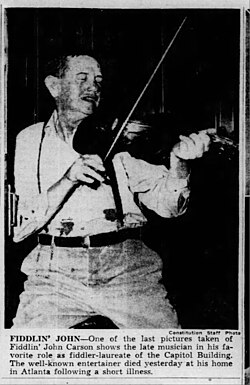
In his final years, Carson worked as an elevator operator for the local government in Atlanta, a position secured through his friendship with Governor Herman Talmadge. He passed away on December 11, 1949, in Atlanta, Georgia, still holding his fiddle. He is buried in Sylvester Cemetery in East Atlanta.
Carson's work and personal life reflected the prejudices of the rural South during his era. He was a regular attendee of Ku Klux Klan rallies, a fact referenced in his song "There Ain't No Bugs on Me," which also mocked the theory of evolution. Additionally, his "Ballad of Little Mary Phagan" contributed to the anti-Semitism prevalent in Atlanta at the time, and he later wrote "Dear Old Oak in Georgia" regarding the tree where Leo Frank was lynched.
Key Facts
- Pioneer Status: Widely regarded as one of the early pioneers of American country music.
- Champion Musician: Named "Champion Fiddler of Georgia" seven times between 1914 and 1922.
- Commercial Hits: Recorded songs that sold over one million copies, including "Old Joe Clark."
- Radio Debut: First broadcast on WSB in Atlanta on September 9, 1922.
- Musical Instrument: Played an 18th-century Stradivari-copy violin from Ireland.
- Songwriting: Wrote over 150 songs, though only nine were copyrighted.
| Category | Details |
|---|---|
| Lifespan | March 23, 1868 – December 11, 1949 |
| Primary Instrument | Fiddle |
| Active Years | 1920s – 1940s |
| Key Labels | Okeh Records, Victor, Bluebird |
| Notable Collaborators | Rosa Lee Carson (Moonshine Kate), Virginia Reelers |
| Birthplace | Fannin County, Georgia |
Frequently Asked Questions
How did Fiddlin' John Carson start his music career?
Carson began performing professionally in the streets of North Atlanta in 1914 after the cotton mill where he worked went on strike, leaving him without a steady income.
What was the significance of his recording with Okeh Records?
His 1923 recordings were among the first commercial successes for old-time music, proving there was a massive market for rural Southern music and paving the way for the country music industry.
Who was "Moonshine Kate"?
Moonshine Kate was the stage name used by Carson's daughter, Rosa Lee Carson, who performed and recorded many songs with her father.
Why was Carson jailed for slander?
He was jailed after writing a version of the "Mary Phagan" song in which he accused Governor John Marshall Slaton of taking a bribe to commute the sentence of a convicted murderer.
What happened to his songs since he couldn't read music?
Because he could not read or write sheet music, he had his compositions transferred to standard notation by Irene Spain, the stepdaughter of Andrew Jenkins.