Fictional Fighters: Iconic Aircraft from Games, Film, and Literature
From the high-stakes dogfights of the Ace Combat series to the interstellar battles of Halo and Stargate, fictional fighter aircraft have long captured the imagination of audiences. These designs often push the boundaries of physics, blending real-world aeronautics with futuristic technology to create "superfighters" capable of feats impossible for current aviation.
Whether they are VTOL (Vertical Take-Off and Landing) craft that hover like helicopters or exoatmospheric interceptors designed for the vacuum of space, these aircraft serve as centerpieces for storytelling in video games, cinema, and novels.
Key Facts
- Ace Combat features a vast array of "superfighters" like the ADF-01 FALKEN and X-02 Wyvern, often utilizing forward-swept wings and laser weaponry.
- The Macross/Robotech series introduced "variable fighters" such as the VF-1 Valkyrie, which can transform into mecha.
- The Halo universe utilizes specialized UNSC craft like the AV-14 Hornet and the F-41 Broadsword for atmospheric and space combat.
- Pop culture myths, such as the F-19 Ghostrider, once shaped public perception of stealth technology before the F-117 Nighthawk was revealed.
- Experimental designs in fiction often incorporate supercruise (the ability to fly at supersonic speeds without afterburners) and 3D thrust vectoring for extreme maneuverability.
The Superfighters of Ace Combat
The Ace Combat series is renowned for its advanced dominance fighters developed by entities like Gründer Industries and Neucom Incorporated. These aircraft often feature supermaneuverability—the ability to maintain control at extremely high angles of attack.
The ADF and XFA Series
The ADF-01 FALKEN is a standout superfighter equipped with an internal laser system and the ability to disrupt enemy HUDs (Head-Up Displays). Its successor, the ADF-11F Raven, introduces modularity, allowing a UCAV (Unmanned Combat Aerial Vehicle) module to replace the manned cockpit. This UCAV can detach from its RAW-F wing unit to fly independently.
Other notable designs include the X-02 Wyvern, which utilizes variable-geometry tail fins and wings that can switch between forward- and backward-swept configurations. The XFA-33 Fenrir takes this further with optical camouflage and a microwave radiation gun.
Neucom and Specialized Craft
Neucom Incorporated produced the R-Series Delphinus fighters, progressing from the agile R-101 to the highly stable R-103. They also developed the R-311 Remora, a parasite attacker dropped from the larger R-531 Mobura. For those seeking extreme speed, the RF-12A2 Blackbird provides stratospheric interception, though its massive weight makes tight maneuvering difficult.
Sci-Fi and Space-Capable Interceptors
Beyond the atmosphere, fictional aviation evolves into spaceplanes and exoatmospheric fighters designed to combat alien threats.
The Stargate and Halo Arsenals
The F-302 Fighter-Interceptor from Stargate is a marvel of hybrid engineering, incorporating alien-derived technologies such as Naquadah-based composites and a short-range hyperspace-window generator for superluminal (faster-than-light) propulsion.
In the Halo series, the UNSC employs the F-41 Broadsword, a multirole strike fighter capable of operating in both atmospheres and vacuums. The F-41E variant is further enhanced with energy shielding. For ground support, the AV-14 Attack VTOL (the Hornet) provides essential airborne firepower.
Variable Fighters of Macross
The VF-0 Phoenix and its evolution, the VF-1 Valkyrie, represent the pinnacle of transformable aviation. Inspired by the F-14 Tomcat, the Valkyrie can shift from a fighter jet to a humanoid mecha. Variants range from the standard VF-1A to the heavily armed VF-1S used by the Skull Squadron.
Cinematic and Literary Aircraft
Movies and novels often use fictional aircraft to create a sense of mystery or futuristic tension.
The Stealth Myths: F-19 and MiG-31
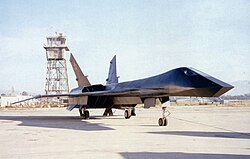
The F-19 Ghostrider was a conceptual design that became the public's image of the "Stealth Fighter" in the 1980s, described in Tom Clancy's Red Storm Rising as a cornerless "Frisbee." Similarly, the MiG-31 Firefox from the novel and film of the same name was portrayed as a Soviet interceptor with stealth capabilities and a thought-controlled weapons system.
Other Notable Screen Aircraft
From the 1967 series Captain Scarlet and the Mysterons, the Angel Interceptor operates from the airborne carrier Cloudbase, powered by turbo-jet compressors and a ramjet. In the world of Top Gun, the MiG-28 served as the antagonist's aircraft, though it was portrayed by a real Northrop F-5.
Comparative Summary of Fictional Aircraft
| Aircraft Name | Origin | Key Feature | Primary Role |
|---|---|---|---|
| ADF-01 FALKEN | Ace Combat | Internal Laser / HUD Jamming | Air Superiority |
| VF-1 Valkyrie | Macross | Transformation to Mecha | Multi-role Combat |
| F-302 | Stargate | Hyperspace-window Generator | Exoatmospheric Interceptor |
| F/A-37 Talon | Stealth (Film) | Mach 3.5 / AI UAV Support | Fighter Attack |
| AV-14 Hornet | Halo | VTOL Capability | Airborne Attack |
Frequently Asked Questions
What is a UCAV in the context of these aircraft?
A UCAV, or Unmanned Combat Aerial Vehicle, is a drone designed for combat operations without a human pilot on board. Examples include the QFA-44 and the modular ADF-11F Raven.
What does VTOL stand for and why is it useful?
VTOL stands for Vertical Take-Off and Landing. It allows aircraft, such as the Firehawk or the AV-14 Hornet, to take off and land without a runway, making them ideal for rugged terrain or carrier operations.
How does the F-19 Ghostrider differ from the real F-117 Nighthawk?
The F-19 was a conceptual, sleek, low-profile design that the public believed was the stealth fighter. The actual F-117 Nighthawk featured a highly angular, faceted design to deflect radar waves.
What are forward-swept wings?
Forward-swept wings are wings that angle forward from the fuselage toward the wingtips. In fiction, such as with the ASF-X Shinden II or XR-45 Cariburn, they are often used to represent extreme maneuverability.
What is the purpose of a parasite attacker?
A parasite attacker, like the R-311 Remora, is a smaller aircraft carried by a larger "mother ship" (such as the R-531 Mobura). It is dropped at high altitudes to conduct rapid strikes before reattaching to the carrier.