Feminist Economics: Challenging Traditional Frameworks and Valuing Unpaid Labor
For decades, the field of economics has been viewed as a neutral science. However, feminist economists argue that economics is socially constructed, meaning it is shaped by the perspectives of those who create it. Historically, mainstream economic theory has been developed primarily by European-descended, heterosexual, middle- and upper-middle-class men. This narrow lens has often privileged male-identified and Western interpretations, effectively excluding the lived experiences of women, children, and non-traditional families.
By incorporating feminist theory, these scholars aim to expose how biased histories, social norms, and political structures influence economic research and methodology. From the way we measure national wealth to the way we perceive labor, feminist economics seeks to create a more inclusive and accurate understanding of global economic life.
Key Facts
- Systemic Bias: Traditional economics often relies on exclusionary assumptions, such as the idea that women are economically dependent or irrational economic agents.
- The Care Economy: Unpaid domestic and care work is central to human well-being but is largely excluded from official production boundaries.
- GDP Gap: In the U.S., the estimated value of unpaid work is between 20% and 50% of GDP; in the U.K., it may be as high as 70%.
- Labor Disparity: Married mothers often work more total hours per week (combining paid and unpaid labor) than fathers.
- Macroeconomic Impact: Gender disaggregation shows that higher female labor force participation can increase an economy's likelihood of recovering from downturns.
Economic Epistemology and History
Economic epistemology examines how we know what we know about economics. Feminist critics argue that traditional communities signal expectations that exclude outsiders, leading to a skewed version of economic reality. This is evident in the historical assumptions embedded in the field, such as the belief that all women are (or should be) housewives due to their reproductive capacities or that they are unproductive in the industrial workforce.
Even influential thinkers like Adam Smith are scrutinized. While Smith engaged with 18th-century discourse, scholars like Edith Kuiper note that he often supported the status quo, overlooking the division of labor within the family and the economic contribution of women. To fill these gaps, feminist economists look to contemporaneous works, such as Mary Collier's The Woman's Labour (1739).
Engendering Macroeconomic Theories
To correct gender bias, economists employ several strategies to integrate gender into macroeconomic models.
Gender Disaggregation
This method separates macroeconomic variables by gender to show how men and women differ in consumption, investment, and saving behaviors. For instance, research by Korkut Ertürk and Nilüfer Çağatay suggests that the feminization of labor stimulates investment, whereas increased female activity in housework raises savings.
Gendered Macroeconomic Variables
Some economists enhance models by addressing variables that traditional neoclassical theories ignore. Bernard Walters argues that assuming population and labor are determined exogenously fails to account for caring labor—the essential work of reproduction and care disproportionately performed by women. Additionally, studies using neoclassical growth models have found that women's education has a statistically significant positive effect on labor productivity, sometimes more robust than that of men's education.
The Care Economy and Unpaid Work
A central pillar of feminist economics is the care economy, which encompasses all tasks involving caregiving. This includes both paid and unpaid work. Scholars argue that unpaid domestic work is as valuable as paid work and should be included in measures of economic success.
The System of National Accounts (SNA), used by the UN, IMF, and World Bank to measure economic output, explicitly excludes unpaid household services from its production boundary. Feminist economists argue that this exclusion ignores basic, necessary labor. Even indices like the Gender-related Development Index (GDI) and the Gender Empowerment Measure (GEM) are criticized for failing to adequately capture unpaid work.
Measuring the Invisible
The most common method for measuring this labor is through time-use surveys, which track how much time individuals spend on unpaid activities. However, this method faces challenges:
- Accuracy: Multitasking (e.g., caring for a child while gathering fuel) is often under-reported.
- Valuation: Determining the monetary value of a chore is complex. Methods include opportunity cost (what the person would earn in the market), replacement cost (what it would cost to hire someone), and input-output cost.
Critics of the opportunity cost method note that it creates absurd disparities—for example, a toilet cleaned by a lawyer would be valued higher than one cleaned by a janitor. Replacement cost is also criticized because wages in female-dominated care industries are often artificially depressed due to gender inequality.
The Formal Economy and Globalization
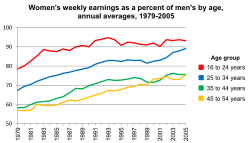
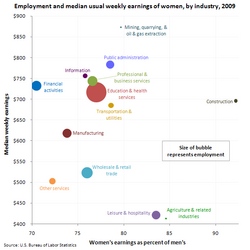
In the formal labor market, feminist economists study occupational segregation, the gender pay gap, and the glass ceiling. While older theories attributed these to "free choices" or different preferences, feminist economists point to sexism, patriarchal institutions, and discrimination.
![Percentage gap between median men's and women's wages, for full-time workers by OECD country, 2006. In the U.K., the most significant factors associated with the remaining gender pay gap are part-time work, education, the size of the firm a person is employed in, and occupational segregation. (Women are under-represented in managerial and high-paying professional occupations.)[40]](/images/b8/cd/b8cd1f83cca8077cbaf595e95d522db9e770f008e5931a0e718958db185f6ad7.jpg)
Research indicates that wage-setting is often driven by social gender norms and the power of actors rather than pure market forces. Furthermore, there is a growing focus on discrimination against caregiver-workers. Because many corporate policies are designed for the "ideal worker" (traditionally a man with no domestic responsibilities), those who provide hands-on care for children or the elderly face systemic inequities.
Degrowth and Ecological Economics
Recent intersections between feminist and ecological economics have led to the degrowth approach. This critique argues that the growth-based capitalist paradigm devalues both nature and care. By moving away from a focus on GDP growth, proponents suggest a work-sharing model that respects the "rhythm of life" inherent in care work rather than treating time solely as a scarce resource for efficient allocation.
| Method | Definition | Primary Criticism |
|---|---|---|
| Opportunity Cost | Based on the market wage the worker would earn. | Value varies wildly based on the individual's profession. |
| Replacement Cost | Based on the cost of hiring a professional substitute. | Often relies on depressed wages in female-dominated sectors. |
| Input-Output | Based on the cost of materials and time inputs. | Complexity in establishing monetary levels for multiple outputs. |
Frequently Asked Questions
What is the primary goal of feminist economics?
The primary goal is to challenge the male-centric biases of traditional economics and integrate the lived experiences of women and marginalized groups into economic theory, particularly regarding unpaid labor and social well-being.
Why is the System of National Accounts (SNA) criticized?
The SNA is criticized because it excludes unpaid household and care services from its production boundary, meaning a massive portion of the labor that sustains society is not counted in a country's economic output or GDP.
What is gender disaggregation in economics?
Gender disaggregation is the practice of separating economic data (such as consumption or saving patterns) by gender to reveal how men and women behave differently and how these differences affect macroeconomic outcomes.
How does the "ideal worker" norm affect caregivers?
The "ideal worker" is a traditional model of an employee with no domestic responsibilities. Because policies are built around this norm, people who provide care for children or the elderly—disproportionately women—face inefficiency and inequity in the workplace.
What is the relationship between feminist economics and degrowth?
Both critique the capitalist growth paradigm. Degrowth advocates argue that focusing on GDP growth devalues care and nature, proposing instead a system that prioritizes human well-being and the rhythms of care over market efficiency.