Farrar, Straus and Giroux: A Legacy of Literary Excellence
Farrar, Straus and Giroux (FSG) is one of the most prestigious American book publishing companies, renowned for its commitment to high-quality literary works. Since its inception, the house has become a sanctuary for some of the world's most influential writers, earning a reputation for intellectual rigor and artistic excellence. Today, FSG operates as a division of Macmillan, which is owned by the German conglomerate Holtzbrinck Publishing Group.
Key Facts
- Founded: 1946 by Roger Williams Straus Jr. and John C. Farrar.
- Parent Company: Macmillan Publishers (Holtzbrinck Publishing Group).
- Specialization: Literary fiction, poetry, and academic works.
- Accolades: Authors have won numerous Nobel Prizes, Pulitzer Prizes, and National Book Awards.
- Headquarters: Equitable Building, New York City, New York.
The Founding and Early Struggles
The company began in 1945 as Farrar, Straus, and Company. Its early catalog featured works such as Yank: The G.I. Story of the War and James Branch Cabell's novel There Were Two Pirates. However, the firm's early years were financially challenging.
A turning point arrived in 1950 with the publication of Gayelord Hauser's diet book, Look Younger, Live Longer. Selling 500,000 copies, the book provided the financial stability necessary for the founders to pursue more ambitious literary projects. During this period, Roger Straus and his wife Dorothea scouted talent in Italy, bringing authors like Carlo Levi, Alberto Moravia, Giovannino Guareschi, and Cesare Pavese to an American audience. They also successfully recruited Edmund Wilson from Random House.
In 1950, the firm was renamed Farrar, Straus & Young to include Stanley Young, a playwright and critic for The New York Times.
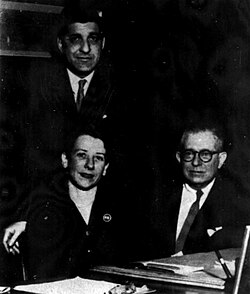
Growth and the Influence of Robert Giroux
The company underwent several structural changes in the 1950s, including a 1953 merger with Pellegrini & Cudahy. However, the most significant shift occurred in 1955 when Robert Giroux joined the firm. Giroux had previously worked at Harcourt, where he grew frustrated after the publisher refused to release J.D. Salinger's The Catcher in the Rye.
Giroux's arrival triggered what is often described as a "Pied Piper sweep," as a massive wave of literary giants followed him to the house. This included T.S. Eliot, Flannery O'Connor, Jack Kerouac, Robert Lowell, and Thomas Merton. By 1964, Roger Straus named Giroux chairman of the board, and the company officially became Farrar, Straus and Giroux.
Corporate Evolution and Modern Era
Roger Straus continued to lead the company for two decades following the death of John C. Farrar. In 1993, Straus sold a majority interest in FSG to the Georg von Holtzbrinck Publishing Group, choosing the German firm specifically for its reputation for publishing serious literature.
In the 21st century, the company has seen leadership from Jonathan Galassi, who served as president and publisher until 2018, and Mitzi Angel, who succeeded him as publisher in 2018 and became president in 2021. Current leadership also includes Jenna Johnson as vice president and editor in chief.
Imprints and Specialized Publishing
FSG manages several imprints to cater to different literary and academic needs:
- FSG Originals: Launched in 2011, this line focuses on paperback and digital originals, including Jeff VanderMeer's Area X trilogy.
- Hill and Wang: A specialized imprint for academic interests and history, featuring authors such as Elie Wiesel and Roland Barthes.
- FSG Books for Young Readers: Operated by Macmillan Children's Publishing Group, this imprint publishes acclaimed authors like Madeleine L'Engle and Roald Dahl.
The company also experimented with the MCD imprint (a lab for new styles and genres) and Sarah Crichton Books (commercial literary works), though MCD was closed in 2026.
| Category | Details |
|---|---|
| Founders | John C. Farrar, Roger W. Straus Jr. |
| Key Partner | Robert Giroux (joined 1955) |
| Current Parent | Macmillan (Holtzbrinck Publishing Group) |
| Notable Imprints | Hill and Wang, FSG Originals, AUWA, Quanta Books |
| Distribution | Macmillan (US), Melia Publishing Services (UK) |
Award-Winning Legacy
FSG is distinguished by the sheer number of prestigious awards won by its authors. The house has published a staggering array of Nobel Prize in Literature winners, including Samuel Beckett, Wole Soyinka, and Louise Glück. Its list of Pulitzer Prize and National Book Award winners spans decades, covering everything from the poetry of Robert Lowell to the non-fiction of Thomas L. Friedman.
Frequently Asked Questions
Who founded Farrar, Straus and Giroux?
The company was founded in 1946 by Roger Williams Straus Jr. and John C. Farrar. Robert Giroux joined later in 1955 and eventually became a partner, adding his name to the firm in 1964.
What is the relationship between FSG and Macmillan?
Since 1993, Farrar, Straus and Giroux has been a division of Macmillan, which is owned by the German publishing conglomerate Holtzbrinck Publishing Group.
What are some of the most famous authors published by FSG?
FSG has published a vast array of literary icons, including T.S. Eliot, Flannery O'Connor, Jack Kerouac, and Nobel laureates such as Aleksandr Solzhenitsyn and Louise Glück.
What is the purpose of the Hill and Wang imprint?
Hill and Wang is an imprint of FSG that specializes in books of academic interest, with a particular focus on history.
Why did Robert Giroux leave Harcourt to join FSG?
Giroux was angered by Harcourt's refusal to allow him to publish J.D. Salinger's The Catcher in the Rye, leading him to join FSG and bring many other authors with him.