Fantômas: The Ruthless Master of Disguise in French Crime Fiction
In the realm of early 20th-century crime literature, few figures loom as large or as terrifying as Fantômas. Described by scholar Schütt (2003) as the catalyst for nearly every unsolved crime in his universe, Fantômas is not a mere thief, but a criminal genius defined by his ruthlessness and an uncanny ability to evade capture. Unlike the more romanticized figures of the era, Fantômas represents a darker, more sadistic side of the criminal underworld.
While he shares the stage of French fiction with the famous Arsène Lupin, the two differ fundamentally in morality. While Lupin maintains a personal code that forbids murder, Fantômas is a sociopath who finds pleasure in sadistic killing. He is a man of no loyalty, showing no mercy even to his own children, and operates as a ghost in plain sight through his mastery of disguise.
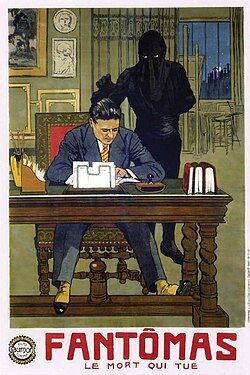
Key Facts
- Nature: A ruthless criminal genius and sociopath known for sadistic murders.
- Specialty: Master of disguise, often assuming the identities of his victims.
- Modus Operandi: Employs bizarre methods, including plague-infested rats, giant snakes, and sand-filled rooms.
- Primary Antagonist: Inspector Juve, the only detective capable of tracking his movements.
- Estimated Birth: 1867.
The Elusive History of a Villain
The background of Fantômas is intentionally vague, suggesting a mixed British and French ancestry. His movements across the globe reveal a pattern of destruction and manipulation that spans decades and continents.
Early Years and Global Movements
Around 1892, the man who would become Fantômas operated in the German principality of Hesse-Weimar under the alias Archduke Juan North. During this time, he fathered a son, Vladimir, with an unnamed noblewoman before being imprisoned under undisclosed circumstances.
By 1895, his trail led to India. It is suggested that he may be the father of a girl named Hélène, born to a European woman, though some accounts suggest the father was an Indian prince who served as Fantômas's acolyte. Hélène was subsequently raised in South Africa.
His path of ruin continued in 1897 through the United States and Mexico, where he systematically destroyed his business partner, Etienne Rambert.
The Boer War and the Path to Paris
In 1899, Fantômas entered the Second Boer War in South Africa using the name Gurn. Serving as an artillery sergeant in the Transvaal under Lord Roberts, he eventually became the aide-de-camp to Lord Edward Beltham of Scottwell Hill. During this tenure, he began an affair with Lord Beltham's younger wife, Lady Maud Beltham.
The tension culminated around 1900 in Paris. When Lord Beltham discovered the pair in their love nest on Rue Levert, Gurn murdered him with a hammer and strangulation. This act set the stage for a complex game of cat-and-mouse with the French authorities.
The Conflict with Inspector Juve and Jerôme Fandor
Following the murder of Lord Beltham, Fantômas impersonated Etienne Rambert to frame Rambert's son, Charles, for the crime. This manipulation brought him into the orbit of Inspector Juve, a detective who became obsessively dedicated to capturing the elusive criminal.
Recognizing Charles's innocence, Juve provided the young man with a new identity: Jerôme Fandor, a journalist for the newspaper La Capitale. Although Juve eventually arrested Gurn and argued in court that he was Fantômas, the evidence was deemed too circumstantial for a conviction. In a final act of deception, Fantômas escaped his execution by arranging for an actor, who had modeled his appearance on Fantômas's latest persona, to be executed in his place.
The Human Toll
The wake of Fantômas's crimes left a trail of tragedy. Lady Beltham, torn between her love for the villain and her horror at his actions, committed suicide in 1910. Meanwhile, Jerôme Fandor found solace in his marriage to Hélène, despite Fantômas's persistent attempts to destroy their relationship.
The cycle of violence concluded with the reappearance of Fantômas's son, Vladimir, in 1911. After Fantômas murdered Vladimir's girlfriend, the son was eventually shot and killed by Inspector Juve.
Summary of Fantômas's Identities and Timeline
| Approximate Year | Alias/Identity | Location | Key Event |
|---|---|---|---|
| 1892 | Archduke Juan North | Hesse-Weimar, Germany | Fathered Vladimir; later imprisoned. |
| 1895 | Unknown | India | Possible father of Hélène. |
| 1897 | Unknown | USA and Mexico | Ruined business partner Etienne Rambert. |
| 1899 | Gurn | South Africa | Served as artillery sergeant in Boer War. |
| c. 1900 | Etienne Rambert (Impersonation) | Paris, France | Framed Charles Rambert for murder. |
Frequently Asked Questions
How does Fantômas differ from Arsène Lupin?
While both are famous thieves in French literature, Arsène Lupin is a gentleman thief who avoids murder. Fantômas is a sociopath who enjoys killing and employs sadistic methods to achieve his goals.
Who is Inspector Juve?
Inspector Juve is the primary antagonist to Fantômas and the only investigator capable of identifying the criminal's tracks. He is characterized by his obsession with capturing Fantômas.
What are some of the bizarre methods Fantômas uses in his crimes?
Fantômas is known for using improbable and terrifying techniques, such as filling rooms with sand, using giant snakes, and deploying plague-infested rats.
How did Fantômas avoid execution?
On the eve of his execution, he was replaced by an actor who had modeled his appearance after one of Fantômas's characters, resulting in the actor being executed instead.
Who is Jerôme Fandor?
Jerôme Fandor is a journalist for La Capitale. He was originally Charles Rambert, a man framed by Fantômas and given a new identity by Inspector Juve to protect him.