F5D Skylancer: The Evolution and Legacy of a Supersonic Fighter
The Douglas F5D Skylancer represents a fascinating chapter in aviation history, marking a transition from a modified interceptor to a specialized research tool. While it never achieved the widespread production numbers of its contemporaries, its contributions to supersonic research and space program simulations left a lasting impact on aeronautical engineering.
Originally conceived as an evolution of the Douglas F4D Skyray, the Skylancer was designed to harness the increased power of the Pratt & Whitney J57 engine. This shift in propulsion necessitated significant structural changes, eventually transforming the aircraft into a distinct design that moved far beyond its predecessor.
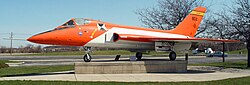
Key Facts
- Manufacturer: Douglas Aircraft Company
- Primary User: United States Navy and NASA
- First Flight: 21 April 1956
- Max Speed: Mach 1.48
- Total Built: 4 aircraft
- Primary Role: Fighter aircraft and NASA research testbed
Design and Technical Development
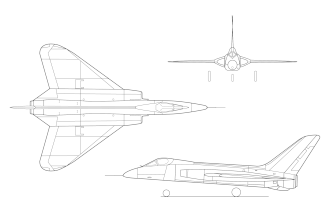
As the design progressed, the aircraft underwent extensive modifications to optimize it for high-speed performance. Although it retained the basic form and wing shape of the Skyray, the wings were made significantly thinner and the skinning was reinforced to address previous structural issues. To reduce transonic drag—the resistance encountered as an aircraft approaches the speed of sound—the fuselage was lengthened by 8 feet (2.4 meters) and utilized area ruling, a design technique that thins the fuselage near the wing roots to improve aerodynamic efficiency.
Armament and Powerplant
The F5D-1 was equipped with four 20 mm autocannons located in the wing roots. However, its primary combat capability was intended to be missile-based, with configurations supporting either four AIM-9 Sidewinders or two AIM-7 Sparrows, alongside a battery of 2-inch (51 mm) unguided rockets. The production models were slated to use the powerful J57-P-14 engine, though engineers had previously explored even more ambitious designs involving the General Electric J79 engine and variable-geometry inlets for Mach 2 capabilities.
Operational History and Navy Cancellation
The F5D-1 made its supersonic debut on 21 April 1956. Early flight testing indicated that the aircraft was highly maneuverable and performed well. Despite this success, the United States Navy cancelled the production order after only four aircraft were constructed. While the official reason cited was the aircraft's similarity to the Vought F8U Crusader, historians suggest that political factors regarding Douglas Aircraft Company's market share may have influenced the decision.
Lt. Cmdr. Alan B. Shepard Jr., the project's test pilot, ultimately reported that the aircraft was not a necessity for the Navy's requirements. Following the cancellation, the existing airframes were repurposed for various military test programs.
NASA Research and the X-20 Dyna-Soar
The Skylancer found a second life in the early 1960s when two airframes were transferred to NASA. These aircraft became vital assets for high-speed research and space program simulations.
Supersonic Transport and Vision Field Testing
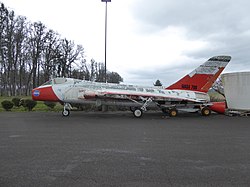
NASA 212 (later NASA 708) served as a testbed for the American supersonic transport program. It was uniquely fitted with an ogival wing platform—a highly curved wing shape similar to that later used on the Concorde—providing data that was shared with European designers. Additionally, it was used as a vision field test platform for the X-20 Dyna-Soar program.
Dyna-Soar Abort Simulations
NASA 802 (formerly NASA 213) played a critical role in simulating abort procedures for the X-20 Dyna-Soar. Because the Skylancer shared similar handling characteristics and shapes with the Dyna-Soar, it provided a realistic environment for testing emergency protocols. Following the cancellation of the Dyna-Soar project, the aircraft continued to serve as a chase plane until its retirement in 1970.
Surviving Aircraft and Museums
Today, two F5D Skylancers are preserved for public viewing, serving as reminders of their unique service histories:
- BuNo 139208 (NASA 708): Currently on display at the Evergreen Aviation & Space Museum in McMinnville, Oregon.
- BuNo 142350 (NASA 802): Located at the Armstrong Air and Space Museum in Wapakoneta, Ohio. This aircraft was famously flown by Neil Armstrong during the Dyna-Soar research program.
Technical Specifications (F5D-1)
| Feature | Specification |
|---|---|
| Crew | 1 |
| Length | 53 ft 9.75 in (16.4021 m) |
| Wingspan | 33 ft 6 in (10.2 m) |
| Empty Weight | 17,444 lb (7,912 kg) |
| Max Speed | Mach 1.48 |
| Service Ceiling | 57,500 ft (17,500 m) |
| Engine | Pratt & Whitney J57-P-8 |
Frequently Asked Questions
Why did the Navy cancel the F5D Skylancer order?
The official reason was that the aircraft was too similar to the Vought F8U Crusader. However, some historians believe political concerns regarding Douglas Aircraft Company's dominance in Navy contracts also played a role.
What was the F5D's role at NASA?
NASA used the aircraft as a testbed for supersonic transport research (including ogival wing testing) and as a simulator for the X-20 Dyna-Soar abort procedures due to its similar handling characteristics.
Did Neil Armstrong fly the F5D Skylancer?
Yes, Neil Armstrong flew the F5D-1 (NASA 802) during the Dyna-Soar research program.
How many F5D Skylancers were built?
A total of four aircraft were constructed.
What is an ogival wing?
An ogival wing is a type of wing with a complex, continuous curve. NASA used this wing shape on the F5D to gather data for future supersonic transport designs.