Everton Women: A Comprehensive History of the Club
The journey of Everton Women is a testament to resilience and growth within the landscape of English women's football. From its humble beginnings as a local side to competing on the grandest stages of Europe, the club has evolved through various identities and divisions to maintain its status as a competitive force in the game.
Early Years and the Leasowe Pacific Era
The club's origins date back to 1983, when it was founded as Hoylake WFC. Through a series of mergers and sponsorships, the team became Leasowe and eventually Leasowe Pacific. The late 1980s marked the club's first major ascent; after winning the North West Women's League in 1987–88, they reached the 1988 Women's FA Cup final, where they fell 3–1 to the Doncaster Belles.
The club quickly rebounded, securing the FA Cup the following year with a 3–2 victory over Friends of Fulham. By the early 1990s, Leasowe Pacific had dominated its regional league for five consecutive years. This success earned them a spot in Division One North during the national competition's expansion, where they finished first to gain entry into the FA Women's Premier League.
The Transition to Everton and National Success
In 1995, the club officially became known as Everton Ladies. This era ushered in a period of significant achievement, most notably in 1998 when the club was crowned National Premier League Champions. While they faced setbacks in various cup finals—including losses to Millwall Lionesses in 1997, Arsenal Ladies in 1999, and Charlton Athletic in 2005—the club remained a top-tier contender.
A pivotal moment occurred in 2007 when Everton finished second in the Premier League. Because the champions, Arsenal, had already secured a spot in the UEFA Women's Cup, Everton made its European debut for the 2007–08 season. In 2008, they achieved a landmark victory by defeating an unbeaten Arsenal side to win the Premier League Cup.
Everton's European campaigns were marked by high scoring and narrow misses. In their first foray, they scored 20 goals across group games against Gintra, Glentoran, and Zulwil. Despite a 3–1 win over Valur in their final group match, they finished third and missed the quarter-finals. A later run in 2011 saw them reach the Champions League quarter-finals before being eliminated by the German side FCR Duisburg.
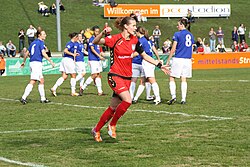
Domestically, the club reached another peak in 2010, defeating Arsenal 3–2 to win the FA Women's Cup, with Natasha Dowie scoring the winning goal in extra time. In March 2011, Everton became one of the eight founding teams of the FA WSL (Women's Super League), the professionalized top flight of English women's football.
Relegation and the Road Back
The 2014 season proved challenging. Following the departure of key players Jill Scott and Toni Duggan to Manchester City, the club's form dipped. A 2–0 loss to Notts County in September 2014 sealed their relegation to WSL 2, ending a 21-year tenure in the top flight.
Despite the league struggle, the club reached the 2014 FA Women's Cup final at Stadium:MK—the last final held outside Wembley. After defeating Cardiff City, Liverpool, and Notts County to reach the showpiece event, Everton ultimately lost to Arsenal. This victory allowed Arsenal to achieve a rare FA Cup double alongside their men's team.
The FA WSL 2 Years and Promotion
Everton spent several seasons in the second tier, finishing third in both 2015 and 2016. In 2017, the league introduced the FA WSL Spring Series, a truncated 9-match season designed to align the league with the FIFA calendar. Everton won the Spring Series with seven wins, led by the scoring of Claudia Walker and Simone Magill.
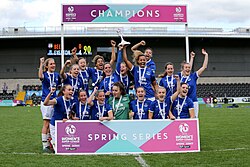
The club's return to the top flight came unexpectedly on 9 June 2017. Following the collapse of Notts County in WSL 1, the FA invited WSL 2 clubs to fill the vacancy, and Everton was awarded the spot for the 2017–18 season.
Modern Era and Recent Form
Upon returning to the top flight, the club faced a period of instability, finishing 9th in the 2017–18 season. However, structural changes to the league prevented their relegation. In preparation for the 2019–20 season, the club dropped "Ladies" from its name, becoming simply Everton (or Everton Women in formal contexts).
Recent years have seen the club continue to compete at the highest level. They reached the delayed 2019–20 FA Women's Cup final at Wembley, losing 1–3 to Manchester City after extra time. In the 2022–23 and 2023–24 seasons, the club finished sixth and eighth in the Women's Super League, respectively.
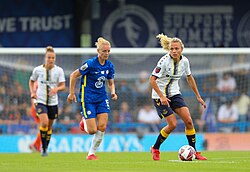
A historic milestone was achieved in December 2024, when Everton recorded its first-ever victory over Manchester City with a 2–1 win, secured by two first-half goals.
Key Facts
- Founded: 1983 as Hoylake WFC.
- Major Honors: National Premier League Champions (1997–98), FA Women's Cup winners (1989, 2010), and FA WSL 2 Spring Series winners (2017).
- European Peak: Reached the UEFA Women's Champions League quarter-finals in 2011.
- WSL Status: Founding member of the FA WSL in 2011.
- Historic Win: First-ever victory against Manchester City achieved in December 2024.
| Year/Season | Achievement/Event | Outcome |
|---|---|---|
| 1989 | Women's FA Cup | Winners |
| 1997–98 | National Premier League | Champions |
| 2008 | Premier League Cup | Winners |
| 2010 | FA Women's Cup | Winners |
| 2014 | FA WSL 1 | Relegated to WSL 2 |
| 2017 | FA WSL Spring Series | Winners |
| 2020 | FA Women's Cup | Runners-up |
Frequently Asked Questions
What was the club called before becoming Everton?
The club was founded as Hoylake WFC in 1983, later becoming Leasowe and then Leasowe Pacific before adopting the name Everton Ladies in 1995.
When did Everton Women first play in European competition?
Everton made its European debut in the 2007–08 season after finishing second in the Premier League.
Why was the club relegated in 2014?
The club struggled with form during the 2014 season, partly due to the loss of key players Jill Scott and Toni Duggan to Manchester City.
What is the significance of the 2017 Spring Series?
The Spring Series was a truncated season to align with the FIFA calendar; Everton won the title, marking their first league title since the 1997–98 season.
When did the club change its name from Everton Ladies to Everton?
The club dropped "Ladies" from its name ahead of the 2019–20 season, though it uses "Everton Women" in formal capacities.