The Evolution of EveR: A Journey Through South Korean Android Development
In the early 2000s, the field of humanoid robotics saw a significant leap forward with the unveiling of the EveR series. Developed by a team of South Korean scientists from the Korea Institute of Industrial Technology (KITECH) and the Korea University of Science and Technology, these female androids were designed to push the boundaries of human-robot interaction. Led by Baek Moon-hong, the project aimed to create machines capable of expressing complex emotions and engaging in sophisticated communication.
The name "EveR" carries a symbolic meaning, combining the biblical "Eve" with the "r" from robot. Since its public debut in May 2003, the series has undergone several iterations, each adding new layers of physical realism and cognitive ability.
Key Facts
- Developer: South Korean scientists from KITECH and Korea University of Science and Technology.
- Project Lead: Baek Moon-hong.
- Core Technology: Use of synthetic silicone jelly skin and miniature motors for facial expressions.
- Primary Goal: To create androids for education and entertainment, such as museum guides or storytellers.
- Evolution: Progressed from the stationary EveR-1 to the mobile EveR-3 and the modular EveR-4.
The Foundation: EveR-1
Unveiled at the 2003 International Robot Exhibition in Tokyo, EveR-1 was designed as a direct competitor to the Actroid android developed in Japan. Built over the course of one year with 300 million won (approximately US$321,000) in state funds, EveR-1 set a high standard for humanoid aesthetics and movement.
The android's appearance was carefully crafted; its face was a composite of two well-known Korean actresses, while its torso was modeled after a singer. Standing 160 centimeters tall and weighing 50 kilograms, EveR-1 utilized a hydraulic system—a method of using liquid pressure to power movement—alongside 35 miniature motors located in its upper body. This allowed for synchronized lip movements during speech and fluid motion of the head and arms.
To enhance realism, the robot's skin was made of a pliable, synthetic silicone jelly designed to mimic the feel of human skin. EveR-1 could recognize 400 words in both Korean and English, respond with 15 different facial expressions, and use motion data process sensors in its eyes to follow people as they moved.
Advancements in Expression: EveR-2 Muse
The successor, EveR-2 (later known as EveR-2 Muse), introduced significant upgrades in both vision and emotional depth. Debuting at Robot World 2006 in Seoul, this model was taller (170 cm) and heavier (61 kg) than its predecessor. One of its most notable improvements was the transition to a full-body covering of soft artificial skin, whereas EveR-1 only featured soft materials on the face and hands.
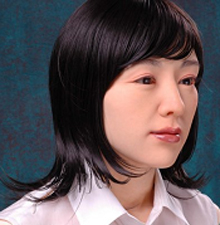
EveR-2 Muse was engineered for much higher degrees of freedom—a technical term referring to the number of independent ways a robot can move. With 29 motors and dozens of joints, it possessed 23 degrees of freedom, which was 25 more than the original model. This allowed for a wider range of expressions, including happiness, sadness, fear, surprise, anger, disgust, and even boredom. It could also perform 100 different gestures and featured upgraded 90-degree wide-range CCD cameras for improved vision.
Comparison of EveR Series Models
| Feature | EveR-1 | EveR-2 Muse | EveR-4M |
|---|---|---|---|
| Height | 160 cm | 170 cm | Not specified |
| Weight | 50 kg | 61 kg | Not specified |
| Skin Coverage | Face and hands only | Full body | Not specified |
| Key Innovation | 35 miniature motors | Increased degrees of freedom | Modular design |
Mobility and Modularity: EveR-3 and EveR-4
As the series progressed, the focus shifted from purely expressive capabilities to physical mobility and structural flexibility.
EveR-3: The Mobile Android
Demonstrated in 2009, EveR-3 was the first model in the series capable of locomotion. To move around, it utilized wheels, which were cleverly concealed beneath long skirts. This model even ventured into the performing arts, appearing in the 2010 Korean play Robot Princess and the Seven Dwarfs.
EveR-4: Modular Design
The EveR-4 (or EveR-4M) introduced a modular architecture, allowing for different configurations. It featured 64 degrees of freedom, with 33 dedicated to the head and neck to facilitate highly detailed facial expressions. While it included an artificial tongue and could be fitted with legs, it primarily utilized a wheel at its base for movement. During exhibitions at RoboWorld 2011 and Expo 2012 Yeosu Korea, studies showed that its facial expressions were most accurately recognized by women in the 20-40 age demographic.
Frequently Asked Questions
What was the primary purpose of the EveR project?
The project lead, Baek Moon-hong, envisioned the androids serving various educational and entertainment roles, such as acting as information guides in museums and department stores or reading stories to children.
How does the skin of an EveR android feel?
The androids use a synthetic, pliable silicone jelly designed to feel similar to human skin, providing a more realistic tactile experience.
What is the difference between EveR-1 and EveR-2 in terms of movement?
EveR-2 Muse featured significantly more "degrees of freedom" than EveR-1, meaning it had more joints and motors (29 motors and dozens of joints) to allow for more complex gestures and a wider range of facial expressions.
Can the EveR androids move around on their own?
While EveR-1 was largely stationary, EveR-3 introduced mobility through the use of wheels hidden under skirts. EveR-4 also utilizes a wheel at its base for movement.
How many emotions can the EveR-2 Muse express?
By 2008, EveR-2 could express happiness, sadness, fear, surprise, anger, disgust, and boredom, alongside 100 different gestures.