Ethnic Russians in Post-Soviet States: Population Trends and Citizenship
The dissolution of the Soviet Union (USSR) in December 1991 triggered one of the most significant demographic shifts of the late 20th century. Overnight, millions of people found themselves living in newly independent nations, separated from the Russian Federation by international borders. For ethnic Russians, this transition created complex challenges regarding identity, legal status, and residency.
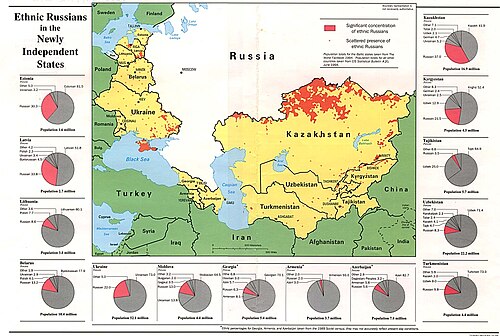
Immediately following the collapse of the USSR, approximately 25 million ethnic Russians were residing in post-Soviet states outside of Russia. Over the subsequent decades, this number saw a dramatic decline, falling to fewer than 6 million today. It is important to note that this figure excludes Ukraine, where the ethnic Russian population is currently difficult to estimate due to the absence of a recent census.
Key Facts
- Population Decline: The number of ethnic Russians in post-Soviet states (excluding Ukraine) dropped from 25 million in 1991 to under 6 million today.
- Citizenship Windows: Former Soviet citizens were given a specific timeframe to transfer their Soviet citizenship to Russian citizenship.
- Legal Status: Status varied by country, ranging from seamless transitions in Belarus to the creation of "non-citizen" statuses in the Baltics.
- Government Policy: In June 2006, President Vladimir Putin announced a national policy to encourage ethnic Russians to immigrate to Russia.
The Complexity of Citizenship and Legal Status
The transition from a single union to multiple sovereign states created a legal vacuum for millions. To address this, a window of opportunity was provided for former Soviet citizens to claim Russian citizenship. Those who did not exercise this option faced varying legal realities depending on the laws of their host country.
Variations in National Policy
In some nations, such as Belarus, there was no perceivable change in status for those remaining. However, the experience in the Baltic states was markedly different. Estonia and Latvia restored their independence in continuity with their sovereign identities as they existed prior to June 1940.
As a result, these two nations restricted citizenship to their pre-World War II citizens and their direct offspring, regardless of their ethnic group. This policy led to a significant number of ethnic Russians becoming permanent residents known as non-citizens, a legal category that granted residency but limited the full political rights associated with citizenship.
Regional Distribution and Demographics
Ethnic Russians are distributed across a wide array of former Soviet republics, including those in Eastern Europe, the Caucasus, and Central Asia. While the overall numbers have declined, specific pockets of population remain significant.
Data collection in these regions can be complex. For instance, certain estimates exclude specific territories such as Transnistria, where a 2015 census recorded 138,072 Russians (29.1% of the population). Similarly, estimates often exclude Abkhazia, which had 22,224 Russians (9.1% of the population) in 2024, and South Ossetia, which recorded 610 Russians (1.1% of the population) in 2015.
| Region/Territory | Population Count | Percentage of Local Population | Data Year |
|---|---|---|---|
| Transnistria | 138,072 | 29.1% | 2015 |
| Abkhazia | 22,224 | 9.1% | 2024 |
| South Ossetia | 610 | 1.1% | 2015 |
Repatriation and National Policy
The trend of ethnic Russians leaving post-Soviet states was further influenced by official Russian state policy. In June 2006, President Vladimir Putin announced a strategic plan to introduce national policies specifically designed to encourage the immigration of ethnic Russians back to the Russian Federation.
Frequently Asked Questions
How many ethnic Russians lived outside Russia after the USSR collapsed?
Approximately 25 million ethnic Russians lived in post-Soviet states immediately following the dissolution of the Soviet Union in December 1991.
What is the current estimated population of ethnic Russians in these states?
Excluding Ukraine, the population has declined to fewer than 6 million people.
Why are some ethnic Russians considered "non-citizens"?
In Estonia and Latvia, citizenship was restricted to those who were citizens prior to June 1940 and their offspring. Those who did not meet these criteria became permanent residents with "non-citizen" status.
What action did the Russian government take to address this population?
In June 2006, President Vladimir Putin announced a national policy aimed at encouraging ethnic Russians living abroad to immigrate to Russia.
Why is the ethnic Russian population in Ukraine not included in the current totals?
The population in Ukraine is excluded from the current estimate because it is hard to determine accurately due to the lack of a recent census.