Erwin Piscator: The Architect of Political and Epic Theatre
Erwin Piscator was a visionary German theatre director and producer who fundamentally reshaped the landscape of 20th-century drama. Alongside Bertolt Brecht, he became a primary exponent of epic theatre—a style that prioritizes socio-political commentary over emotional manipulation or purely aesthetic beauty. By integrating technology and documentary evidence into his productions, Piscator transformed the stage into a tool for social change and political education.
Key Facts
- Core Philosophy: Developed "Political Theatre," focusing on causality, typicality, and didacticism over individual emotion.
- Technical Innovations: Pioneered the use of cinematic projections, mechanized sets, and complex scaffold stages.
- Educational Legacy: Founded the Dramatic Workshop at The New School for Social Research in New York (1940).
- Notable Students: Taught future icons including Marlon Brando, Tony Curtis, and Tennessee Williams.
- Major Work: Authored the influential theoretical text The Political Theatre (1929).
Early Life and the Impact of War
Born on December 17, 1893, in Greifenstein-Ulm, Erwin Friedrich Max Piscator was the descendant of Johannes Piscator, a noted 17th-century theologian. His early academic journey took him through the Gymnasium Philippinum in Marburg and later to the Ludwig-Maximilians-Universität München (LMU), where he studied German, philosophy, and art history. It was here that he attended Arthur Kutscher's seminar in theatre history, a course that would later be attended by Bertolt Brecht.
Piscator's worldview was irrevocably altered during World War I. Serving as a Landsturm soldier and signaller in a frontline infantry unit, he witnessed the horrors of the Ypres Salient. This experience instilled in him a lifelong hatred of militarism, which he expressed through bitter poetry in the Expressionist magazine Die Aktion. By the time of the 1918 armistice, Piscator had transitioned from soldier to revolutionary, speaking at the first meeting of a revolutionary Soldiers' Council in Hasselt.
The Weimar Republic and the Rise of Political Theatre
Returning to Berlin, Piscator joined the Communist Party of Germany (KPD) and began experimenting with proletarian theatre. He sought to create a "people's stage" (Volksbühne), focusing on works by authors like Maxim Gorky and Leo Tolstoy to clarify left-wing policies and influence voters.
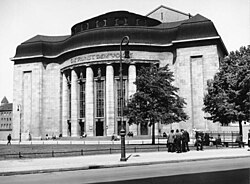
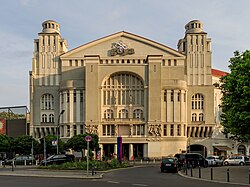
As a director at the Volksbühne (1924–1927) and later at his own Piscator-Bühne, he introduced groundbreaking technical elements. He utilized movies, lectures, and mechanized sets to break the "fourth wall" and engage the audience intellectually. One of his most controversial moves occurred at the Preußisches Staatstheater, where he reinterpreted Schiller's The Robbers, transforming the character of Spiegelberg into a Trotskyist intellectual and ending the play with the singing of The Internationale.
In 1928, Piscator collaborated with Bertolt Brecht on a "montage" adaptation of The Good Soldier Schweik. He also directed Leo Lania's Konjunktur (Oil Boom), featuring music by Kurt Weill, which critiqued the environmental and human cost of corporate greed in the Balkans.
The Theory of the Political Theatre
In 1929, Piscator published The Political Theatre. In this work, he argued that theatre should move away from private themes toward generalization, and from fantasy toward documentary reality. He believed that the specific political message of a play should determine the technical means used to produce it, rather than the other way around.
Exile and the American Experience
The rise of Adolf Hitler in 1933 forced Piscator into exile. After a period in the Soviet Union—where he directed the film Revolt of the Fishermen—he moved to France in 1936 and married dancer Maria Ley. By 1939, he immigrated to the United States.
In New York, Piscator was invited by Alvin Johnson to establish the Dramatic Workshop at The New School for Social Research. This institution became a breeding ground for some of the greatest talents in American acting and writing, including Harry Belafonte, Bea Arthur, and Walter Matthau.
Return to Germany and Final Years
Piscator returned to West Germany in 1951, driven by the political pressures of the McCarthy era in the United States. Despite settling in West Berlin, he maintained ties with cultural figures in East Germany and was elected to the East German Academy of Arts in 1956.
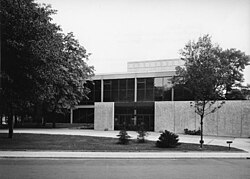
From 1962 until his death, he served as the manager and director of the Freie Volksbühne in West Berlin. During this final chapter, he focused on documentary theatre and the necessity of confronting Germany's Nazi past, most notably with the 1963 premiere of Rolf Hochhuth's The Deputy.
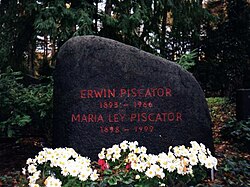
Erwin Piscator passed away on March 30, 1966, in Starnberg, West Germany.
Legacy and Influence
Piscator's influence on modern production is immense. His use of cinematic projections and scaffold staging anticipated contemporary multimedia theatre. His commitment to "mnemonic" theatre—works that serve as a collective memory of historical trauma—continues to inspire documentary playwrights today.
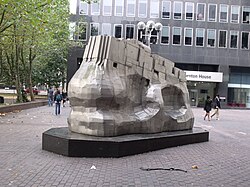
His legacy is preserved through the Erwin Piscator Award in New York and monuments in London and his birthplace of Greifenstein-Ulm. In 2016, Berlin hosted a major exhibition marking the 50th anniversary of his death.
| Category | Details |
|---|---|
| Lifespan | 1893–1966 |
| Key Styles | Epic Theatre, Documentary Theatre, Political Theatre |
| Major Institutions | Volksbühne Berlin, Piscator-Bühne, The New School (Dramatic Workshop) |
| Key Collaborators | Bertolt Brecht, Kurt Weill, Maria Ley |
| Primary Goal | Using theatre as a utilitarian tool for socio-political education |
Frequently Asked Questions
What is the difference between Piscator's theatre and traditional theatre?
While traditional theatre often focuses on emotional manipulation and the beauty of the production, Piscator's political theatre emphasized socio-political content, causality, and didacticism, using the stage to educate the audience on systemic social issues.
How did Piscator use technology in his plays?
Piscator was a pioneer in integrating non-theatrical elements into his shows, including cinematic projections, movies, and complex mechanized sets, to provide documentary context and create a "montage" effect.
Who were some of the famous students of the Dramatic Workshop?
The workshop in New York produced a remarkable array of talent, including legendary actors like Marlon Brando, Tony Curtis, and Walter Matthau, as well as the playwright Tennessee Williams.
What was the significance of 'The Deputy'?
Directed by Piscator in 1963, The Deputy was a highly acclaimed and controversial play that examined Pope Pius XII's role and the alleged failure to rescue Italian Jews during the Holocaust.
What is the relationship between Erwin Piscator and Bertolt Brecht?
Both were foremost exponents of epic theatre. They collaborated on projects such as the adaptation of The Good Soldier Schweik and shared a goal of moving theatre away from emotionalism toward political analysis.