Erica: A Comprehensive Guide to Heaths and Heathers
The genus Erica represents one of the most diverse and visually striking groups of flowering plants in the world. Comprising approximately 857 species, these plants are widely known by the common names heath or heather. While they are often grouped with the genus Calluna, true Erica species are distinguished by their specific floral structures and leaf characteristics, often earning them the nickname "winter or spring heather" to differentiate them from the "summer or autumn heather" represented by Calluna.
Key Facts
- Species Count: Approximately 857 species.
- Family: Ericaceae.
- Primary Habitat: Acidic soils, ranging from dry sandy areas to wet bogs.
- Global Diversity: Over 750 species are native to the Cape fynbos of South Africa.
- Growth Habit: Mostly evergreen shrubs, ranging from dwarf varieties to trees reaching 10 meters.
- Ecological Role: Important food source for various Lepidoptera larvae and pollinators like sunbirds.
Botanical Description and Characteristics
Most Erica species are small, evergreen shrubs typically growing between 20 and 150 centimeters in height. They are characterized by their minute, needle-like leaves, which generally measure between 2 and 15 millimeters in length. The flowers are highly varied; they may grow in the leaf axils or appear in terminal umbels (clusters) or spikes, often facing outward or downward.
One of the most remarkable traits of the genus is the resilience of its seeds. In certain species, the tiny seeds are capable of surviving in the soil for several decades, waiting for the right conditions to germinate.
Size Variations
While many species remain low-growing, there are significant exceptions. The tree heather (Erica arborea) and the broom heather (Erica scoparia) are the giants of the genus, capable of reaching heights of 6 to 10 meters.
Global Distribution and Habitat
The distribution of Erica is vast, but the center of its diversity is undeniably South Africa. Roughly 690 species are endemic to the region, forming the largest genus within the Cape fynbos—a unique Mediterranean-type shrubland. These South African species often feature long, disc-shaped flowers.
Beyond Africa, Erica species are found in Madagascar, the Mediterranean, and Europe. In Europe, most species are dwarf shrubs, typically growing between 20 and 80 centimeters tall. In the Afromontane zones of East Africa, species like Erica rossii can grow to several meters in height.
Soil Preferences: The Calcifuge Nature
A defining characteristic of the Erica genus is that they are calcifuges. This means they are plants that avoid lime-rich soils and instead thrive in acidic or very acidic environments. The term "ericaceous" is frequently used in horticulture to describe both these plants and the specific acidic compost required to cultivate them successfully.
| Region/Type | Typical Height | Notable Characteristics |
|---|---|---|
| European Species | 20–80 cm | Mostly dwarf shrubs |
| African (Cape) Species | Varies | High diversity; disc-shaped flowers |
| Tree/Broom Heather | 6–10 meters | Largest species (e.g., E. arborea) |
| General Shrubs | 20–150 cm | Evergreen with needle-like leaves |
Ecology and Pollination
Erica species play a vital role in their local ecosystems. They serve as a primary food source for the larvae of many Lepidoptera (moths and butterflies) species. Notable examples include the garden tiger moth, the silver-studded blue, and various Coleophora case-bearers.
Pollination is often carried out by birds. In certain regions, species of sunbirds, such as the southern double-collared sunbird and the orange-breasted sunbird, are known to visit the flowers to feed, facilitating the plant's reproduction in the process.
Cultivation in Gardens
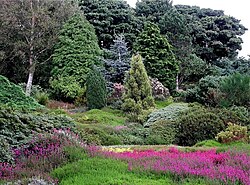
In horticulture, Erica is prized for its floral display. Because many species can produce color throughout much of the year, they are excellent for providing interest during autumn and winter. They are frequently used as massed ground cover in landscape designs, often paired with conifers.
The practice of planting large beds of heather to replicate natural moorlands became popular in the 1920s. Today, they remain versatile, suitable for large garden beds, tubs, or window boxes.
Frequently Asked Questions
What is the difference between Erica and Calluna?
While both are commonly called heather, Calluna is distinguished by having much smaller scale-leaves (less than 2–3 mm) and a flower corolla consisting of separate petals. Erica is often referred to as "winter or spring heather," whereas Calluna is known as "summer or autumn heather."
What kind of soil do Erica plants need?
Erica species are calcifuges, meaning they require acidic to very acidic soils. They do not tolerate lime-rich environments well and can grow in habitats ranging from dry, sandy soils to very wet bogs.
Are Erica plants evergreen?
Yes, the species within the Erica genus are evergreen, maintaining their needle-like foliage throughout the year.
How large can Erica plants grow?
Most species are small shrubs between 20 and 150 cm tall, but some species like Erica arborea and Erica scoparia can grow into large shrubs or trees reaching up to 10 meters.
Why is the term "ericaceous" used in gardening?
The term "ericaceous" refers to plants belonging to the Ericaceae family. In a practical gardening sense, it is often used to describe the acidic compost necessary for these plants to thrive.