Equitable Holdings: A Legacy of Financial Services and Insurance
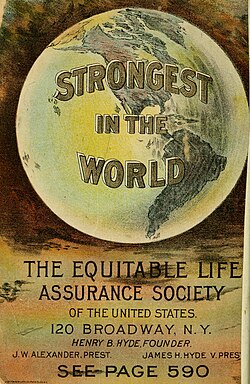
Founded in 1859, Equitable Holdings, Inc. has evolved over more than 160 years from a pioneering life insurance society into a modern financial services powerhouse. Headquartered in New York City, the company provides a comprehensive suite of products, including life insurance, annuities, and reinsurance, serving as a cornerstone of the American insurance landscape.
Key Facts
- Founded: 1859 by Henry Baldwin Hyde.
- Current Leadership: Mark Pearson (President & CEO).
- 2024 Financials: US$12.4 billion in revenue and US$1.23 billion in net income.
- Assets: US$792 billion in Assets Under Management (AUM) and US$296 billion in total assets.
- Market Status: Publicly traded on the NYSE under the ticker EQH and a component of the S&P 400.
- Major Subsidiaries: AllianceBernstein and Equitable Life.
Foundations and Early Growth
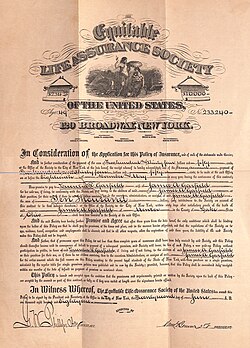
The company began as The Equitable Life Assurance Society of the United States. By 1870, it established its presence in Manhattan's Financial District with the Equitable Life Building. The early leadership team, led by founder Henry Baldwin Hyde, included James Waddell Alexander as vice president, George W. Phillips as actuary, and Samuel Borrowe as secretary.
Equitable's early influence extended beyond the United States; between 1889 and 1891, the firm constructed the Palais Equitable in Vienna, Austria.
Controversy and Resilience
The company faced a significant crisis in 1905 known as the Hyde costume ball scandal. James Hazen Hyde, the founder's son, was accused of charging a $200,000 Versailles-themed party to the company. While the accusations were part of a media smear campaign by internal rivals, the event triggered a New York State Legislature investigation into the entire insurance industry.
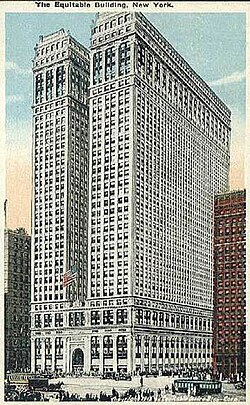
Following a devastating fire that destroyed its headquarters in 1912, the company rebuilt the Equitable Building on the same Manhattan site, maintaining its status as a dominant force in the industry.
Mid-Century Operations and Social Impact
Throughout the 20th century, Equitable maintained ties with industrial magnates, including T. Coleman du Pont, who acquired a majority stake in 1915. During World War II, the company played a critical role in supporting government employees through the War Agencies Employees Protective Association (WAEPA), providing group life insurance to those working in war zones, including agents of the Office of Strategic Services.
However, the company's history also includes a period of systemic exclusion. In 1954, Equitable implemented a policy in East Palo Alto that forbade issuing mortgages to white families in integrated communities. This practice facilitated "white flight" and contributed to the demographic shifts of the region.
The AXA Era and Transition to Public Ownership
In 1985, the company diversified by forming Equitable Real Estate Investment Management to handle its US$20 billion real estate portfolio. By 1990, the firm decided to demutualize—the process of converting a member-owned mutual insurance company into a shareholder-owned stock company—to diversify its assets.
This transition paved the way for the AXA Group of France to acquire a 49% stake in 1991 for $1 billion, providing critical capital to stabilize the firm's real estate and junk bond portfolios. Under AXA, the company grew exponentially, eventually becoming a global leader with over 50 million clients by 2003.
The Spinoff and Rebranding
Starting in 2018, AXA began spinning off its U.S. operations to focus on property and casualty insurance. This process included an IPO in May 2018 and a secondary stock offering in 2019. By November 2019, AXA sold its remaining shares to Goldman Sachs, completing the company's return to independence.
On January 14, 2020, the company officially became Equitable Holdings, Inc. and introduced a new logo featuring the Greek goddess Athena, a symbol that has remained part of its visual identity for over 160 years.
Future Outlook: The Corebridge Merger
Equitable continues to expand its scale. In March 2026, the company announced an all-stock merger with Corebridge Financial valued at $22 billion. This transformational move is expected to create a combined entity with over 12 million clients and US$1.5 trillion in assets under management.
| Metric | Value (2024) |
|---|---|
| Revenue | US$ 12.4 Billion |
| Net Income | US$ 1.23 Billion |
| Assets Under Management (AUM) | US$ 792 Billion |
| Total Assets | US$ 296 Billion |
| Total Equity | US$ 1.59 Billion |
| Employee Count | c. 8,000 |
Frequently Asked Questions
Who founded Equitable Holdings?
The company was founded in 1859 by Henry Baldwin Hyde.
What is the relationship between AXA and Equitable?
AXA Group of France acquired a majority stake in Equitable in 1991 and operated it as AXA Equitable for several years. AXA fully spun off the company through a series of public offerings, ending its ownership in November 2019.
What are the primary products offered by Equitable?
Equitable specializes in financial services, specifically life insurance, annuities, and reinsurance.
What is the significance of the 2026 Corebridge Financial merger?
The $22 billion all-stock merger is designed to create a massive financial entity with US$1.5 trillion in assets under management and a client base exceeding 12 million people.
What does the Equitable logo represent?
The logo features the Greek goddess Athena, which has been a consistent element of the company's visual identity for 160 years.