Empididae: The Fascinating World of Dagger and Balloon Flies
The Empididae family comprises a diverse group of flies known commonly as dagger flies or balloon flies. With over 3,000 described species distributed across every biogeographic realm, these insects are most prevalent in the Holarctic region. Primarily predatory, these small to medium-sized flies play a critical role in their ecosystems as natural biological control agents for various pest species.
While they are sometimes referred to as "dance flies," modern taxonomy distinguishes the true dance flies (family Hybotidae) from the Empididae. These insects are characterized by their slender bodies, bristly appearance, and a lack of metallic gloss, distinguishing them from many of their relatives in the superfamily Empidoidea.
Key Facts
- Species Diversity: Over 3,000 described species worldwide.
- Size Range: Typically small to medium, ranging from 1.0 to 15.0 mm.
- Diet: Mostly predatory adults; some species feed on nectar or pollen.
- Distinctive Feature: Many species possess sharp, piercing mouthparts (hence the name "dagger flies").
- Courtship: Famous for "nuptial gifts," where males present prey to females.
- Temporal Range: Established since at least the Cretaceous period.
Physical Characteristics and Identification
Empidids are generally slender or elongated flies with colors ranging from yellow to black. Their heads are typically small and rounded with large eyes; in males, these eyes may be holoptic (contiguous or touching). A defining feature of their anatomy is the proboscis, which is often long and powerful, projecting forward or downward to facilitate predation.
Their legs are long and slender, and in some genera, the forelegs are raptorial—specifically adapted for catching and holding prey. The wings are usually clear or partially tinged, often featuring a stigma spot. Taxonomists distinguish Empididae from similar families, such as Dolichopodidae, by the presence of unrotated and symmetrical terminalia (reproductive organs) and a prosternum fused with the proepisternum.
Larval and Pupal Stages
The larvae of Empididae are hemicephalic, meaning they have a very slim, reduced head capsule that is often retracted into the thorax. They possess an eight-segmented abdomen with paired prolegs equipped with hooks. These larvae are typically found in moist soil, rotten wood, dung, or aquatic environments, where they act as predators of other arthropods or consume detritus.
Biology and Ecology
Adult Empididae inhabit a wide array of environments, from forest leaves and tree trunks to stream beds, grasslands, and coastal beaches. Their diet consists of a vast range of arthropods, including other flies (Diptera), beetles (Coleoptera), and wasps (Hymenoptera). While most are hunters, certain groups like Iteaphila and Anthalia derive all their protein from pollen.
One of the most remarkable aspects of Empididae biology is their complex mating systems. In some species, males form mating swarms to compete for females. In others, sex roles are reversed, and females compete for the attention of males.
The "balloon fly" moniker comes from the elaborate courtship rituals of species like Hilara maura. In these rituals, the male wraps a prey item in a silk "balloon" and presents it as a nuptial gift to the female to stimulate copulation. These gifts vary by species: some are large prey items, some are inedible dried remains, and others are entirely empty balloons made of silk or saliva.
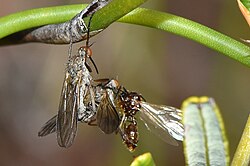
In North American species such as Rhamphomyia longicauda, the competition for these food gifts is so intense that females have evolved ornaments to attract males, including inflatable abdominal sacs and feathery "pennate" scales on their legs.
Classification and Evolution
Empididae have a long evolutionary history, with significant representation in amber deposits dating back to the Cretaceous period. The family is divided into several subfamilies, including Empidinae, Clinocerinae, and Brachystomatinae.
| Feature | Description |
|---|---|
| Scientific Order | Diptera (True Flies) |
| Superfamily | Empidoidea |
| Primary Habitats | Forests, stream beds, grasslands, and coastal zones |
| Key Subfamilies | Empidinae, Clinocerinae, Brachystomatinae, etc. |
| Feeding Strategy | Predatory (Adults & Larvae); some Pollen/Nectar feeders |
Frequently Asked Questions
What is the difference between a dagger fly and a balloon fly?
Both terms refer to members of the Empididae family. "Dagger fly" refers to the sharp, piercing mouthparts used by some species to hunt, while "balloon fly" refers to the silk-wrapped nuptial gifts used by others during courtship.
Are dagger flies dangerous to humans?
While they have piercing mouthparts for hunting other insects, they are primarily predatory toward other arthropods and are considered beneficial as biological control agents for pests.
What are nuptial gifts in Empididae?
Nuptial gifts are prey items (or silk simulations of prey) presented by the male to the female during courtship. These gifts serve to stimulate the female and encourage copulation.
Where are these flies most commonly found?
Although they exist worldwide, the majority of Empididae species are found in the Holarctic region, typically in moist habitats like forests and near water sources.
How do Empididae differ from true dance flies?
While the term "dance fly" was once used for both, true dance flies are now classified in their own separate family, Hybotidae, based on taxonomic revisions.