Edward Dean Adams Power Plant: A Milestone in Hydroelectric History
The harnessing of Niagara Falls represented one of the most significant engineering achievements of the late 19th century. At the center of this effort was the Edward Dean Adams Power Plant, a facility that proved the viability of large-scale hydroelectric power and helped shape the modern electrical grid.
The Vision and Planning
The journey began with an 1886 plan by engineer Thomas Evershed, who proposed using a hydraulic canal and a 7,500-foot brick-lined tunnel to tap the energy of the falls. To execute this vision, the Cataract Construction Company was formed under the leadership of president Edward Dean Adams. In 1890, the company established the International Niagara Commission to determine the best method for harnessing the water's power.
While the Commission favored electricity, they initially struggled to recommend a specific technical solution. This changed in 1892 when George Forbes was hired as a technical consultant. By May 1893, Forbes convinced the company to implement a hydroelectric system based on polyphase alternating current (AC)—a system that allows electricity to be transmitted efficiently over long distances.
Engineering and Construction
The technical execution of the plant relied on the era's leading innovators. Westinghouse Electric was subcontracted to build generators based on the pioneering work of Nikola Tesla and Benjamin G. Lamme. Simultaneously, the I. P. Morris Company of Philadelphia constructed the turbines, utilizing designs from the Swiss firm Faesch and Piccard.
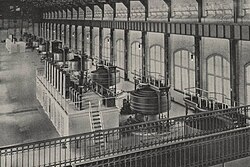
The facility officially began operations on August 25, 1895. The architectural firm McKim, Mead, and White designed the transformer house using locally quarried limestone. The power houses were built over deep excavations that housed twenty-one generating units.
One of the most grueling aspects of construction was the tailrace tunnel. This 18-foot by 21-foot tunnel, which carried water beneath the city to the lower river near the current Rainbow Bridge, required over three years to complete. The project used more than 16 million bricks for its four-course lining and tragically cost the lives of twenty-eight workers.
Technical Specifications and Power Distribution
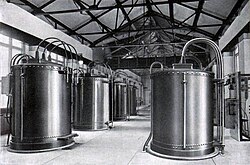
Originally known as Niagara Power Station No. 1, the plant eventually reached a total capacity of 50,000 horsepower (37 MW). The system featured ten vertical shaft generators, each rated at 5,000 horsepower (3.7 MW) with an outside revolving field. These were organized into two banks of five generators, each managed by independent switchboards.
To distribute power effectively, the plant utilized a tiered voltage system:
- 2,000 volts: Used for local service within and around Niagara Falls.
- 10,000 volts: Stepped up via transformers for medium-distance distribution.
- 20,000 volts: Stepped up for long-distance transmission to Buffalo, Lockport, and Tonawanda.
| Feature | Detail |
|---|---|
| Total Capacity | 50,000 HP (37 MW) |
| Number of Generators | 10 (5,000 HP each) |
| Generator Type | Vertical shaft, outside revolving field |
| Transmission Voltages | 2,000V, 10,000V, and 20,000V |
| Tailrace Tunnel Length | 7,000 feet |
| Operational Dates | 1895–1961 |
Key Facts
- The plant was a primary application of Nikola Tesla's polyphase AC system.
- The tailrace tunnel required 16 million bricks and took over three years to build.
- The facility served as the blueprint for a second similar station built in 1904.
- It was officially named after Edward Dean Adams in 1927.
- The plant operated for 66 years before closing in 1961.
Legacy and Preservation
The original Westinghouse generators remained in service until 1961, when the plant was replaced by the Lewiston Pump-Generating Plant and the Robert Moses Niagara Power Plant. Today, the Power Portal on Goat Island serves as a reminder of the plant's main arch.
Recognized for its immense contribution to engineering, the building was added to the National Register of Historic Places in 1975. It further received designation as a National Historic Landmark in 1983 and was named an IEEE Milestone in 1990. It remains a major contributing feature of the Niagara Falls National Heritage Area.
Frequently Asked Questions
Who were the primary inventors behind the plant's technology?
The generators were based on the work of Nikola Tesla and Benjamin G. Lamme, while the turbines were designed by the Swiss company Faesch and Piccard.
What was the significance of the polyphase alternating current system?
The use of polyphase AC, recommended by George Forbes, allowed the plant to step up voltage via transformers, making it possible to transmit electricity over medium and long distances to cities like Buffalo.
How was the water managed after passing through the generators?
Tailwater passed into a 7,000-foot tailrace tunnel, which was 18 by 21 feet in size and lined with over 16 million bricks, conveying the water to the lower river.
When did the plant cease operations?
The plant closed in 1961, with its functions being taken over by the Robert Moses Niagara Power Plant and the Lewiston Pump-Generating Plant.
What historic designations does the site hold?
The site is listed on the National Register of Historic Places (1975), designated as a National Historic Landmark (1983), and recognized as an IEEE Milestone (1990).