Edgerton, Wisconsin: The Historic Tobacco City U.S.A.
Nestled across the border of Rock and Dane counties, Edgerton, Wisconsin, is a city defined by its rich industrial heritage and a legacy of legal and literary significance. Known historically as "Tobacco City U.S.A.," Edgerton evolved from a small rail stop into a thriving hub of the tobacco trade, leaving behind a landscape of historic architecture and a community spirit rooted in its agricultural past.
Key Facts
- Motto: "Tobacco City U.S.A."
- Population: 5,945 (2020 Census).
- Location: Spans Rock and Dane counties in southern Wisconsin.
- Historic Claim: Home to the oldest free-standing brick tobacco warehouse in Wisconsin.
- Legal Legacy: Site of the landmark "Edgerton Bible case" regarding sectarian instruction.
- Geography: Located near Lake Koshkonong and the Rock River.
A Legacy of Tobacco and Trade
Originally known as Fulton Station, the city was renamed in honor of Elisha W. Edgerton, a 19th-century businessman, or possibly his brother, civil engineer Benjamin Hyde Edgerton. During the late 19th and early 20th centuries, the city became the epicenter of the tobacco industry in southern Wisconsin.
The scale of this industry was immense; at its peak, 52 tobacco warehouses lined the city streets. This economic boom is still visible today through the Queen Anne style mansions on Washington Street, which were built by wealthy merchants of the era. Another symbol of this prosperity was the Carlton Hotel on Henry Street; though it burned down in the 1990s, it was once a primary meeting place for tobacco buyers and sellers.
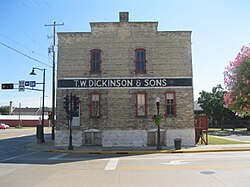
Historic Landmarks
The Pomeroy and Pelton Tobacco Warehouse (later known as the T. W. Dickinson & Son Tobacco Warehouse) stands as a testament to this era. Listed on the National Register of Historic Places, it holds the distinction of being the oldest free-standing brick warehouse in the state of Wisconsin.
The Edgerton Bible Case
Beyond its industry, Edgerton played a pivotal role in American legal history. In 1886, a conflict arose when Catholic parents protested the use of the King James Bible in public schools, advocating instead for the Douay version. The school board's refusal to change policy led to a lawsuit claiming that the practice violated the Wisconsin Constitution's ban on sectarian instruction (religious teaching that promotes a specific denomination).
While a circuit court initially rejected the claim in 1888, the Wisconsin Supreme Court overruled that decision on March 18, 1890. The court concluded that reading the Bible in public schools did constitute sectarian instruction and illegally merged church and state functions. This ruling became a significant legal precedent, cited by Justice William Brennan in 1963 when the U.S. Supreme Court banned prayer in public schools.
Geography and Natural Attractions
Edgerton covers approximately 4.14 to 4.16 square miles of land. While the city itself is primarily land-based, with the exception of Saunders Creek, it is located just a five-minute drive from Lake Koshkonong. As the third largest lake in Wisconsin, Lake Koshkonong is a shallow body of water popular for tubing, skiing, and fishing.
The area is also defined by the Rock River, which feeds into the lake and eventually flows into the Mississippi River, providing further opportunities for outdoor recreation.
Community, Culture, and Arts
The city continues to celebrate its roots through Tobacco Days, an annual festival featuring live music, tobacco demonstrations, a parade, and a car show. For literary enthusiasts, the Sterling North Book and Film Festival takes place every September.
Literary and Artistic Contributions
- Sterling North: The childhood home of authors Sterling North and Jessica Nelson North MacDonald is now a museum. North's famous book, Rascal, was set in Edgerton, which he referred to as "Brailsford Junction."
- Pauline Jacobus: A pioneer of American art pottery, Jacobus moved her business to Edgerton in 1888. Her "Pauline Pottery" is globally recognized in art galleries. A factory warehouse and a log cabin from her home, "The Bogart," still survive.
City Profile and Demographics
Edgerton has seen steady growth over the last century, evolving from a village of 869 people in 1880 to nearly 6,000 residents today.
| Category | Data / Detail |
|---|---|
| 2020 Population | 5,945 |
| Population Density | 1,429.4 per sq mi |
| Racial Composition (2020) | 90.6% White, 5.5% Two or more races, 5.7% Hispanic/Latino |
| Education | Edgerton School District (Elementary, Middle, and High Schools) |
| Time Zone | Central (CST/CDT) |
Frequently Asked Questions
Why was Edgerton called "Tobacco City U.S.A."?
Edgerton earned this nickname because it was the center of the tobacco industry in southern Wisconsin during the late 19th and early 20th centuries, once hosting as many as 52 tobacco warehouses.
What was the significance of the Edgerton Bible case?
The case established that reading the Bible in public schools constituted sectarian instruction. This ruling served as a legal precedent for the U.S. Supreme Court's 1963 decision to ban prayer in public schools.
Who is Sterling North and what is his connection to the city?
Sterling North was a noted author who grew up in Edgerton. He used the city as the setting for several of his books, including the famous Rascal, where he referred to the town as "Brailsford Junction."
What is the oldest brick warehouse in Wisconsin?
The Pomeroy and Pelton Tobacco Warehouse (also known as the T. W. Dickinson & Son Tobacco Warehouse) in Edgerton is the oldest free-standing brick warehouse in the state.
What outdoor activities are available near Edgerton?
Residents and visitors frequently enjoy skiing, tubing, and fishing at Lake Koshkonong and along the Rock River.