Economies of Scale: How Increased Production Lowers Unit Costs
In the world of microeconomics, efficiency is often a matter of size. Economies of scale refer to the cost advantages that enterprises achieve as they increase their scale of operation. Typically measured by the amount of output produced per unit of cost, these advantages allow a business to expand production while simultaneously lowering the cost per individual unit.
When a company can produce more goods at a lower average cost, it gains a significant competitive edge. These efficiencies can arise at various levels, including individual production lines, specific plants, or across an entire enterprise. The underlying drivers of these savings can be technical, statistical, organizational, or related to market control.
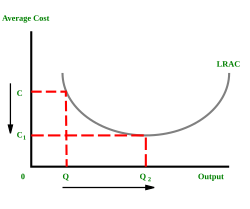
As shown in the relationship between quantity and cost, as production increases from Q to Q2, the average cost of each unit decreases from C to C1. The LRAC represents the long-run average cost.
Key Facts
- Definition: Cost advantages obtained by an enterprise due to its scale of operation.
- Core Metric: Measured by the amount of output produced per unit of production cost.
- Primary Driver: The division of labour, a concept famously analyzed by Adam Smith.
- The Limit: Beyond an optimum design point, businesses may encounter diseconomies of scale, where costs per additional unit begin to rise.
- External vs. Internal: Internal economies benefit a single firm, while external economies benefit all firms within an industry.
Determinants of Scale Efficiencies
Economies of scale are not monolithic; they stem from various foundational drivers:
Physical and Engineering Basis
Some efficiencies have a direct physical or engineering foundation. This includes the economies of increased dimension, such as reducing friction loss in transportation and industrial equipment or optimizing the capital costs of large manufacturing facilities. In chemical engineering, the "rule of six-tenths" suggests that costs are often proportional to tonnage raised to the power of approximately 0.6.
Organizational and Managerial Factors
As firms grow, they can benefit from specialized management and the division of labour. By breaking down complex tasks into specialized roles, workers become more proficient, increasing overall productivity. Additionally, larger firms can better manage transaction economies and the balancing of production capacity to ensure steady output.
Purchasing and Technological Advantages
Larger operations often benefit from increased purchasing power and the ability to implement superior technical processes. They can also achieve learning and growth economies, where the cumulative experience of production leads to improved techniques and reduced error rates over time.
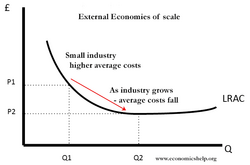
The graph above depicts external economies of scale, which provide benefits to most or all firms within a specific industry.
Limits to Growth: Diseconomies of Scale
Scaling up is not infinitely beneficial. Every enterprise eventually faces limits where the cost per additional unit begins to increase. These are known as diseconomies of scale. Common limiting factors include:
- Resource Scarcity: Exceeding the local supply of necessary raw materials (e.g., wood in the paper industry).
- Market Saturation: Reaching a point where a regional market is full, forcing the company to ship products over uneconomic distances.
- Operational Inefficiency: Using energy less efficiently or experiencing higher defect rates due to excessive complexity.
- Loss of Flexibility: Large producers of commodities often find it too costly to switch between product grades, whereas smaller facilities can remain viable by focusing on specialty products.
Summary of Economic Scale Concepts
| Concept | Primary Effect | Context |
|---|---|---|
| Economies of Scale | Decreased average cost per unit | As production volume increases |
| Diseconomies of Scale | Increased average cost per unit | When scale exceeds optimal limits |
| External Economies | Industry-wide cost benefits | Benefits all firms in a sector |
| Capacity Utilization | Decreased total average cost | Increasing use of an existing plant |
Frequently Asked Questions
What is the difference between economies of scale and returns to scale?
While related, they are distinct. Economies of scale refer to the reduction in average cost as output increases, whereas returns to scale refers to how output changes in response to a proportional increase in all inputs.
Can a small company still be efficient?
Yes. Smaller manufacturing facilities often maintain viability by focusing on specialty products with higher margins, avoiding the high-volume commodity markets where large-scale producers dominate.
What are external economies of scale?
External economies of scale are benefits that accrue to all firms within an industry, rather than just one specific company. This can include improved infrastructure or a specialized local labor pool.
Why does increasing production sometimes increase costs?
This occurs due to diseconomies of scale. Factors such as logistical complexities, reaching the limits of raw material supplies, or managing excessive organizational layers can cause the cost per unit to rise.
Is increasing plant utilization the same as economies of scale?
Not necessarily. Economists like Nicholas Georgescu-Roegen and Nicholas Kaldor argue that increasing the utilization of a plant that is currently below its optimal capacity should be distinguished from true economies of scale.