Echinocereus triglochidiatus: The Vibrant Claret Cup Cactus
In the arid landscapes of the Southwestern United States and Northern Mexico, a burst of scarlet color often signals the presence of Echinocereus triglochidiatus. Known by several evocative common names—including the claret cup cactus, kingcup cactus, and red-flowered hedgehog cactus—this resilient succulent is a true icon of the desert. Notably, it holds the distinction of being the official state cactus of Colorado.
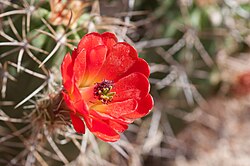
This highly variable species thrives in diverse environments, ranging from low-lying deserts to rocky slopes, scrublands, and mountain woodlands. Whether it is growing as a small mound or a large cushion, its striking blooms and unique growth patterns make it a fascinating subject for botanists and nature enthusiasts alike.
Key Facts
- Common Names: Claret cup cactus, kingcup cactus, red-flowered hedgehog cactus, Mojave mound cactus.
- Official Status: State cactus of Colorado.
- Conservation Status: Secure (NatureServe) and Least Concern (IUCN 3.1).
- Flower Color: Bright scarlet red to orange-red.
- Native Range: Southwestern United States and Northern Mexico.
- Etymology: Derived from the Greek tri- and glochidium, meaning "three glochids."
Physical Description and Characteristics
Echinocereus triglochidiatus is primarily a mounding cactus. It grows in bulbous piles consisting of spherical to light bluish-green cylindrical stems. These stems can form dense cushions exceeding 1 meter in diameter, sometimes containing up to 500 individual shoots. Each stem typically ranges from 5 to 40 cm in length and 5 to 15 cm in diameter.
The structure of the cactus is defined by its five to twelve ribs, which may be straight-edged or tuberculated (having small, rounded projections). The plant is densely spiny and possesses a somewhat woolly texture. Its spines are quite prominent: the central spines are similar to the peripheral spines, and there can be up to 22 marginal spines per stem. These spines are typically yellow to dark, measuring between 1 and 7 cm in length.
The Showy Bloom
The most recognizable feature of the species is its funnel-shaped flower. These blooms can reach 8–9 cm (3.1–3.5 inches) in width and feature brilliant scarlet red or orange-red tepals (undifferentiated petals and sepals). At the center of the corolla lies a thick nectar chamber surrounded by numerous thready pink stamens.
Following pollination, the cactus produces spherical to obovate fruits. These fruits are slightly pink or reddish and gradually lose their thorns as they mature.
Taxonomy and Subspecies
The taxonomy of the kingcup cactus is complex due to the extreme variability in stem and spine morphology among different populations. While many varieties have been observed in cultivation, their natural occurrences are not always documented.
Currently, there are two recognized subspecies:
- Echinocereus triglochidiatus subsp. mojavensis: Found in Arizona, California, Colorado, Nevada, Utah, and Baja California, Mexico.
- Echinocereus triglochidiatus subsp. triglochidiatus: Found in Arizona, Colorado, and New Mexico.
A notable variation is E. t. arizonicus (the Arizona Hedgehog cactus), which is federally listed as an endangered species in the United States. It is restricted to the intersection of Arizona, New Mexico, and Mexico. There is ongoing taxonomic debate regarding whether this variety should be classified as a subspecies or a distinct species, Echinocereus arizonicus.
Ecology and Habitat
Echinocereus triglochidiatus is highly adaptable, inhabiting elevations between 150 and 3500 meters. Its range spans Arizona, New Mexico, Colorado, California, Texas, and Northern Mexico.
Pollination and Seed Dispersal
The cactus plays a vital role in its ecosystem. While its flowers are frequently visited by hummingbirds, they are not exclusively specialized for them; bees also serve as important pollinators.
Seed dispersal is primarily managed by animals. While ants occasionally transport fruit to their mounds, rodents and lagomorphs (such as rabbits) are the most common means of dispersal. Interestingly, new sprouts often thrive in the shade of the fourwing saltbush. This plant acts as a natural nursery, protecting young cacti from desiccation and animals. However, the relationship is not always symbiotic; rodents can sometimes destroy the plants by digging nests directly beneath them, damaging the root systems.
Summary of Species Data
| Feature | Details |
|---|---|
| Kingdom | Plantae |
| Family | Cactaceae |
| Genus | Echinocereus |
| Chromosome Count | 2n = 22 |
| Typical Stem Length | 5 to 40 cm |
| Flower Width | 8 to 9 cm |
Frequently Asked Questions
What is the state cactus of Colorado?
The Echinocereus triglochidiatus, commonly known as the claret cup cactus or kingcup cactus, is the official state cactus of Colorado.
What colors can the flowers of this cactus be?
The flowers are typically a bright, showy scarlet red to orange-red.
How do these cacti reproduce in the wild?
Seeds are dispersed through fruits, primarily by rodents and lagomorphs. The plants also rely on pollinators like bees and hummingbirds for fertilization.
Is the claret cup cactus endangered?
The species as a whole is considered "Least Concern" by the IUCN. However, a specific variety known as E. t. arizonicus is federally listed as an endangered species in the United States.
Where can I find this cactus in the wild?
You can find various varieties throughout the Southwestern United States (including Arizona, Colorado, California, New Mexico, Texas, and Utah) and Northern Mexico.