Eastern Orthodox ChurchEastern OrthodoxyEcumenical PatriarchateByzantine RiteAutocephalous churches

Eastern Orthodox Church: History, Theology, and Global Structure

Eastern Orthodox Church The Eastern Orthodox Church is one of the oldest institutional expressions of Christianity, tracing its origins to 1st-century Judaea within the Roman Empire. As a...

Eastern Orthodox Church

The Eastern Orthodox Church is one of the oldest institutional expressions of Christianity, tracing its origins to 1st-century Judaea within the Roman Empire. As a communion of self-governing churches, it maintains a deep commitment to the traditions and doctrines established by the early apostles and the first seven ecumenical councils.

The term "Orthodoxy" is derived from the Greek words for "right belief" or "right glory," while "Catholicity" refers to the church's universality. Together, these concepts define a faith that seeks to preserve the original teachings of Jesus Christ without alteration.
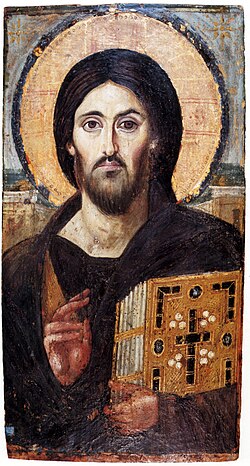
Christ Pantocrator, sixth century, Saint Catherine's Monastery, Sinai; the oldest known icon of Christ, in one of the oldest monasteries in the world

Key Facts

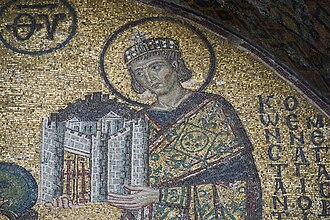
Emperor Constantine presents a representation of the city of Constantinople as tribute to an enthroned Mary and baby Jesus in this church mosaic (Hagia Sophia, c. 1000).
  • Global Membership: Approximately 220 million adherents as of 2020.
  • Leadership: Organized as a communion of autocephalous (self-governing) churches, with the Ecumenical Patriarch of Constantinople serving as primus inter pares (first among equals).
  • Scripture: Utilizes the Septuagint (the Greek Old Testament) and the New Testament.
  • Liturgy: Predominantly follows the Byzantine Rite.
  • Core Beliefs: Centered on the Holy Trinity, the incarnation, and the resurrection of Christ.

Historical Evolution
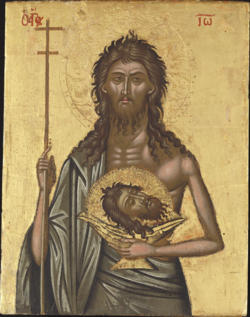
Eastern Orthodox icon of St. John the Baptist by Emmanuel Tzanes, 17th century

The Early Church and Ecumenical Councils

The foundation of Eastern Orthodoxy is built upon the decisions of seven ecumenical councils, which are authoritatively recognized as defining the faith. These councils addressed critical theological disputes and formulated the Niceno-Constantinopolitan Creed of 381, a central statement of belief in one God, the Father Almighty.

Icon depicting Constantine the Great, accompanied by the bishops of the First Council of Nicaea (325), holding the Niceno-Constantinopolitan Creed of 381. First line of main text in Greek: Πιστεύω εἰς ἕνα Θ[εό]ν, πατέρα παντοκράτορα, ποιητὴν οὐρανοῦ κ[αὶ] γῆς. Translation: "I believe in one God, Father Almighty, Creator of heaven and earth."

The Roman and Byzantine Eras

For centuries, the church was closely linked to the Byzantine Empire, with the Hagia Sophia in Constantinople serving as the patriarchal basilica and one of the largest churches in the world. However, political and theological tensions eventually led to the Great Schism of 1054, which formally separated the Eastern Orthodox Church from the Roman Catholic Church.

The Hagia Sophia, the largest church in the world and patriarchal basilica of Constantinople for nearly a thousand years, later converted into a mosque, then a museum, then back to a mosque

Expansion and Challenges

The faith spread significantly through the conversion of the South and East Slavs, led by missionaries such as Saints Cyril and Methodius. Over time, the church navigated periods of intense hardship, including Ottoman rule in Greece and the suppression of religious institutions under various Communist regimes in the 20th century.
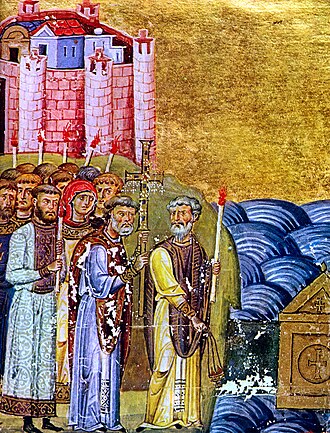
Miniature of Saints Cyril and Methodius, missionaries to the Slavs, from the Menologion of Basil II, c. 11th century

Organization and Global Structure

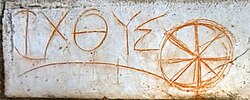
An early Christian "Ichthys" (fish) inscription from ancient Ephesus

Unlike a centralized hierarchy, the Eastern Orthodox Church is a communion of autocephalous churches. Each is self-governing but remains in theological and sacramental unity with the others.

Major Autocephalous Eastern Orthodox Churches (Approximate Data)
Denomination Primary Canonical Territory Estimated Members
Russian Orthodox Church Russia, Belarus, Kazakhstan, etc. 110,000,000 – 120,000,000
Romanian Orthodox Church Romania 16,000,000 – 19,000,000
Church of Greece Greece 8,500,000 – 10,000,000
Serbian Orthodox Church Serbia, Bosnia, Montenegro, etc. 8,000,000
Ecumenical Patriarchate Global / Constantinople 4,000,000 – 5,200,000

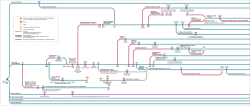
A timeline showing the main autocephalous Eastern Orthodox churches, from an Eastern Orthodox point of view, up to 2022

Theology and Spiritual Life

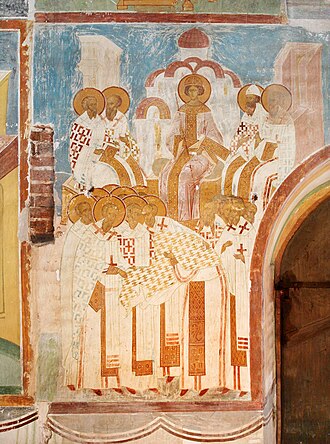
15th-century mural from Ferapontov Monastery depicting the deposition of Nestorius at the Council of Ephesus (431).

Core Doctrines

Eastern Orthodox theology emphasizes the Trinity and the process of salvation. It teaches that through the incarnation and resurrection of Christ, humanity is offered a path to restoration. The church also holds a high veneration for the Virgin Mary (Theotokos) and the saints.
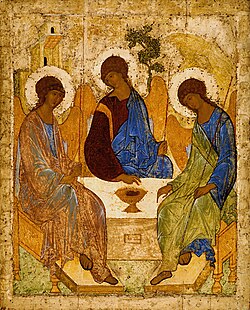
The Trinity by Russian icon painter Andrei Rublev, early 15th century

Liturgy and Sacraments

The spiritual life is centered on the Divine Liturgy, characterized by chanting and the use of incense. The church recognizes several "Holy Mysteries" (sacraments), including:

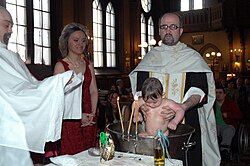
  • Baptism: The initiation into the faith.
  • Chrismation: The sealing of the Holy Spirit.
  • Holy Communion (Eucharist): The central act of worship.
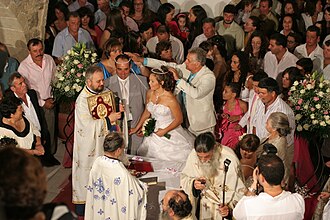
  • Marriage: The union of a couple in Christ.
  • Holy Orders: The ordination of deacons, priests, and bishops.
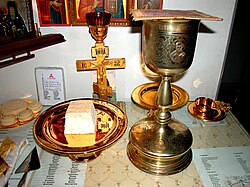
Eucharistic elements prepared for the Divine Liturgy

Art and Architecture

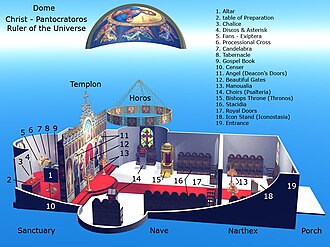
Icons are not merely art but are considered "windows to heaven," used to aid in prayer and veneration. A defining feature of Orthodox church interiors is the iconostasis, a screen of icons that separates the nave (where the congregation stands) from the sanctuary (the altar area).
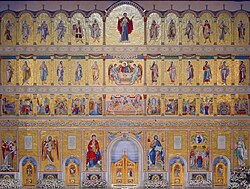
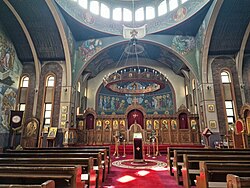
Iconostasis of the Romanian People's Salvation Cathedral

Frequently Asked Questions
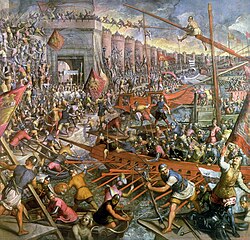
Latin Crusaders sacking the city of Constantinople, the capital of the Eastern Orthodox–controlled Byzantine Empire, in 1204
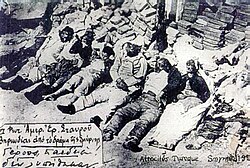
Greek Orthodox massacred during the Greek genocide in Smyrna in 1922
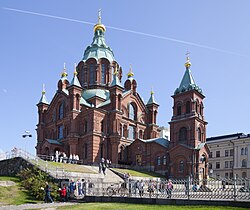
Uspenski Cathedral, a main cathedral of the Finnish Orthodox Church in Helsinki, Finland, was built under Imperial Russia.
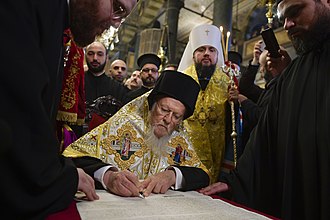
Patriarch Bartholomew signing the tomos of the autocephaly of the OCU
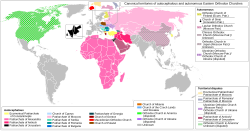
The canonical territories of the main autocephalous and autonomous Eastern Orthodox jurisdictions as of 2022
St. Nicholas Cathedral in Seoul, Korea
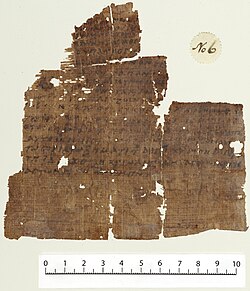
Oldest extant manuscript of the Nicene Creed, dated to the fifth century
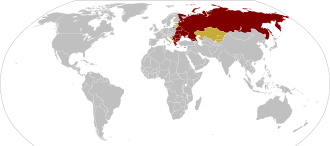
Distribution of Eastern Orthodoxy in the world by country Dominant religion Important minority religion
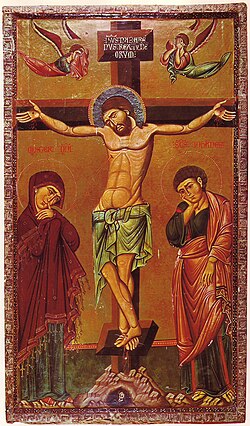
Crucifixion Icon from Saint Catherine's Monastery, 13th century
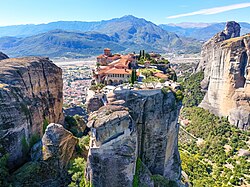
Monastery of the Holy Trinity in Greece.
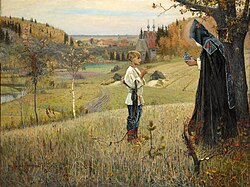
The Vision to the Youth Bartholomew by Mikhail Nesterov (1890).
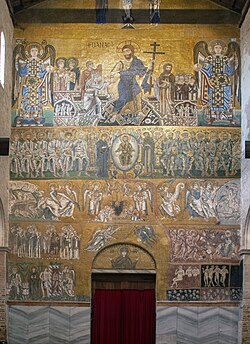
Last Judgment: 12th-century Byzantine mosaic from Torcello Cathedral
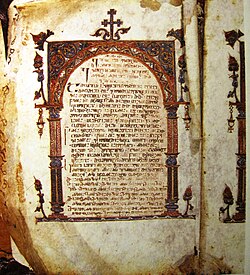
Alaverdi Gospels, an 11th-century Georgian illuminated manuscript Gospel Book
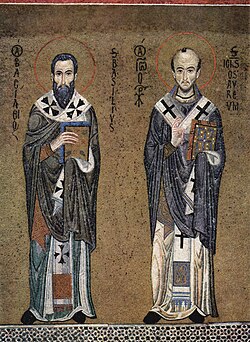
Icon of Ss. Basil the Great (left) and John Chrysostom, ascribed authors of the two most frequently used Eastern Orthodox Divine Liturgies, c. 1150 (mosaic in the Palatine Chapel, Palermo).
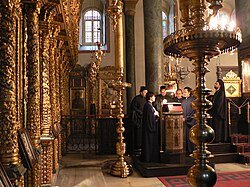
Chanters singing on the kliros at the Church of St. George, Patriarchate of Constantinople
An illustration of the traditional interior of an Orthodox church
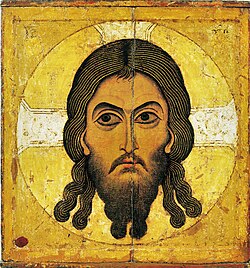
The Saviour Not Made by Hands, an icon of the Novgorod school, c. 1100
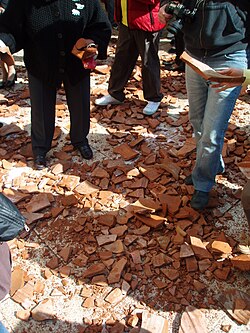
Shards of pottery vases on the street, after being thrown from the windows of nearby houses. A Holy Saturday tradition in Corfu.
An Eastern Orthodox baptism
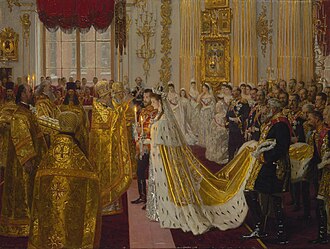
The wedding of Tsar Nicholas II of Russia by Laurits Tuxen
Greek Orthodox wedding
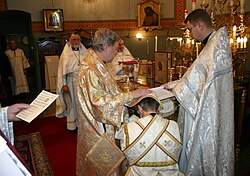
Eastern Orthodox subdeacon being ordained to the diaconate. The bishop has placed his omophorion and right hand on the head of the candidate and is reading the Prayer of Cheirotonia.
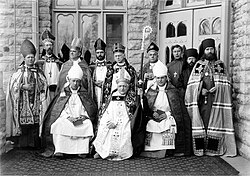
The consecration of Reginald Heber Weller as an Anglican bishop at the Cathedral of St. Paul the Apostle in the Episcopal Diocese of Fond du Lac, with Anthony Kozlowski of the Polish National Catholic Church and Tikhon, then Bishop of the Aleutians and Alaska (along with his chaplains John Kochurov and Sebastian Dabovich) of the Russian Orthodox Church present
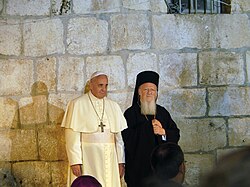
Pope Francis and Ecumenical Patriarch Bartholomew I in the Church of the Holy Sepulchre, Jerusalem, 2014
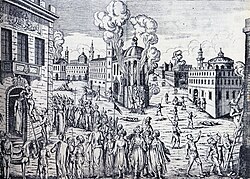
The Constantinople Massacre of April 1821: a religious persecution of the Greek population of Constantinople under the Ottomans. Patriarch Gregory V of Constantinople was executed.
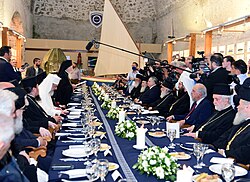
The Pan-Orthodox Council, Kolymvari, Crete, Greece, June 2016
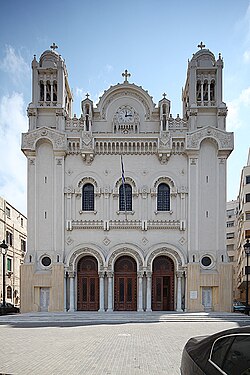
Cathedral of Evangelismos, Alexandria
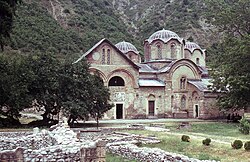
Patriarchate of Peć in Kosovo, the seat of the Serbian Orthodox Church from the 14th century, when its status was upgraded into a patriarchate
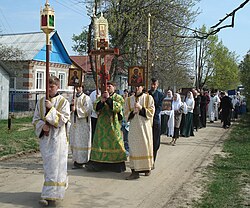
Traditional Paschal procession by Russian Orthodox Old-Rite Church

Who is the head of the Eastern Orthodox Church?

There is no single "Pope" in Eastern Orthodoxy. Instead, the Ecumenical Patriarch of Constantinople is recognized as the primus inter pares, or "first among equals," providing spiritual leadership without absolute jurisdictional authority over other autocephalous churches.

What is the difference between an icon and a painting?

In the Orthodox tradition, an icon is a sacred image intended for veneration and spiritual instruction. It follows specific theological guidelines and is viewed as a medium through which the believer connects with the prototype (the saint or Christ) depicted.

What was the Great Schism of 1054?

The Great Schism was the formal break between the Eastern Orthodox and Roman Catholic churches. It was caused by long-standing disputes over the authority of the Bishop of Rome (the Pope) and theological differences, such as the filioque clause in the Nicene Creed.

What does "autocephalous" mean?

Autocephalous comes from the Greek words for "self-headed." It describes a church that has the authority to govern itself and appoint its own primate (head bishop) without needing approval from an external ecclesiastical authority.

References

  1. Rus' is a region inhabited by East Slavs who were once ruled by princes from the Rurik dynasty. This term refers to the Middle Ages, in contrast to the more recent (15th century) term "Russia". See also: Names of Rus', Russia and Ruthenia.
  2. The numerous Protestant groups in the world, if taken all together, substantially outnumber the Eastern Orthodox, but they differ theologically and do not form a single communion.[203]
  3. According to Roman Lunkin in an interview about the 2012 survey published by Среда (Sreda), about 40% of the Russian Federation population is Orthodox. However, only 5% belong to a parish or regularly attend Divine Liturgy. Lunkin said that this was long known by experts but a myth persists that 80–90% of the population is Orthodox.[209] According to The World Factbook 2006 estimate, 15–20% are practising Russian Orthodox but there is a large populations of non-practising believers.[210]
  4. Data are estimated, there are no census figures available, Greece is said to be 98% Orthodox by CIA, but additional studies found only 60–80% believe in God, if true, then no more than 80% may be Orthodox.
  5. With an absolute majority in the subnational entity of Republika Srpska.