Articles/Earth: A Comprehensive Profile of Our Living Planet
Earth physical characteristicsEarth atmosphere compositionEarth orbital characteristicsEarth internal structureEarth surface area
Earth: A Comprehensive Profile of Our Living Planet
Earth: A Comprehensive Profile of Our Living Planet Earth, often referred to as the world, the globe, or Terra, is the unique celestial body that supports life as we know it. As the third...
Earth: A Comprehensive Profile of Our Living Planet
Earth, often referred to as the world, the globe, or Terra, is the unique celestial body that supports life as we know it. As the third planet from the Sun, it possesses a complex system of atmosphere, hydrosphere, and lithosphere that works in concert to maintain a habitable environment. From its deep internal layers to its expansive atmosphere, Earth is a dynamic system in constant motion.
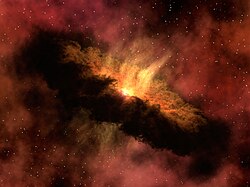
A depiction of the early Solar System's protoplanetary disk from which Earth and other Solar System bodies were formed: A depiction of the early Solar System's protoplanetary disk from which Earth and other Solar System bodies were formed
Key Facts
Pale orange dot, an impression of Early Earth, featuring its tinted orange methane-rich early atmosphere[47]
An impression of the Archean, the eon after Earth's formation, featuring round stromatolites, which are early oxygen-producing forms of life from billions of years ago. After the Late Heavy Bombardment, Earth's crust had cooled, its water-rich barren surface is marked by continents and volcanoes, with the Moon still orbiting Earth half as far as it is today, appearing 2.8 times larger and producing strong tides.[60]
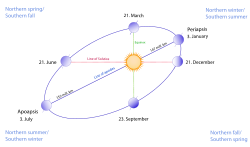
Earth follows an elliptical path around the Sun, characterized by specific orbital parameters. Its semi-major axis is approximately 149,598,023 km. The distance between Earth and the Sun varies, reaching aphelion (the farthest point) at 152,097,597 km and perihelion (the closest point) at 147,098,450 km.
Exaggerated illustration of Earth's elliptical orbit around the Sun, marking that the orbital extreme points (apoapsis and periapsis) are not the same as the four seasonal extreme points, the equinox and solstice: Exaggerated illustration of Earth's elliptical orbit around the Sun, marking that the orbital extreme points (apoapsis and periapsis) are not the same as the four seasonal extreme points, the equinox and solstice
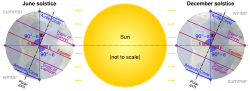
The planet's rotation on its axis is responsible for the cycle of day and night. While the synodic rotation period (the time it takes for the Sun to return to the same position in the sky) is exactly 24 hours, the sidereal rotation period (the time it takes to rotate relative to the stars) is approximately 23 hours, 56 minutes, and 4.1 seconds. Furthermore, Earth's axial tilt of roughly 23.44° is the primary driver of our seasonal changes.
Earth's axial tilt causing different angles of seasonal illumination at different orbital positions around the Sun: Earth's axial tilt causing different angles of seasonal illumination at different orbital positions around the Sun
Physical Composition and Structure
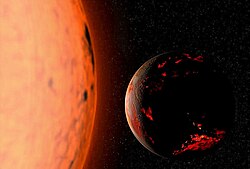
A conception of the scorched Earth after the Sun has entered the red giant phase, about 5–7 billion years in the future
Earth is not a uniform sphere but an oblate spheroid, slightly flattened at the poles due to its rotation. This is reflected in the difference between its equatorial radius (6,378.137 km) and its polar radius (6,356.752 km).
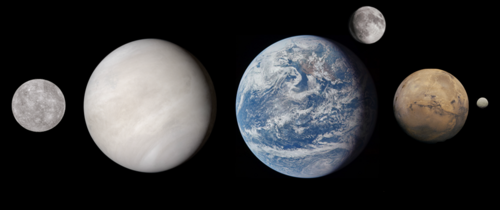
Earth depicted to scale alongside the planetary-mass objects of the Inner Solar System. From left: Mercury, Venus, Earth, the Moon, Mars and Ceres.: Earth depicted to scale alongside the planetary-mass objects of the Inner Solar System. From left: Mercury, Venus, Earth, the Moon, Mars and Ceres.
Internal Layers
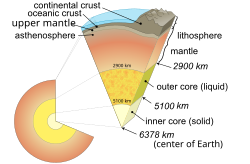
The interior of the Earth is divided into distinct layers based on density and composition. The outermost layer is the lithosphere, which includes the crust. Beneath the crust lies the upper mantle and lower mantle. The Earth's core is divided into two parts: a liquid outer core and a solid inner core.
Internal Structure of Earth
Component Layer
Depth (km)
Density (g/cm³)
Crust
0–35
2.2–2.9
Upper Mantle
35–660
3.4–4.4
Lower Mantle
660–2,890
3.4–5.6
Outer Core
2,890–5,100
9.9–12.2
Inner Core
5,100–6,378
12.8–13.1
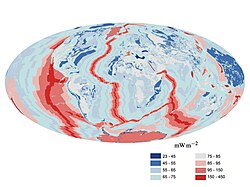
A map of heat flow from Earth's interior to the surface of Earth's crust, mostly along the oceanic ridges: A map of heat flow from Earth's interior to the surface of Earth's crust, mostly along the oceanic ridges
Surface and Tectonics
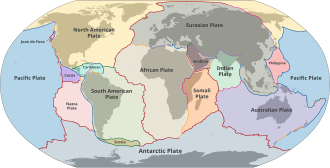
The Earth's surface is a mosaic of tectonic plates that move over the semi-fluid asthenosphere. This movement shapes the topography of the planet, creating mountains, valleys, and ocean basins. The surface is divided between land (approximately 148,940,000 km²) and water (approximately 361,132,000 km²).
Map of Earth's 16 principal tectonic plates: Map of Earth's 16 principal tectonic plates
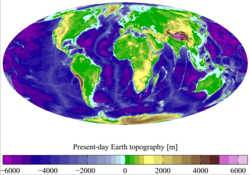
Topographic relief map of Earth's crust: Topographic relief map of Earth's crust
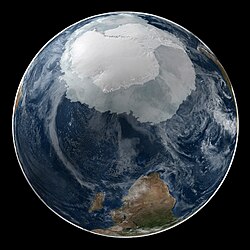
A composite image of Earth with an opaque cloud cover, making the different types of surface discernible: Earth's surface dominating Ocean (blue), Africa with lush (green) to dry (brown) land and Earth's polar ice in the form of Antarctic sea ice (grey) covering the Antarctic or Southern Ocean and the Antarctic ice sheet (white) covering Antarctica.: A composite image of Earth with an opaque cloud cover, making the different types of surface discernible: Earth's surface dominating Ocean (blue), Africa with lush (green) to dry (brown) land and Earth's polar ice in the form of Antarctic sea ice (grey) covering the Antarctic or Southern Ocean and the Antarctic ice sheet (white) covering Antarctica.
Atmosphere and Climate
ภาพประกอบจากบทความต้นฉบับ
Earth's atmosphere is a protective blanket of gases. At sea level, the average surface pressure is 101.325 kPa. The composition is dominated by nitrogen (78.08%) and oxygen (20.95%), with trace amounts of argon, carbon dioxide, and other gases.
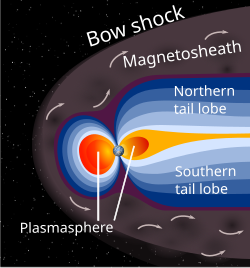
A schematic view of Earth's magnetosphere with solar wind flowing from left to right: A schematic view of Earth's magnetosphere with solar wind flowing from left to right
The atmosphere is organized into layers, including the troposphere (where weather occurs) and the stratosphere. The interaction between the atmosphere, the oceans (the hydrosphere), and solar radiation creates the complex climate systems seen across the globe.
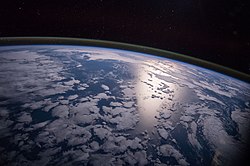
A view of the Southern Pacific under moonlight with different layers of Earth's atmosphere visible: the troposphere with its clouds casting shadows, a band of stratospheric blue sky at the horizon, and a line of green airglow of the lower thermosphere around an altitude of 100 km, at the edge of space: A view of the Southern Pacific under moonlight with different layers of Earth's atmosphere visible: the troposphere with its clouds casting shadows, a band of stratospheric blue sky at the horizon, and a line of green airglow of the lower thermosphere around an altitude of 100 km, at the edge of space
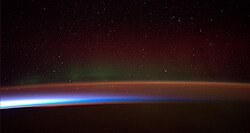
Earth's night-side upper atmosphere appearing from the bottom as bands of afterglow illuminating the troposphere in orange with silhouettes of clouds, and the stratosphere in white and blue. Next the mesosphere (pink area) extends to the orange and faintly green line of the lowest airglow, at about one hundred kilometers at the edge of space and the lower edge of the thermosphere (invisible). Continuing with green and red bands of aurorae stretching over several hundred kilometers.: Earth's night-side upper atmosphere appearing from the bottom as bands of afterglow illuminating the troposphere in orange with silhouettes of clouds, and the stratosphere in white and blue. Next the mesosphere (pink area) extends to the orange and faintly green line of the lowest airglow, at about one hundred kilometers at the edge of space and the lower edge of the thermosphere (invisible). Continuing with green and red bands of aurorae stretching over several hundred kilometers.
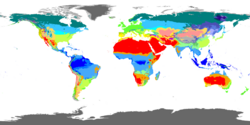
Climate patterns are often categorized using systems like the Köppen climate classification, which accounts for temperature and precipitation variations across different regions.
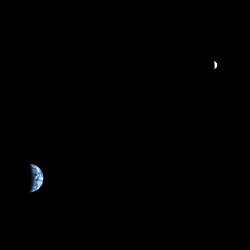
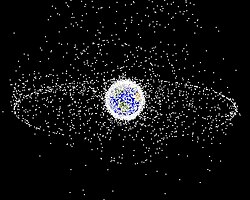
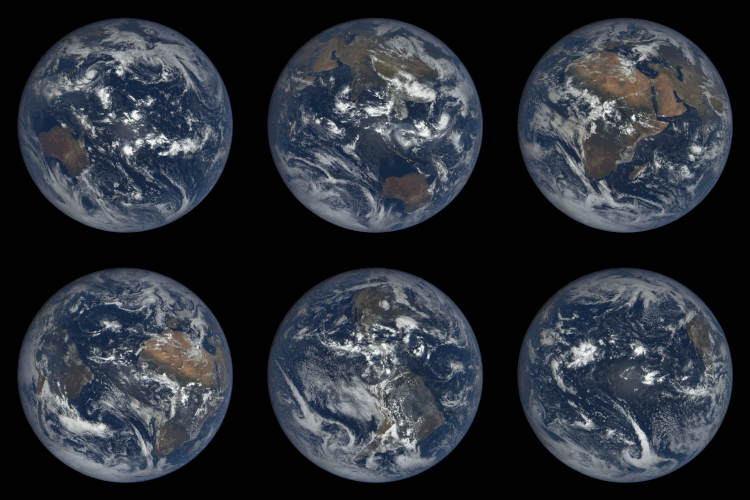
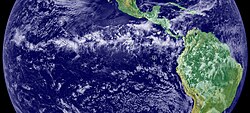
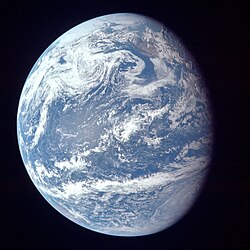
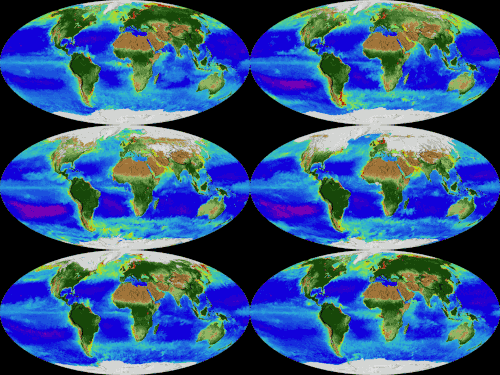
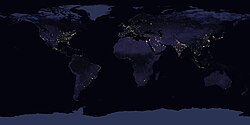
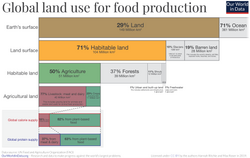
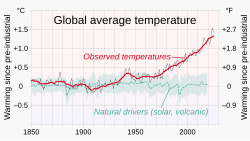
Earth and the Moon as seen from Mars by the Mars Reconnaissance OrbiterA computer-generated image mapping the prevalence of artificial satellites and space debris around Earth in geosynchronous and low Earth orbitSatellite time-lapse imagery of Earth's rotation showing axis tiltThe ITCZ's band of clouds over the Eastern Pacific and the Americas as seen from spaceA view of Earth with its global ocean and cloud cover, which dominate Earth's surface and hydrosphere; at Earth's polar regions, its hydrosphere forms larger areas of ice cover.An animation of the changing density of productive vegetation on land (low in brown; heavy in dark green) and phytoplankton at the ocean surface (low in purple; high in yellow)A composite image of artificial light emissions at night on a map of EarthThe flag of the United NationsEarth's land use for human agriculture in 2019Overall increase in average surface air temperature juxtaposed with natural drivers: human activity has caused increased temperatures, with natural forces adding some variability.[274][275]A combination of different cosmological Middle Eastern axis mundi ideas from the post-classical age (The Wonders of Creation by Zakariya al-Qazwini) showing a flat round Earth surrounded by a range of Qaf Mountains, resting on the back of a giant bull (Kujata or Behemoth), which in turn stands on a vast fish (Bahamut or Leviathan) in a cosmic ocean held up by an angel or jinn[281][282]
What is the composition of Earth's atmosphere?
The dry atmosphere is primarily composed of nitrogen (78.08%) and oxygen (20.95%), with argon (0.9340%) and carbon dioxide (0.0430%) also present in significant trace amounts.
How much of Earth's surface is covered by water?
Water covers approximately 361,132,000 km² of the Earth's 510,072,000 km² total surface area.
Why does Earth have seasons?
Seasons are caused by Earth's axial tilt of approximately 23.44°, which changes the angle of sunlight hitting different parts of the planet throughout its orbit around the Sun.
What are the main layers of Earth's interior?
The interior consists of the crust, the mantle (upper and lower), the liquid outer core, and the solid inner core.
What is the difference between a sidereal and synodic day?
A sidereal day is the time it takes Earth to rotate once relative to the stars (about 23h 56m), while a synodic day is the time it takes for the Sun to return to the same position in the sky (exactly 24h).
![Pale orange dot, an impression of Early Earth, featuring its tinted orange methane-rich early atmosphere[47]](/images/93/9a/939a43caa7bdce7fde5659c25de742305a0ff635766584bd7e2884151f510ad5.jpg)
![An impression of the Archean, the eon after Earth's formation, featuring round stromatolites, which are early oxygen-producing forms of life from billions of years ago. After the Late Heavy Bombardment, Earth's crust had cooled, its water-rich barren surface is marked by continents and volcanoes, with the Moon still orbiting Earth half as far as it is today, appearing 2.8 times larger and producing strong tides.[60]](/images/7e/c4/7ec4b5b1add29c96973c06cf8c7cd195287b9d64cbd80a7b1f33858a69b2c751.png)

![A combination of different cosmological Middle Eastern axis mundi ideas from the post-classical age (The Wonders of Creation by Zakariya al-Qazwini) showing a flat round Earth surrounded by a range of Qaf Mountains, resting on the back of a giant bull (Kujata or Behemoth), which in turn stands on a vast fish (Bahamut or Leviathan) in a cosmic ocean held up by an angel or jinn[281][282]](/images/81/90/8190ce8e5ed683729045097580f5b3d2c01a4e23b80b40b2b79112f32a347f6c.jpg)