E-Government Implementation: Global Trends and National Strategies
The shift toward e-government—the use of information and communication technology (ICT) to deliver public services—has become a cornerstone of modern public administration. By transitioning from traditional paper-based bureaucracy to digital platforms, nations aim to increase transparency, reduce operational costs, and improve the accessibility of state services for their citizens.
From the integration of "single-window" portals in Azerbaijan to the mobile-first approach of Saudi Arabia and Ukraine, the global landscape of digital governance varies by region and developmental stage. This evolution is not merely about digitizing existing forms but about fundamentally transforming how governments interact with the public.
Key Facts
- Azerbaijan provides over 140 e-services from 27 state agencies via a single-window portal.
- Saudi Arabia's Absher app grants access to more than 279 government services.
- Turkey has scaled its digital reach to over 51 million users with thousands of applications.
- Ukraine launched the Diia app to digitize ID cards and passports on smartphones.
- The United States pioneered open data initiatives with the launch of Data.gov in 2009.
Digital Governance in Asia
Asia presents a diverse array of e-government maturity levels, ranging from comprehensive national strategies to city-specific initiatives.
Central and East Asia
Kazakhstan has focused on maximizing efficiency through its egov.kz portal, which integrates services like birth registration with social benefit applications. This system has received international acclaim, including awards at the World Government Summit. In China, the "Digital Economy" has been a priority in government reports since 2017, with the 14th Five-Year Plan emphasizing digital transformation across production and governance.
Southeast Asia
Indonesia has transitioned from fragmented regional systems to a centrally based integrated system. Major cities like Jakarta and Surabaya are implementing smart city concepts, prioritizing e-health, e-education, and e-procurement. Malaysia launched its efforts in 1996 under the Multimedia Super Corridor (MSC) to reinvent government operations. Thailand is currently executing a digital government project (2016–2021) aiming for 80% of agencies to use electronic identification.
South and West Asia
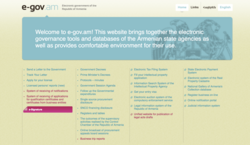
Armenia has streamlined state and local fee payments through an electronic system supporting Visa, Mastercard, and PayPal. Iran introduced a phase-one e-government rollout in 2017, including E-Tax and E-Visa services, following the launch of its National Information Network. Myanmar has focused on urban governance, with Yangon and Mandalay developing portals to reduce paper usage and improve G2C (Government-to-Citizen) interactions.
European Digital Transformations
European nations have largely aligned their e-government frameworks with broader regional standards, such as those set by the European Union.
Eastern Europe
Russia has seen a significant rise in its e-government development index, becoming a leader in Eastern Europe. Its public services portal allows citizens to perform tasks such as exchanging driver's licenses online. Poland began its journey in 2000, introducing the Public Information Bulletin (BIP) and electronic signatures to facilitate the "ePoland" strategy. Ukraine is currently pursuing a goal to make all governmental services available digitally by 2023 via the Diia ecosystem.
Western Europe and Turkey
The United Kingdom emphasized "Transformational Government" in 2005, advocating for personalized services designed around citizen needs. Turkey has achieved massive scale, with 700 agencies offering over 5,000 applications to millions of users as of 2020.
North and South American Initiatives
In the Americas, the focus has shifted toward transparency, open data, and total digitization.
United States and Canada
The United States accelerated its digital transparency under the Obama administration with the 2009 Memorandum on Transparency and Open Government. This led to the creation of Data.gov and the adoption of social media for civic engagement, such as San Francisco's @SF311 Twitter service for reporting city issues. Canada has focused on "Government On-Line," aiming to transform services to reflect the expectations of its citizens.
South America
Brazil has set an ambitious target through its Digital Government Strategy to achieve total digitization of services by the end of 2022.
African E-Government Progress
African nations are establishing dedicated directorates to plan ICT implementations. Kenya, for example, established a Directorate of e-government in 2004 to draw action plans for future ICT implementations following a change in government administration.
Summary of Global E-Government Features
| Country | Key Platform/Initiative | Primary Focus/Achievement |
|---|---|---|
| Azerbaijan | e-gov.az | Single-window access to 140+ services |
| Saudi Arabia | Absher | 279+ smartphone-based services |
| Kazakhstan | egov.kz | Integrated life-event services (e.g., birth registration) |
| Ukraine | Diia | Digital ID and passport integration |
| USA | Data.gov | Open data and public transparency |
| Russia | Public Services Portal | High e-participation and Eastern European leadership |
Frequently Asked Questions
What is the "single-window" principle in e-government?
The single-window principle, as seen in Azerbaijan, is a system where citizens can access multiple services from various government agencies through one centralized portal, eliminating the need to visit different offices or websites.
How does the Absher app benefit citizens in Saudi Arabia?
Absher allows users to access over 279 government services—including passport, traffic, and civil affairs services—directly from their smartphones, reducing bureaucracy and the need to wait in physical queues.
What is the goal of the Diia app in Ukraine?
The Diia app aims to digitize government documents, such as passports and ID cards, and provide a comprehensive digital gateway for all governmental services.
How has the US government used open data?
Through Data.gov, the US federal government makes vast amounts of government data available to the public, enabling developers to create apps, websites, and mashups that increase transparency and utility.
What are the priority areas for smart cities in Indonesia?
Indonesian smart cities, including Jakarta and Bandung, prioritize the implementation of e-government, e-health, e-education, e-logistics, and e-procurement.