Exploring Dongguk University: A Legacy of Wisdom and Tradition
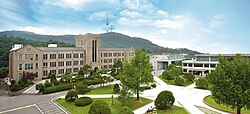
Located in the heart of Seoul, South Korea, Dongguk University stands as a premier private institution with a history spanning over 120 years. Founded on the principles of Mahayana Buddhism, the university has evolved from a small religious school into a comprehensive global research institution. Today, it is recognized for its academic excellence, particularly in fields such as Police Administration, North Korean Studies, and the arts.
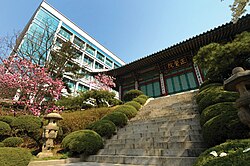
The university's identity is deeply rooted in its Buddhist heritage. Its motto, Wisdom, Compassion, and Endeavor (Jihye, Jabi, Jeongjin), guides its educational mission. This spiritual connection is further reflected in its symbols: the elephant, inspired by the precognitive dream of Queen Māyā regarding the birth of the Buddha, and the lotus blossom, which represents Buddhist truth.
Key Facts
- Established: May 8, 1906 (as Myeongjin School)
- Religious Affiliation: Mahayana Buddhism
- Motto: Wisdom, Compassion, Endeavor
- Main Campus: Seoul, South Korea
- Mascot: Elephant
- Official Colors: Orange
A Journey Through History
Foundations and Early Challenges
The institution began its journey on May 8, 1906, as Myeongjin School, established by the Association of Buddhism Research to provide specialized Buddhist education. Over the following decades, the school underwent several name changes, including Buddhist Normal School and Central Education Institution. During the Japanese Occupation, the school faced significant hardship; it was closed between 1922 and 1928 due to its connections to the Samil Undong uprising.
The school's resilience was demonstrated when Buddhist temples across colonial Korea donated 601,425 yen to help re-establish the institution. Following the end of World War II, the school expanded and eventually gained full university status in 1953, officially becoming Dongguk University.
Post-War Expansion and Modernization
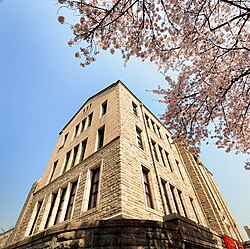
The Korean War necessitated a temporary withdrawal from Seoul, with lectures held in Busan until the university returned to its original home in September 1953. The subsequent decades saw rapid growth. In 1956, construction began on Myeongjin Hall, which remains the university's oldest building. The university also expanded its reach by establishing the Gyeongju Campus in 1979 and later integrating the Royal University of America to form the Los Angeles campus.
In recent years, Dongguk has continued to innovate. In 2025, the university was selected for the 2026 Campus Town Project by the Seoul Metropolitan Government, an initiative aimed at fostering youth start-up companies and supporting entrepreneurship within the school.
Academic Excellence and Global Presence
Diverse Academic Programs
Dongguk University offers a vast array of academic opportunities. As of 2017, the university comprised 127 undergraduate and graduate schools. The academic structure includes 53 undergraduate majors and 59 graduate programs. The institution is particularly renowned for its Police Administration department, which has produced numerous high-ranking officers in South Korean law enforcement.
Furthermore, the university has been a pioneer in specialized fields, such as being the first in Korea to establish a North Korean Studies major in 1994 to foster inter-Korean dialogue. Its Division of Theatre & Film and Media is also considered one of the top film schools in the country, boasting many alumni from the K-pop and film industries.
Global Rankings and Partnerships
The university maintains a strong international profile, holding MOUs with nearly 160 universities across 40 nations, including prestigious institutions like UCLA, the University of Manchester, and Duke University. This global connectivity allows Dongguk to attract approximately 1,800 international students annually.
| Category | Details |
|---|---|
| Undergraduate Students | 13,701 |
| Postgraduate Students | 1,801 |
| Bachelor's Degrees Granted | 3,140 |
| Master's Degrees Granted | 470 |
| Doctorate Degrees Granted | 172 |
Campuses and Facilities
Seoul Campus
The Seoul campus is an urban campus easily accessible via Dongguk University Station (Subway Lines 3 and 4). It serves as the primary hub for the university's diverse academic and cultural activities.
Gyeongju and Los Angeles Campuses
The Gyeongju Campus, established in 1979, focuses on interdisciplinary integration, specifically in Industrial Design and Public Police Administration. The Los Angeles Campus, formed through a merger with the Royal University of America, focuses on traditional Korean medicine.
Frequently Asked Questions
What are the official symbols of Dongguk University?
The university's symbol animal is the elephant, which refers to the dream of Queen Māyā regarding the birth of the Buddha. The symbol flower is the lotus blossom, representing Buddhist truth.
Which fields is Dongguk University most famous for?
Dongguk is highly regarded for its Police Administration, North Korean Studies, and its Division of Theatre & Film and Media, which has produced many famous stars in the Korean entertainment industry.
How can I get to the Seoul campus?
The main entrance is located at Dongguk University Station, where Seoul Subway Lines 3 and 4 intersect. The rear entrance is near Chungmuro Station.
Does the university have international programs?
Yes, Dongguk has partnerships with nearly 160 universities worldwide and offers various exchange programs, dual degree programs (such as with Stony Brook University), and hybrid programs combining language and area studies.