The Vital Role of DNA Repair: Protecting the Blueprint of Life
Every single day, the cells in your body engage in a silent, high-stakes battle to protect your genetic blueprint. Your DNA is not a static document; it is constantly under siege from a variety of internal and external forces. To survive, cells rely on DNA repair—a sophisticated collection of biological processes designed to identify and correct damage to the molecules that encode your genome.
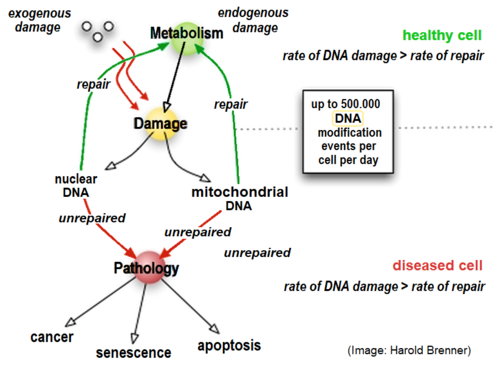
Without these constant corrective measures, the integrity of your genetic information would rapidly degrade. In fact, a single cell can experience tens of thousands of individual molecular lesions every day. When these repair mechanisms function correctly, life continues smoothly; however, a weakened capacity for DNA repair is a significant risk factor for the development of cancer.
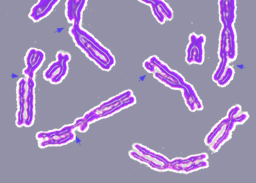
Understanding DNA Damage: Sources and Types
DNA damage can be categorized into two primary origins: endogenous (internal) and exogenous (external) sources.
Endogenous Damage
Internal cellular processes can inadvertently damage DNA. This includes replication errors—mistakes made when the cell copies its DNA—and damage caused by internal metabolic by-products. Common internal issues include alkylation (the addition of chemical groups, such as methylation, to DNA bases) and thermal disruption or hydrolysis.
Exogenous Damage
External agents pose a constant threat to genomic stability. These include:
- Ultraviolet (UV) radiation: Light from the sun or artificial sources (200–400 nm).
- Ionizing radiation: High-energy radiation that can cause severe breaks.
- Chemical Mutagens: Human-made chemicals, particularly aromatic compounds that act as intercalating agents (substances that wedge themselves between the rungs of the DNA ladder).
- Biological agents: Including various viruses and certain plant toxins.
The Consequences of Unrepaired Damage
When molecular lesions occur, they can cause structural damage to the DNA molecule. This can alter or even eliminate the cell's ability for transcription—the process of reading DNA to create RNA—and gene expression. Furthermore, these lesions can induce harmful mutations that affect the survival of daughter cells during mitosis (cell division).
If a cell accumulates significant damage or can no longer repair it effectively, it typically enters one of three states:
- Senescence: An irreversible state of cellular dormancy.
- Apoptosis: A form of programmed cell death used to eliminate potentially dangerous cells.
- Unregulated division: When repair fails and the cell continues to divide uncontrollably, it can lead to the formation of cancerous tumors.
How Cells Repair the Blueprint: Key Mechanisms
Cells utilize a diverse toolkit of specialized pathways to address different types of damage. These mechanisms are part of the broader DNA damage response (DDR).
Major Repair Pathways
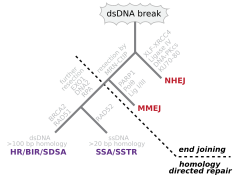
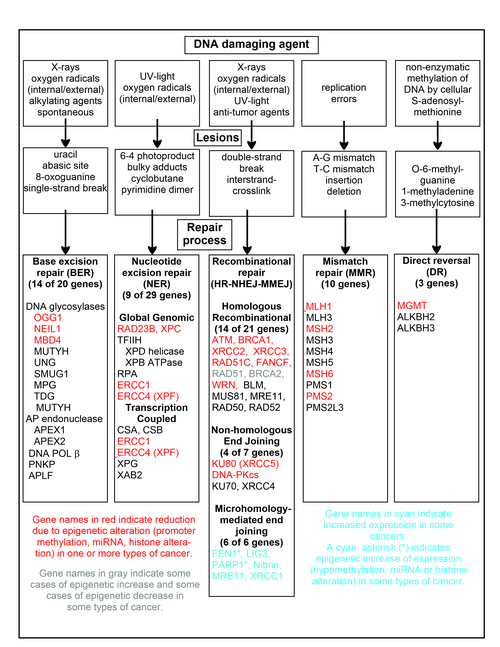
Different lesions require different "specialists." For example, Base Excision Repair (BER) targets small, non-bulky lesions, while Nucleotide Excision Repair (NER) handles larger, bulky adducts. When the DNA backbone itself is severed, the cell employs Homologous Recombination (HR) or Non-Homologous End Joining (NHEJ) to fix double-strand breaks.
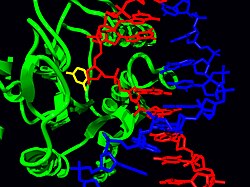
A critical component in many of these processes is DNA ligase. This enzyme acts like biological glue, joining broken nucleotides together by catalyzing the formation of an internucleotide ester bond between the phosphate backbone and the deoxyribose nucleotides.
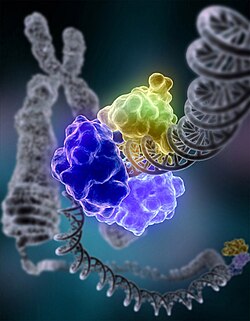
The Role of Regulatory Proteins
The repair process is heavily regulated by key proteins. For instance, the proteins ATM and ATR act as sensors that trigger downstream targets like p53. The p53 protein is essential for inducing apoptosis when damage is too severe to fix. Additionally, the inhibitor p21 can arrest the cell cycle at specific checkpoints (G1/S and G2/M), giving the cell time to attempt repairs before proceeding with division.
DNA Repair, Aging, and Disease
The efficiency of DNA repair is a major determinant of cell pathology and is closely linked to the aging process. Research suggests that most genes influencing human lifespan are those that affect the rate of DNA damage. Interestingly, some studies indicate that caloric restriction may promote genomic stability by inducing base excision repair.
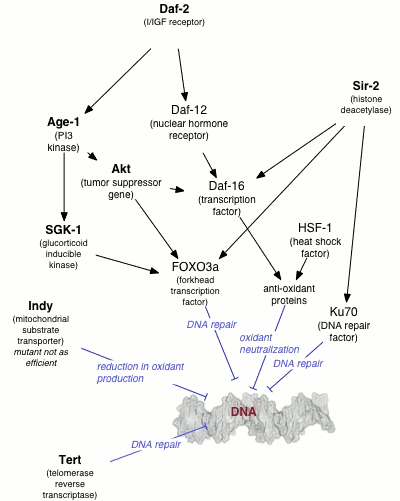
Genetic Disorders of DNA Repair
When specific repair mechanisms are genetically defective, it leads to serious hereditary disorders:
- Cockayne syndrome: Characterized by extreme hypersensitivity to UV and chemical agents.
- Trichothiodystrophy: Results in sensitive skin and brittle hair and nails.
- Werner's syndrome: Leads to premature aging and delayed growth.
- Ataxia telangiectasia: Causes sensitivity to ionizing radiation and certain chemicals.
The Link to Cancer
Defects in DNA repair are a hallmark of many cancers. In many tumors, certain repair pathways are upregulated (increased expression), while others may be epigenetically silenced. For example, the microhomology-mediated end joining pathway, which is more error-prone, often shows increased expression in various cancers.
The Epigenetic Connection
DNA repair does not just fix the sequence of bases; it can also influence epigenetic markers. Epigenetics refers to chemical modifications, such as DNA methylation, that regulate how genes are turned on or off without changing the underlying DNA sequence.
Oxidative damage can trigger changes in these markers. For example, the enzyme OGG1 targets oxidative damage like 8-OHdG. At certain sites, OGG1 can recruit proteins like TET1 to initiate the demethylation (removal of methyl groups) of adjacent DNA. Conversely, certain types of oxidative stress can cause mismatch repair proteins to recruit DNA methyltransferase 1 (DNMT1), leading to increased methylation at specific locations.
![Initiation of DNA demethylation at a CpG site. In adult somatic cells DNA methylation typically occurs in the context of CpG dinucleotides (CpG sites), forming 5-methylcytosine-pG, or 5mCpG. Reactive oxygen species (ROS) may attack guanine at the dinucleotide site, forming 8-hydroxy-2'-deoxyguanosine (8-OHdG), and resulting in a 5mCp-8-OHdG dinucleotide site. The base excision repair enzyme OGG1 targets 8-OHdG and binds to the lesion without immediate excision. OGG1, present at a 5mCp-8-OHdG site recruits TET1 and TET1 oxidizes the 5mC adjacent to the 8-OHdG. This initiates demethylation of 5mC.[142]](/images/d4/8b/d48b1b6c391410faa1b567ad343c2f82811f6814bf429f870eae97d97e798f7e.webp)
| Type of Damage | Common Cause/Agent | Primary Repair Pathway |
|---|---|---|
| Bulky Adducts | UV Radiation / Chemical Mutagens | Nucleotide Excision Repair (NER) |
| Small Base Lesions | Oxidative Stress / Alkylation | Base Excision Repair (BER) |
| Mismatched Bases | Replication Errors | Mismatch Repair (MMR) |
| Double-Strand Breaks | Ionizing Radiation | HR or NHEJ |
Key Facts
- High Frequency: Cells experience tens of thousands of DNA lesions every single day.
- Cancer Risk: A weakened DNA repair capacity is a primary risk factor for cancer development.
- Cellular Outcomes: Unrepaired damage leads to senescence (dormancy), apoptosis (cell death), or unregulated division (cancer).
- Aging Link: The rate of DNA repair is a significant determinant of biological aging and longevity.
- Epigenetic Impact: DNA repair processes can actively alter DNA methylation patterns.
Frequently Asked Questions
What is the main purpose of DNA repair?
The main purpose is to identify and correct molecular lesions in the genome to maintain genetic stability, ensure proper gene expression, and prevent mutations that could lead to cell death or cancer.
How does DNA damage lead to cancer?
If DNA damage occurs in genes that regulate cell growth and is not properly repaired, it can cause mutations. These mutations can lead to unregulated cell division, which is the fundamental characteristic of a tumor.
What is the difference between senescence and apoptosis?
Senescence is a state of permanent dormancy where the cell remains alive but stops dividing. Apoptosis is programmed cell death, where the cell is actively destroyed to prevent it from causing harm to the organism.
Can lifestyle factors influence DNA repair?
Yes. External factors like UV radiation and exposure to mutagenic chemicals can increase DNA damage. On the other hand, some research suggests that factors like caloric restriction may help promote genomic stability.
What are the symptoms of DNA repair disorders?
Symptoms vary widely depending on the specific disorder. They can include premature aging (Werner's syndrome), hypersensitivity to sunlight (Cockayne syndrome), or physical abnormalities like brittle hair and nails (Trichothiodystrophy).