Diving: The Evolution of Competitive and Recreational Aquatic Acrobatics
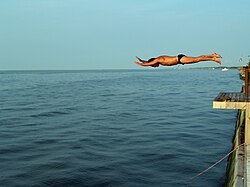
Diving is the sport of jumping into water, often incorporating complex acrobatic maneuvers. While it is widely recognized today as a precision Olympic sport governed by World Aquatics, its roots stretch back to antiquity and evolved from simple plunges into sophisticated aerial displays.
Unlike underwater diving or freediving, which focus on submersion and breath-holding, competitive diving emphasizes the grace, height, and technical execution of the descent from a platform or springboard into a pool.

Key Facts
- Governing Body: World Aquatics is the highest global authority for the sport.
- Olympic History: Plain diving entered the Olympics in 1904; fancy diving was added in 1908.
- Core Disciplines: Includes springboard, platform, synchronized, and high diving.
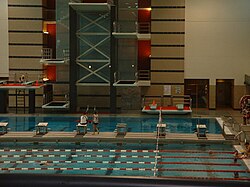
- Safety Standard: World Aquatics recommends minimum pool depths of 5m for 10m platforms and 3-4m for springboards.
- Entry Technique: High diving (up to 27m) requires feet-first entry to prevent severe injury.
The History of Diving
Antiquity and Early Beginnings
Evidence of diving exists in ancient art, such as the "Tomb of the Diver" fresco in Paestum, Italy, dating back to 470 BCE.

From Plunging to Fancy Diving
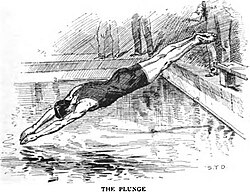
In the 17th century, gymnasts began bringing their equipment to beaches to perform acrobatics over water. By the mid-19th century, "plunging"—a competition based on the distance covered after a dive—was recorded in England. For instance, records from 1870 note a swimmer named Mr. Young plunging 56 feet (17 m).
The sport shifted toward aesthetics in the late 1800s. The first diving stages were erected at Highgate Ponds in 1893, leading to the National Graceful Diving Competition in 1895. This era saw the introduction of "fancy diving" by Swedish athletes Otto Hagborg and C F Mauritzi, who utilized acrobatic techniques from 10m boards. This movement led to the creation of the Amateur Diving Association in 1901.
The Olympic Era and Competitive Evolution

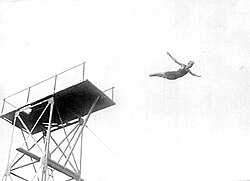
Diving has been a staple of the Summer Olympic programme since 1904. While it began with "plain diving," the 1908 London Games introduced "fancy diving" and elastic springboards. Women first competed in Olympic diving in 1912 in Stockholm. By 1928, the disciplines were merged into "Highboard Diving."
Synchronized Diving
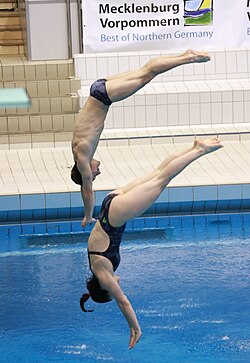
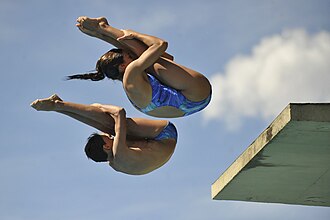
Synchronized diving requires two divers to perform the same dive simultaneously. Judging for these events focuses on the timing of the take-off, the height attained, the synchronization of twists and rotations, and the simultaneous entry into the water.
Judging and Scoring
Judges evaluate dives based on several technical criteria:
- The Apex: The height the diver reaches at the peak of the jump.
- Rotation: The precision and amount of revolution completed before entry.
- Hand-stands: For armstand dives, the quality and duration of the hold are assessed.
Technical Classifications
Dive Groups
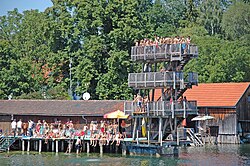
Competitive dives are categorized into six primary groups:
- Forward Group: Diver faces forward and rotates forward.
- Back Group: Diver faces away from the water and rotates backward.
- Reverse Group: Diver faces forward but rotates backward.
- Inward Group: Diver faces away from the water and rotates forward.
- Twist Group: Any dive incorporating axial twisting movements.
- Armstand Group: Dives commencing from a handstand (platform only).
Dive Positions
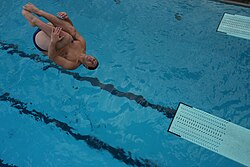
Divers assume one of four body positions during flight:
- Straight: No bend at the knees or hips; considered the most difficult.
- Tuck: Body folded into a tight ball, holding the shins; considered the easiest.
- Pike: Body bent at the hips with legs straight.
- Free: A combination of positions.
Safety and Risk Management
Recreational Hazards
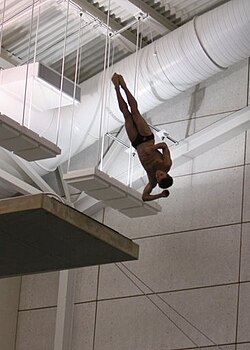
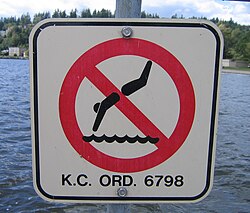
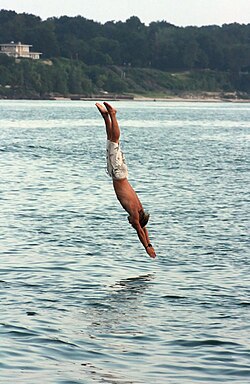
Recreational diving carries significant risks, particularly in residential pools. A landmark 1993 case involving a "suicide dive" (hands at sides) led to a multimillion-dollar lawsuit and a shift in how pool depths are regulated. Many residential builders now avoid installing springboards due to the risk of spinal cord injuries (SCI).
Competitive Injuries and Fatalities
Even at the professional level, injuries occur. The most common areas affected are the wrist, shoulder, and lumbar spine. Data from the 2012 Olympics showed an injury rate of 8.1% among divers. In extreme cases, collisions with the platform have proven fatal, such as the deaths of Sergei Chalibashvili (1983) and Nathan Meade (1987) during reverse somersault attempts.
![A jump from a 10 metre diving platform that has been performed by taking a running start. A running start increases the difficulty of the jump and the chances that the person may over rotate and impact the water with their stomach or back instead of their feet.[20] Germany. 2007](/images/d7/56/d756910585c36034e312848ddc461a33a0b11a4b5b02790797b73e7a7664eb22.jpg)
High Diving
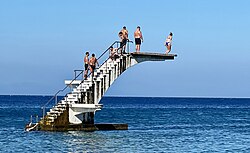
High diving takes place in open-air locations from platforms up to 89 feet (27 m). Because of the extreme height, divers must enter the water feet-first to avoid catastrophic injury. They typically perform the final half-somersault backward to spot their entry point.

Summary of Diving Specifications
| Category | Platform/Board Height | Recommended Pool Depth | Entry Method |
|---|---|---|---|
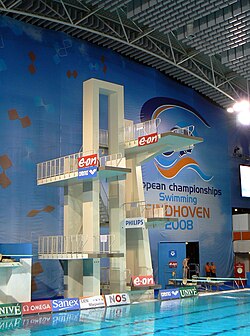
| Springboard | 3 Meters | 3 - 4 Meters | Head or Feet First |
| Olympic Platform | 10 Meters | 5 Meters | Head or Feet First |
| High Diving | Up to 27 Meters | Varies (Open Water) | Feet First Only |
Frequently Asked Questions

What is the difference between plain and fancy diving?
Plain diving refers to basic jumps without acrobatic maneuvers, while fancy diving incorporates twists, somersaults, and other complex aerial movements.
Why must high divers enter the water feet-first?
Entering the water from heights up to 27 meters head-first would cause an impact force capable of causing severe, potentially fatal injuries.
How is a dive's difficulty measured?
Dives are assigned a Degree of Difficulty (DD) based on the group, position, and number of rotations or twists performed.
What are the most common injuries in competitive diving?
The most frequently injured areas are the lumbar spine, shoulders, and wrists, often occurring during practice rather than competition.
Who governs the sport of diving globally?
World Aquatics is the international governing body responsible for the rules and regulation of competitive diving.