Diving in Football: Simulation, Detection, and Disciplinary Actions
In the high-stakes world of association football, diving—formally known as simulation by FIFA—is a controversial tactic where a player intentionally falls to the ground. The goal is to deceive the referee into believing a foul has occurred, often by faking an injury or exaggerating physical contact during a challenge. By doing so, players seek an unfair advantage, such as winning a penalty kick, earning a free kick, or provoking a penalty card for an opponent.
Depending on the region, this behavior is known by various names. In continental Europe, it is often called Schwalbe (German for "swallow"), while in Australia, it is referred to as staging. In North American sports generally, the term flopping is more common.
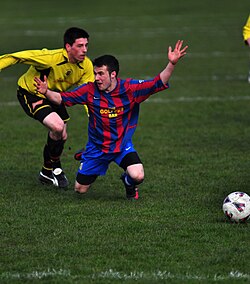
Key Facts
- Definition: An attempt to gain an unfair advantage by faking a foul or exaggerating contact.
- Motivations: Securing scoring opportunities (penalties/free kicks) or getting opponents sent off.
- Detection: Identified by a time gap between impact and fall, or a lack of ballistic continuity.
- Penalties: Can range from fines and match suspensions to the rescinding of red cards for the accused defender.
Detecting the Dive
Because deciding whether a player has dived is highly subjective, it remains one of the most debated aspects of the sport. However, scientific research has highlighted specific traits that can help distinguish a genuine foul from a simulation. A 2009 study identified two primary indicators:
- Temporal Separation: A noticeable gap in time between the actual physical impact and the player's simulation of the fall.
- Lack of Ballistic Continuity: This occurs when a player's movement exceeds what would be physically expected based on the momentum of the tackle.
Disciplinary Actions and Punishments
Different football governing bodies have implemented various systems to punish simulation and correct wrongful dismissals.
European Regulations (England)
Starting in the summer of 2017, the Football Association (FA) in England introduced a retrospective review process. A three-man panel—comprising a former player, manager, and match official—reviews video evidence every Monday. If the panel unanimously decides a player deceived the referee to win a penalty or cause an opponent's dismissal, the player is charged with "Successful Deception of a Match Official," resulting in a two-match suspension.
Notable cases include Bristol City's Bailey Wright and Everton's Oumar Niasse, both of whom became the first players to receive two-match bans under this rule in November 2017. In February 2023, Eveliina Summanen of Tottenham Women became the first top-flight female player to receive such a ban.
North American Regulations (MLS)
Major League Soccer (MLS) utilizes a Disciplinary Committee to handle simulation. Penalties often include fines and suspensions. For example, in June 2011, D.C. United's Charlie Davies was fined US$1,000 for intentionally deceiving officials. In July 2011, Real Salt Lake's Álvaro Saborío received a one-game suspension and a US$1,000 fine after his simulation led to the sending-off of defender Bobby Burling.
Similar to the FA, the MLS Disciplinary Committee has the authority to rescind red cards and suspensions if it is proven that the dismissal was caused by an opponent's simulation.
Summary of Regional Penalties
| Region/League | Common Penalty | Review Process | Corrective Action |
|---|---|---|---|
| England (FA) | Two-match suspension | Three-man independent panel | Opponent's card can be rescinded |
| North America (MLS) | Fines (e.g., $1,000) and suspensions | Disciplinary Committee | Opponent's red card can be rescinded |
Frequently Asked Questions
What is the difference between diving and simulation?
In the context of football, they are the same. "Diving" is the common term, while "simulation" is the official terminology used by FIFA.
How do referees and experts spot a dive?
They look for a lack of ballistic continuity (unnatural movement relative to momentum) and a time delay between the contact and the player falling.
Can a red card be overturned if a player dived?
Yes. In both the English FA and MLS systems, if a player is found to have deceived the official to get an opponent sent off, the opposing player's red card and subsequent suspension can be rescinded.
What are the typical motivations for diving?
Players typically dive to win a penalty kick or free kick, or to gain a tactical advantage by getting an opposing player cautioned or sent off.
Who are some players known for having a diving reputation?
Over the years, various players have been associated with simulation in media and sports discussions, including Neymar, Arjen Robben, Sergio Ramos, and Ashley Young.