Distinguished Service Order
The Distinguished Service Order (DSO) is a prestigious military award of the United Kingdom, historically conferred throughout the Commonwealth. It is awarded for operational gallantry, specifically recognizing highly successful command and leadership during active operations, typically within actual combat environments.
In the hierarchy of British military decorations, the DSO holds a precedence equal to the Conspicuous Gallantry Cross and the Royal Red Cross. While it was once reserved for senior officers, modern reforms have expanded its eligibility to ensure that exceptional leadership is recognized regardless of rank.
Key Facts
- Established: 6 September 1886 by Queen Victoria.
- Eligibility: Open to all ranks of the Armed Forces since 1993.
- Primary Criteria: Highly successful command and leadership during active operations.
- Sovereign: Currently King Charles III.
- Post-nominal: Recipients are entitled to use the letters "DSO".
- Precedence: Sits below the Commander of the Most Excellent Order of the British Empire (CBE) and above the Lieutenant of the Royal Victorian Order (LVO).
History and Evolution
The Order was instituted by Royal Warrant in 1886 to recognize meritorious or distinguished service in war. For much of its early history, the DSO was typically conferred upon officers in command above the rank of major. For those of lower rank to receive the award, they generally had to demonstrate a high degree of gallantry just short of the requirements for the Victoria Cross.
During the early years of World War I (1914–1916), some awards were granted to staff officers in circumstances where they were not under fire. This caused significant resentment among front-line officers, leading to a directive on 1 January 1917, which mandated that the decoration be recommended only for those serving under fire.
Over time, the eligibility criteria expanded. In 1942, the award was extended to officers of the Merchant Navy who performed acts of gallantry under enemy attack. Additionally, a requirement that recipients must first be "Mentioned in Despatches" (an official report of gallant or meritorious action) was removed in 1943.
![Major Paul Garneau, of the Royal 22e Régiment, with the DSO insignia he received for "gallant and distinguished services in the combined attack on Dieppe" after his investiture at Buckingham Palace in October 1942[7]](/images/99/2b/992b99492b22a85fcde2e46796d26e224667a558651ded72e51aef204dbfd92e.jpg)
The Modern Era
A comprehensive review of the British honours system in 1993 removed rank distinctions for operational awards. Consequently, the DSO became open to all ranks. While the criteria were redefined as "highly successful command and leadership during active operations," the award has yet to be conferred on a non-commissioned rank, despite recent conflicts in Iraq and Afghanistan.
Historically, the DSO was used across the Commonwealth. However, by the 1990s, nations such as Canada, Australia, and New Zealand established their own independent honours systems and ceased recommending British awards.
Design and Nomenclature
Recipients are formally styled as Companions of the Distinguished Service Order. The physical decoration is a silver-gilt cross (originally gold until 1889) measuring 1.6 inches (4.1 cm) wide, featuring white enamel and gilt edges. It is manufactured by the Crown Jewellers, Messrs Garrard & Co.
The obverse features an Imperial Crown in gold on a red background, surrounded by a green enamelled laurel wreath. The reverse displays the Royal Cypher of the reigning monarch. The decoration is suspended from a red ribbon with narrow blue edges.
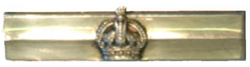
When a recipient is awarded the DSO multiple times, a Bar is added to the ribbon. This gold bar features an Imperial Crown in the center. In undress uniforms, a rosette is worn on the ribbon to signify each additional Bar received.
Statistics and Recipients
Between 1886 and 1979, the DSO was conferred 16,845 times, with the vast majority occurring during the First World War. Between 1980 and 2017, approximately 90 additional conferrals were made for conflicts including the Falklands, Gulf, Iraq, and Afghanistan Wars.
The award has seen significant international distribution, including 1,220 conferrals to Canadians and 1,018 to Australians. Additionally, at least 14 officers of the British Indian Army received the honor, with an increase in awards during World War II due to the Indianization of the army.
| Period | Dates | Crosses | 1st Bar | 2nd Bar | 3rd Bar |
|---|---|---|---|---|---|
| Pre-First World War | 1886–1913 | 1,732 | — | — | — |
| First World War | 1914–1919 | 9,881 | 768 | 76 | 7 |
| Inter-war | 1919–1939 | 148 | 16 | — | — |
| Second World War | 1939–1946 | 4,880 | 947 | 59 | 8 |
| Post-1945 | 1947–1979 | 204 | 20 | 5 | 1 |
| Total | 1886–1979 | 16,845 | 1,751 | 140 | 16 |
Quadruple Recipients
A small number of exceptional individuals received the DSO four times (the original award plus three Bars). Notable recipients include Sir Bernard Freyberg (who also received the Victoria Cross), Paddy Mayne of the Special Air Service, and Frederic John Walker, a renowned U-boat hunter of the Royal Navy.
Frequently Asked Questions
Who is currently eligible for the Distinguished Service Order?
Since 1993, the DSO has been open to all ranks of the British Armed Forces, provided they demonstrate highly successful command and leadership during active operations.
What is the difference between the DSO and the Victoria Cross?
While both are high honors, the Victoria Cross is the highest award for gallantry. Historically, the DSO was often awarded to those whose actions were just short of the requirements for the Victoria Cross, or to senior officers for distinguished leadership in combat.
Can the DSO be awarded more than once?
Yes. Subsequent awards are recognized by the addition of a Bar to the original insignia. Some rare individuals have received the award four times (the DSO and three Bars).
Is the DSO still awarded in Commonwealth countries?
While it was previously conferred throughout the Commonwealth, most member nations (such as Canada, Australia, and New Zealand) have since established their own national honours systems and no longer recommend the DSO.
What do the post-nominal letters "DSO" signify?
The letters "DSO" indicate that the individual is a Companion of the Distinguished Service Order, a title formally granted upon the conferral of the award.