Disc Jockeys: The Evolution of Art, Equipment, and Performance
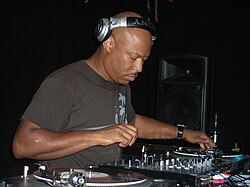
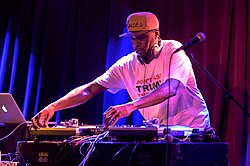
A disc jockey, commonly known as a DJ, is an artist who plays recorded music for an audience. While the term originally referred to the use of shellac and vinyl records, the modern DJ is a versatile performer who mixes music from a vast array of media, including cassettes, CDs, and digital audio files. Whether hosting a radio show, energizing a nightclub, or managing a private event, the DJ's primary role is to curate and blend sounds to create a seamless auditory experience.
At its core, DJing involves using audio equipment to play at least two music sources simultaneously. This allows the performer to align beats—matching the rhythms and tempos of two different tracks—to ensure a smooth transition that keeps the audience engaged without a clash in timing.
Key Facts
- Versatility: DJs operate across various environments, including radio stations, nightclubs, festivals, and private events.
- Core Technique: Beat-matching and blending are essential for creating seamless transitions between songs.
- Technological Shift: The industry has evolved from analog vinyl and turntables to digital controllers and laptop-based software.
- Cultural Impact: Jamaican sound system culture and the invention of the "DJ scratch" in the South Bronx laid the foundation for modern hip-hop.
Types of Disc Jockeys
The role of a DJ varies significantly depending on the setting and the intended goal of the performance:
- Club DJs: Perform at nightclubs or music festivals, often focusing on maintaining a high-energy dance floor.
- Radio DJs: Host programs on music radio stations, blending music with commentary and interviews.
- Mobile DJs: Freelance professionals hired for private events such as weddings and parties.
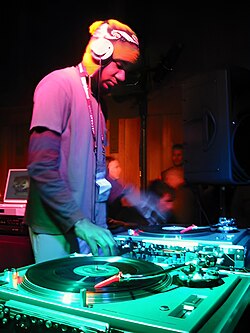
- Turntablists: Specialists who use turntables to manipulate sounds on phonograph records, treating the equipment as a musical instrument.
- Residents: DJs who hold a regular, recurring position at a specific venue.
In some regions, such as Germany, the term DJane is used to specifically describe female DJs, reflecting the grammatical gender of the language.
The Evolution of DJ Equipment
As technology has advanced, the tools of the trade have shifted from heavy analog hardware to streamlined digital interfaces.
Turntables and Vinyl
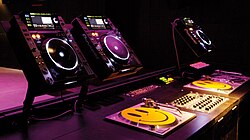
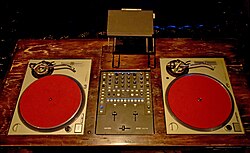
Early DJs relied on vinyl records and direct-drive turntables. A landmark development occurred in 1972 with the release of the Technics SL-1200. Its high-torque motor allowed the platter to maintain a consistent RPM even when the DJ manipulated the record, enabling the birth of scratching and beat juggling.
DJ Mixers and the Crossfader
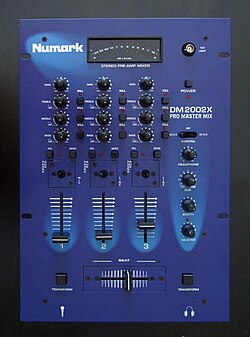
A DJ mixer is a specialized audio console used to blend sound sources. Unlike large studio mixers with dozens of channels, DJ mixers are compact, typically featuring two to four channels. The most critical component is the crossfader—a horizontal slider that allows the DJ to transition smoothly between two different audio sources.
Digital Revolution: CDJs and Software
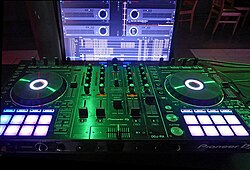
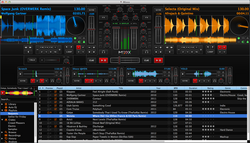
The 1990s and 2000s saw a shift toward digital audio. The introduction of the CDJ-1000 by Pioneer in 2001 made digital recordings practical for professional use. Today, many DJs use DJ software (such as Mixxx) paired with a DJ controller. These systems allow performers to manage massive libraries on a laptop or tablet, displaying visual waveforms of the music for precise mixing.
Additional Tools
- Headphones: Used for "cueing," allowing the DJ to pre-listen to and adjust a track before the audience hears it.
- Microphones: Used to engage the crowd and introduce songs.
- Electronic Instruments: Drum machines (like the Roland TR-808) and synthesizers (like the TB-303) are often integrated into live sets.
A Brief History of the Craft
The roots of DJing can be traced back to the 1940s. In 1943, Jimmy Savile hosted one of the first live dance parties using a single turntable. By 1947, the first discotheque, Whisky à Gogo, opened in Paris. In the 1960s, Jamaican producers like King Tubby and Lee "Scratch" Perry pioneered dub music, experimenting with tape-based composition and rhythmic structures that heavily influenced American hip-hop.
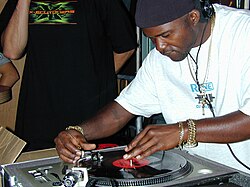
In the 1970s, the South Bronx became a hub of innovation. Grand Wizzard Theodore invented the "DJ scratch," while DJ Kool Herc and Afrika Bambaataa used direct-drive decks to isolate and extend rhythmic breaks.
The late 20th century saw the rise of the "Raving Society," epitomized by the Love Parade, which grew from a small 1989 demonstration into a massive festival with 1.5 million attendees by 1999. This era solidified the DJ as a central figure in global electronic dance music culture.
DJ Equipment Summary
| Equipment Type | Primary Medium | Key Feature | Era of Prominence |
|---|---|---|---|
| Turntables | Vinyl Records | Tactile manipulation/Scratching | 1970s - Present |
| CDJs | CDs / Digital Files | Digital precision with physical feel | 2000s - Present |
| DJ Controllers | Digital Audio Files | Software integration/Portability | 2010s - Present |
| DJ Mixer | Multiple Audio Sources | Crossfader for seamless transitions | 1960s - Present |
Frequently Asked Questions
What is the difference between a DJ and a Turntablist?
While a DJ generally focuses on selecting and mixing records for an audience, a turntablist treats the turntable as a musical instrument, using advanced techniques like scratching and beat juggling to create new sounds.
What does a crossfader do?
A crossfader is a horizontal slider on a DJ mixer that allows the performer to transition the audio output from one channel (e.g., Channel A) to another (e.g., Channel B) or blend them equally at the midpoint.
How did the Roland TR-808 influence DJing?
The TR-808 analog drum machine provided unique, booming bass and sharp snare sounds that became foundational to the sound of hip-hop and electronic dance music.
What is beat-matching?
Beat-matching is the process of aligning the tempos and rhythms of two different songs so that they play in synchronization, allowing for a smooth transition without a noticeable break in the beat.
Can you DJ without physical turntables?
Yes. Modern DJs frequently use laptops, tablets, or smartphones running specialized DJ software, often paired with a digital controller that mimics the layout of traditional analog equipment.