Direct Current: Principles, History, and Modern Applications
Direct current (DC) is the one-directional flow of electric charge. Unlike alternating current (AC), which reverses direction periodically, DC flows in a constant direction. This fundamental characteristic makes it essential for a vast array of technologies, from the smallest smartphone battery to massive industrial smelting processes.
DC can travel through various mediums, including conductors like copper wire, semiconductors, insulators, or even a vacuum, as seen in ion or electron beams. A common example of a DC power source is the electrochemical cell.

Key Facts
- Direction: Electric charge flows in a single, constant direction.
- Conversion: AC is converted to DC via a rectifier; DC is converted to AC via an inverter.
- Polarity: DC systems have distinct positive and negative terminals.
- Primary Sources: Batteries, solar panels, and fuel cells naturally produce DC.
- Transmission: High-voltage direct current (HVDC) is used for long-distance and undersea power transmission.
The Evolution of Direct Current
The history of DC began in 1800 when Italian physicist Alessandro Volta created the Voltaic pile, the first battery. While the nature of current flow was not fully understood at the time, André-Marie Ampère conjectured that it traveled from positive to negative.
In 1832, Hippolyte Pixii built the first dynamo electric generator. He discovered that the machine naturally produced alternating current. To achieve direct current, Pixii added a commutator—a mechanical switch using brushes to ensure the current flowed in only one direction.
![Brush Electric Company's central power plant with dynamos generating direct current to power arc lamps for public lighting in New York. Beginning operation in December 1880 at 133 West Twenty-Fifth Street, the high voltages it operated at allowed it to power a 2-mile (3.2 km) long circuit.[4]](/images/68/9c/689c969c7b3d5364ae0f6fe41dc8250196aef032149b8923fc91f9a4c9c70cc8.jpg)
By the late 1870s, power stations began using high-voltage DC (often exceeding 3,000 volts) for public arc lighting. In 1882, Thomas Edison launched a low-voltage DC utility for indoor incandescent lighting. However, AC eventually became the standard for power delivery because transformers allowed AC to be stepped up to higher voltages, enabling much longer transmission distances with less loss.
Defining DC and Circuit Behavior
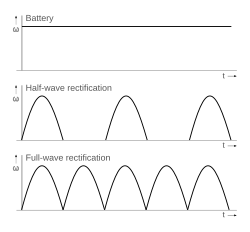
In technical terms, DC refers to power systems with a single electrical polarity. While often associated with a constant voltage, DC can also refer to a "constant polarity" system where the voltage may vary over time, such as the fluctuating signal on a telephone line or the raw output of a rectifier.
A standard DC circuit consists of constant voltage sources, constant current sources, and resistors. In these circuits, voltages and currents are independent of time, meaning the mathematical equations used to describe them do not require integrals or derivatives.
When components like capacitors or inductors are added, the circuit enters a DC steady state once transient variations settle. In most DC applications, polarity is critical; connecting a load backward can prevent the device from functioning or cause damage, unless a diode bridge is present to correct the flow.
![This symbol which can be represented with Unicode character U+2393 (⎓, "Direct Current Symbol Form Two") is found on many electronic devices that either require or produce direct current. ("Form One" is an em dash.[10])](/images/7b/0d/7b0d6860fb3b5026f3f0bd53d0d31f1a21c5b44a0c7fa6f513c6243d0bc97305.webp)
Practical Applications of DC
Domestic and Commercial Use
DC is the standard for extra-low voltage applications, particularly those powered by solar panels or batteries. Because most electronic devices require DC, they use internal or external power supplies to convert AC wall power into the required DC voltage.
Automotive Systems
Almost all vehicles rely on DC. Standard passenger cars typically use a 12V system, while heavy machinery often uses 24V. In internal combustion vehicles, an alternator generates AC, which is then converted to DC via a rectifier to charge the battery. Battery electric vehicles (BEVs) utilize two systems: a low-voltage system (12V) for accessories and a high-voltage system (300-400V) to power traction motors efficiently.
Telecommunications
Telephone exchanges typically use a standard -48V DC supply. The positive terminal is grounded to prevent electrolysis depositions. To separate the audio signal (AC) from the power supply (DC) on a single pair of wires, a bias tee is used.
Industrial and High-Voltage Transmission
DC is indispensable for electrochemical processes, such as the smelting of aluminum. For bulk power transport, High-Voltage Direct Current (HVDC) is used to move energy from remote generation sites to grids. HVDC is often more cost-effective than AC for long distances and is the only technically feasible method for long-distance undersea cables, such as the NorNed link.
| Application | Typical Voltage | Primary Source/Method |
|---|---|---|
| Passenger Vehicles | 12V | Lead-acid Battery / Alternator |
| Heavy Equipment | 24V | Battery / Alternator |
| Telecommunications | -48V | Battery Bank |
| Electric Vehicle Traction | 300V - 400V | High-voltage Battery Pack |
| Long-distance Power | High Voltage (HVDC) | Rectifier / Inverter Stations |
Frequently Asked Questions
What is the difference between DC and AC?
Direct current (DC) flows in one constant direction, whereas alternating current (AC) periodically reverses its direction of flow.
How is AC converted to DC?
AC is converted to DC using a device called a rectifier, which uses electronic or electromechanical elements to allow current to flow in only one direction.
Why is HVDC used for undersea cables?
High-voltage direct current (HVDC) is used for long-distance undersea cables because it is the only technically feasible option for such distances, offering lower electrical losses compared to AC.
Does polarity always matter in DC circuits?
In most DC applications, polarity is critical, and connecting a device backward will result in failure. However, some specific circuits are designed so that polarity does not matter.
What are some natural sources of DC?
Batteries, solar panels, and fuel cells are all primary examples of power sources that naturally produce direct current.