Dippers: The Unique Underwater Songbirds
Dippers are extraordinary birds belonging to the genus Cinclus within the family Cinclidae. While they are classified as passerines (perching birds), they possess a capability entirely unique among their order: the ability to dive and swim underwater. Named for their characteristic bobbing or "dipping" motion while perched by the water, these stout birds have evolved to master the challenging environments of fast-flowing upland rivers.
Key Facts
- Unique Ability: The only passerines capable of diving and swimming underwater.
- Species: There are five recognized species across the Americas, Europe, and Asia.
- Habitat: Cold, clear, fast-moving freshwater rivers in highland regions.
- Adaptations: Solid bones to reduce buoyancy and specialized eyes for underwater vision.
- Diet: Primarily aquatic invertebrates, such as mayfly and caddisfly larvae.
- Conservation: Most species are of Least Concern, though the Rufous-throated dipper is Vulnerable.
Taxonomy and Classification
The genus Cinclus was first established in 1797 by German naturalist Moritz Balthasar Borkhausen. The name is derived from the Ancient Greek word kinklos, referring to small, tail-wagging birds found near water. In Britain and America, the White-throated and American dippers are sometimes referred to as "water ouzels," a term originally linked to the Eurasian blackbird.
Molecular phylogenetic research from 2002 indicates that the family Cinclidae is most closely related to the thrush family (Turdidae). The study revealed that the White-throated and Brown dippers are sister species, while the White-capped and Rufous-throated dippers share a similar sister-species relationship in South America.
| Common Name | Scientific Name | Primary Region |
|---|---|---|
| White-throated (European) Dipper | Cinclus cinclus | Europe, Asia, North Africa |
| Brown Dipper | Cinclus pallasii | Asia |
| American Dipper | Cinclus mexicanus | North America |
| White-capped Dipper | Cinclus leucocephalus | South America |
| Rufous-throated Dipper | Cinclus schulzii | South America |
Physical Characteristics
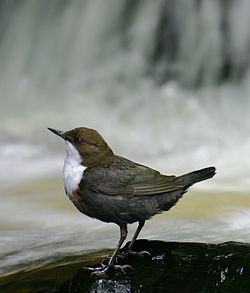
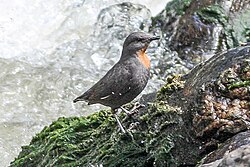
Dippers are small, chunky birds with short tails, short wings, and strong legs. Most species exhibit dark brown or nearly black plumage, often accented with white. The Rufous-throated dipper is distinct for its reddish-brown throat patch. They typically range from 14 to 22 cm in length and weigh between 40 and 90 g, with males generally being larger than females.
Their flight is characterized by a distinctive whirring sound due to their short wings. When submerged, a thin, silvery film of air is trapped against their plumage, providing a layer of insulation and buoyancy control.
Specialized Aquatic Adaptations
To survive in turbulent, cold waters, dippers have evolved several morphological and physiological adaptations. Unlike many water birds, they do not have webbed feet; instead, they possess sharp claws and strong legs to grip slippery rocks in swift currents.
Physical Adaptations
- Skeletal Structure: They have evolved solid bones to reduce buoyancy, making it easier to dive.
- Musculature: Short, powerful wing muscles allow them to use their wings as flippers underwater.
- Waterproofing: Dense plumage and an enlarged preen gland ensure their feathers remain waterproof.
- Sensory Organs: Nasal flaps prevent water from entering the nostrils, and specialized focus muscles in the eyes enhance underwater vision by altering the lens curvature.
Physiological Adaptations
Dippers possess a high concentration of haemoglobin in their blood, allowing them to store more oxygen than other birds and remain submerged for 30 seconds or more. Additionally, their basal metabolic rate is approximately one-third slower than terrestrial passerines of a similar size. In extreme conditions, such as in the Suntar-Khayata Mountains of Siberia, some populations have been observed feeding underwater when air temperatures plummet below −55 °C (−67 °F).
Behavior and Ecology
Dippers are highly territorial, with pairs establishing linear territories along rivers. The size of these territories—ranging from 300 to 2,500 metres—is primarily determined by the availability of food. They build large, domed nests made of moss with an internal cup of grass, typically tucked into crevices, under bridges, or on ledges close to running water.
Diet and Foraging
Their diet consists mainly of aquatic invertebrates, including the larvae of stoneflies, mayflies, blackflies, and caddisflies. They also consume small fish, fish eggs, molluscs, and crustaceans. While they often feed from the water's edge, they frequently walk along the riverbed or swim using their wings to find prey beneath stones.
Communication
Because they live near loud, rushing water, dippers have evolved high-pitched calls (4.0–6.5 kHz) that sit well above the frequency of torrent noise (maximum 2 kHz). They also use visual signals, such as their signature bobbing motion and rapid blinking to flash the white feathers of their upper eyelids during courtship or threats.
Conservation Status
Dippers are highly sensitive to environmental changes. Water pollution, acidification, and turbidity caused by erosion can devastate their food sources. Furthermore, river regulation—such as the construction of dams, reservoirs, and channelization—destroys critical nesting and foraging habitats.
Historically, dippers faced persecution. In Scotland and Germany, they were once hunted due to the false belief that they depleted fish stocks. While most species are currently listed as Least Concern, the Rufous-throated dipper is classified as Vulnerable due to fragmented populations and river management issues in Argentina.
Frequently Asked Questions
How do dippers breathe underwater?
Dippers do not breathe underwater; instead, they have a high haemoglobin concentration in their blood that allows them to store significant amounts of oxygen, enabling them to stay submerged for 30 seconds or more.
Why are they called "dippers"?
They are named for their characteristic bobbing or dipping motion that they perform while perched on rocks beside the water.
Do dippers have webbed feet?
No, dippers do not have webbed feet. They rely on strong legs and sharp claws to grip rocks in fast-flowing currents.
Which dipper species is most at risk?
The Rufous-throated dipper is the most threatened, currently classified as Vulnerable by the IUCN due to declining and fragmented populations.
What do dippers eat?
Their diet primarily consists of aquatic insect larvae (such as mayflies and caddisflies), though they also eat small fish, fish eggs, crustaceans, and molluscs.