Diocese of Rochester: A Comprehensive History of Faith and Challenge
The history of the Catholic Church in Rochester, New York, is a narrative of dramatic transformation. From a period of colonial prohibition and legal persecution to the establishment of a sprawling network of schools and parishes, the Diocese of Rochester has mirrored the broader social and religious evolution of the United States.
Early History and the Path to Religious Freedom
During the 17th and 18th centuries, under Dutch and British rule, the Province of New York was hostile toward Catholicism. Laws passed by the first colonial governor, Richard Coote, mandated life sentences for Catholic priests found within the colony. Those who harbored Catholics faced a £250 fine and three days in the pillory. The environment was so restrictive that in 1763, Bishop Richard Challoner of London noted the unlikely prospect of priests being permitted to enter the provinces.
The tide turned with the American Revolution. In 1777, the new State of New York approved a constitution guaranteeing freedom of worship for Catholics, a right later solidified by the US Bill of Rights.
The Foundation of the Diocese (1784–1881)
The administrative structure of the American Church began in 1784 when Pope Pius VI created the Apostolic Prefecture of the United States of America, which later became the Diocese of Baltimore in 1789. By 1808, the Diocese of New York was established, encompassing the entire state. Early Catholic activity in the region included the first mass for non-native Catholics in a private Auburn residence in 1816, the construction of St. Patrick's in Rochester in 1823, and St. Francis de Sales in Geneva in 1832.
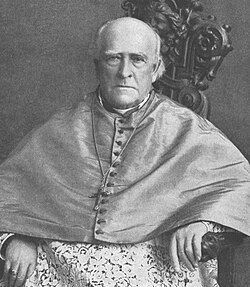
The Diocese of Rochester was officially erected on March 3, 1868, by Pope Pius IX. This new entity took eight counties—Monroe, Livingston, Wayne, Ontario, Seneca, Cayuga, Yates, and Tompkins—from the Diocese of Buffalo. Monsignor Bernard J. McQuaid was appointed as the first bishop, overseeing approximately 54,500 Catholics, 35 parish churches, and 29 mission churches.
Educational Expansion under Bishop McQuaid
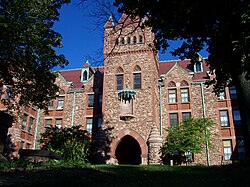
Bishop McQuaid focused heavily on education. In 1870, he opened St. Patrick minor seminary (renamed St. Andrew's in 1879). By 1871, he launched a system of tuition-free parochial schools staffed by the Sisters of St. Joseph. This commitment to learning culminated in the 1893 opening of Saint Bernard's Seminary, which grew rapidly to become one of the largest seminaries in the country by 1910.
Growth and Institutional Development (1881–1969)
The diocese's boundaries reached their current form in 1896 when Pope Leo XIII added Schuyler, Tioga, Chemung, and Steuben counties. Following McQuaid's death in 1909, Bishop Thomas F. Hickey took leadership. Hickey expanded the church's social reach, pioneering Catholic Charities, establishing catechetical programs for public school students, and founding the Aquinas Institute for Boys, Nazareth Academy for girls, and Nazareth College in Pittsford.
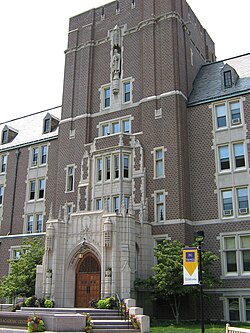
Subsequent leaders continued this growth. Bishop John Francis O'Hern (1929–1933) focused on ecumenical ties and lay associations. Archbishop Edward Mooney (1933–1937) promoted the Catholic Action movement and outreach to the African-American community via the Knights of Peter Claver before becoming the archbishop of Detroit.
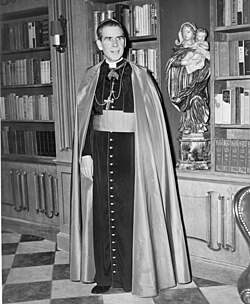
Bishop James E. Kearney (1937–1966) contributed to the planning of McQuaid Jesuit High School. He was succeeded by the well-known Auxiliary Bishop Fulton J. Sheen. While Bishop Sheen established the Sheen Ecumenical Housing Foundation, his tenure was marked by a controversial, unsuccessful attempt to give the St. Bridget's Parish building to the federal Housing and Urban Development program for African-American services.
Modern Era and Contemporary Challenges (1969–Present)
From 1969 onward, the diocese was led by Bishop Joseph Hogan and later Bishop Matthew H. Clark. Bishop Clark's tenure was marked by both administrative restructuring and theological conflict. He faced criticism from Cardinal Josef Ratzinger over a sex education manual and defended theologian Charles Curran against Vatican criticism regarding birth control and divorce.
The late 1990s saw a congregational split when the diocese removed Father James Callan for opening communion to non-Catholics and blessing LGBTQ unions, leading to the formation of Spiritus Christi Church. In the early 2000s, Bishop Clark oversaw the "re-sizing" of the diocese, which involved the unpopular closing of numerous parishes and schools.
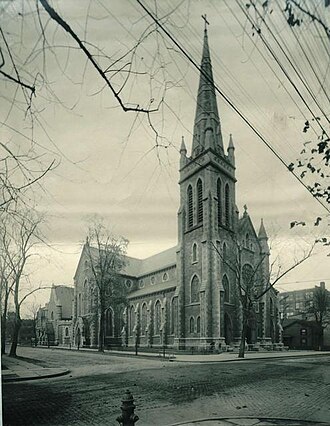
Bishop Salvatore Matano, appointed in 2013, led the diocese through its sesquicentennial anniversary in 2017. However, the diocese faced a severe crisis in September 2019, filing for Chapter 11 bankruptcy—the first New York diocese to do so—due to numerous lawsuits alleging sexual abuse of children by clergy and staff.
In 2026, Pope Leo XIV appointed John S. Bonnici as the tenth bishop of Rochester following Matano's resignation.
Key Facts
- Founded: March 3, 1868, by Pope Pius IX.
- First Bishop: Bernard J. McQuaid.
- Peak Population: Catholic population peaked in the 1960s with over 360,000 members.
- Legal Milestone: First diocese in New York State to file for bankruptcy protection (2019).
- Educational Legacy: Established Saint Bernard's Seminary and Nazareth University.
Diocesan Growth Statistics
| Year | Catholics | Parishes | Schools | Priests | Sisters |
|---|---|---|---|---|---|
| 1909 | 121,000 | 93 | 53 | 164 | 500+ |
| 1938 | 223,657 | 129 | 72 | 289 | Not listed |
| 1966 | 361,790 | 155 | 99 | 371 | 1,549 |
| 1978 | 358,850 | 161 | 75 | 311 | 1,095 |
| 1992 | Not listed | 162 | 58 | 208 | 842 |
Clerical Abuse and Legal Proceedings
The diocese has been plagued by numerous cases of sexual abuse. Notable cases include Brother John Walsh (1985), Gerard Guli (1989), and Eugene Emo (1996). In 2002, lawsuits were filed regarding the actions of Robert O'Neil. More recently, the diocese revealed it had paid $1.6 million in compensation to 20 individuals since 1950.
The bankruptcy proceedings, initiated in 2019, have been protracted. In 2020, Bishop Emeritus Matthew Clark was required to testify despite claims of Alzheimer's disease. In January 2024, a jury awarded a $95 million verdict in a case involving Foster P. Rogers. As of August 2024, the bankruptcy settlement remains unresolved.
Frequently Asked Questions
When was the Diocese of Rochester established?
The Diocese of Rochester was established on March 3, 1868, by Pope Pius IX, separating eight counties from the Diocese of Buffalo.
Who was the first bishop of the diocese?
Monsignor Bernard J. McQuaid was appointed as the first bishop of Rochester.
Why did the Diocese of Rochester file for bankruptcy?
The diocese filed for Chapter 11 bankruptcy in September 2019 due to the financial pressure of multiple lawsuits alleging the sexual abuse of children by clergy and staff.
What is the significance of Saint Bernard's Seminary?
Opened in 1893, Saint Bernard's Seminary became a major center for priestly formation, reaching an enrollment of 233 seminarians by 1910, making it the second largest of its kind in the U.S. at the time.
Who is the current bishop of Rochester?
John S. Bonnici was appointed as the tenth bishop of Rochester in 2026 by Pope Leo XIV.