Diffuse Reflection: How Light Scatters to Create the Visible World
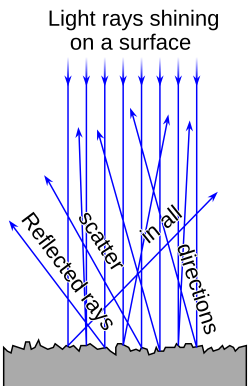
When we look at the world around us, we rarely see a collection of perfect mirrors. Instead, we see a rich tapestry of colors, textures, and shapes. This visibility is made possible by diffuse reflection—a process where light hitting a surface is scattered in many different directions rather than being reflected at a single, predictable angle.
While specular reflection (the mirror-like reflection seen on smooth surfaces) is responsible for glints and glare, it is diffuse reflection that allows us to perceive the form and color of most objects from almost any viewing angle. Without it, the world would appear much more difficult to navigate and interpret.
![Diffuse and specular reflection from a glossy surface.[1] The rays represent luminous intensity, which varies according to Lambert's cosine law for an ideal diffuse reflector.](/images/d6/89/d689364e95f3c55452e7e63c3917b413b04b049fb064b07fd2781fec796f41bb.webp)
Key Facts
- Diffuse reflection scatters light at many angles, whereas specular reflection reflects light at a single angle.
- An ideal diffuse reflector is known as a Lambertian surface, providing equal luminance from all viewing directions.
- Most diffuse reflection is caused by subsurface scattering rather than surface roughness alone.
- The color of an object is determined by which wavelengths are absorbed as light travels through the material's internal structure.
- Interreflection occurs when light reflected from one diffuse object illuminates another.
The Mechanism of Scattering
A common misconception is that diffuse reflection is caused solely by a rough surface. While surface irregularities can contribute, many materials reflect light diffusely even when they are highly polished. For example, a piece of polished white marble remains white; polishing it may increase its specular reflection, but it will not turn the stone into a mirror.
The primary mechanism for diffuse reflection in solids is actually subsurface scattering. Instead of bouncing off the immediate surface, light enters the material and encounters various scattering centers beneath the surface. As light travels through these internal structures, it is reflected and redirected multiple times by different particles or interfaces.
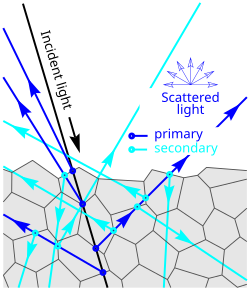
Consider the example of snow. Snow is composed of transparent ice crystallites. When light hits snow, it enters the crystals, reflects off the interfaces between them, and undergoes a series of primary, secondary, and tertiary scattering events. Because these crystals do not absorb the light, the rays eventually exit the surface in random directions, making the snow appear bright white.
This mechanism is incredibly common because most natural materials are composed of "small things" held together. Mineral materials are often polycrystalline (made of a mosaic of small crystals), while organic materials consist of complex networks of fibers and cells. Every internal interface or imperfection acts as a site for light to deviate and scatter.
Materials and Reflectivity
Not all materials cause diffuse reflection. Metals, gases, liquids, glass, and transparent plastics typically do not exhibit significant subsurface scattering because they lack the internal subdivisions required to redirect light. Single crystals, such as certain gems or salt, also tend toward specular reflection. However, if these materials have a microscopically rough surface—such as frosted glass—they can exhibit diffuse properties.
Many common materials exist on a spectrum between specular and diffuse. For instance, glossy paints provide a fraction of specular reflection, while matte paints are designed to be almost exclusively diffuse. Among common materials, only polished metals like silver or aluminum are highly efficient at specular reflection.
How Diffusion Creates Color
The way light scatters through a material is fundamental to how we perceive color. When a material is absorbent, the diffused rays lose certain wavelengths as they travel through the internal structure. The light that eventually emerges carries the signature of those absorbed wavelengths, resulting in a colored appearance.
The path length of the light is critical. For example, red ink in a bottle may appear black because the light must travel through several centimeters of ink, absorbing almost all wavelengths. However, when that same ink is applied to paper, the light only travels a fraction of a millimeter through the fibers and ink, allowing the vivid red color to be perceived through diffuse reflection.
Interestingly, when an object exhibits both specular and diffuse reflection, the colors are often found only in the diffuse component. In a cherry, for example, the diffuse reflection is red, while the specular reflection (the shiny highlight) remains essentially white.
Applications and Importance
Vision and Perception
The vast majority of the objects we see are visible because of diffuse reflection. While Rayleigh scattering explains the blue color of the sky and Mie scattering explains the white appearance of clouds, it is the diffuse scattering from surfaces that allows us to see the physical world around us.
Interreflection and Computer Graphics
In the real world, light does not stop at the first object it hits. Diffuse interreflection occurs when light reflected from a non-shiny surface (like a wall or the ground) strikes another object, illuminating it. This can even transfer color; a red wall will cast a subtle red tint onto nearby objects.
In 3D computer graphics, modeling this effect is essential for achieving realistic global illumination. Techniques such as radiosity and photon mapping are used to simulate how light bounces between surfaces to create lifelike scenes.
Spectroscopy
In scientific analysis, diffuse reflectance spectroscopy is a vital tool. It allows researchers to determine the absorption spectra of powdered samples using UV-Vis-NIR or mid-infrared spectroscopy, particularly in cases where traditional transmission spectroscopy is not possible.
Summary of Reflection Types
| Feature | Specular Reflection | Diffuse Reflection |
|---|---|---|
| Directionality | Single, predictable angle | Many random angles |
| Surface Requirement | Smooth, polished surface | Rough surface or internal scattering centers |
| Primary Cause | Surface interface | Subsurface scattering (in many solids) |
| Common Examples | Mirrors, polished metal, calm water | Paper, matte paint, snow, marble |
Frequently Asked Questions
What is the difference between specular and diffuse reflection?
Specular reflection occurs when light hits a smooth surface and reflects at a single, specific angle, creating a mirror-like effect. Diffuse reflection occurs when light is scattered in many different directions, which is what allows us to see the shape and color of most objects.
Why does snow look white if ice is transparent?
Snow appears white because it is composed of many tiny ice crystals. When light enters the snow, it undergoes multiple scattering events at the interfaces between these crystals. Because the crystals do not absorb the light, the scattered light exits the surface in all directions, appearing white to our eyes.
Can a surface be both specular and diffuse?
Yes. Many materials exhibit a mixture of both. For example, glossy paint provides a specular highlight (the shine), while the underlying pigment provides diffuse reflection (the color). Most polished stones also show a mix of both types of reflection.
How does diffuse reflection affect color perception?
Color is perceived based on which wavelengths of light are absorbed as they travel through a material. Diffuse reflection involves light traveling through the material's internal structure; the longer the path the light takes, the more likely certain wavelengths are to be absorbed, which determines the final color we see.
What is diffuse interreflection?
Diffuse interreflection is the process where light reflected from a non-shiny surface strikes another object. This helps illuminate shadows and can even cause colors to bleed from one object to another, such as light from a colored floor reflecting onto a nearby wall.