Delphinium: A Comprehensive Guide to the Larkspur Genus
The genus Delphinium, commonly known as larkspur, comprises approximately 300 species of annual and perennial flowering plants. Belonging to the family Ranunculaceae, these striking plants are native to the Northern Hemisphere and can also be found in the high mountains of tropical Africa. The genus was originally established by the renowned botanist Carl Linnaeus.
The name Delphinium finds its roots in the Ancient Greek word delphínion, meaning "dolphin." This nomenclature was used by Pedanius Dioscorides in De Materia Medica to describe the plant's dolphin-shaped flowers.
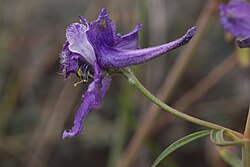
Flowers of most species have five spreading sepals and four petals (e.g. Delphinium nuttallianum).
Key Facts
- Scientific Family: Ranunculaceae
- Common Name: Larkspur
- Toxicity: All members are toxic to humans and livestock.
- Pollinators: Primarily butterflies and bumble bees.
- Global Presence: Northern Hemisphere and tropical African mountains.
Botanical Description and Habitat
Delphinium species exhibit a wide range of physical characteristics depending on their environment. For instance, species like Delphinium nuttallianum and Delphinium bicolor feature shorter stems and fewer flowers, making them well-suited for prairies and sagebrush steppes. In contrast, robust species such as Delphinium occidentale are more frequently found in forested areas.
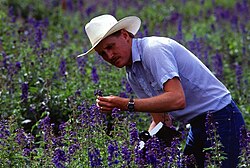
In high mountain habitat, central Utah rangelands
The foliage of the genus is typically characterized by deeply lobed, palmate leaves with three to seven toothed, pointed lobes. The flowering stems are erect and vary significantly in height; while some alpine species may only reach 10 centimeters, larger meadowland species can grow up to 2 meters tall. The seeds are notably small and often possess a shiny black appearance. Flowering typically occurs from late spring through late summer.
Ecology and Toxicity
While Delphiniums are vital food plants for the larvae of certain Lepidoptera (moths and butterflies), such as the dot moth and small angle shades, they pose a significant risk to others. All parts of the plant are poisonous in large doses, with the seeds being particularly dangerous as they can contain up to 1.4% alkaloids. This toxicity makes them hazardous to both humans and livestock.
Taxonomy and Classification
Modern genetic analysis has significantly reshaped our understanding of Delphinium taxonomy. Previously, the genus was considered sensu lato (in the broad sense), but molecular data revealed it was polyphyletic. To ensure the genus is monophyletic (containing only descendants of a common ancestor), several taxonomic adjustments were made.
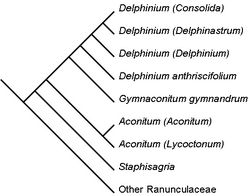
Subgenera of Delphinium and related taxa
Key changes include the erection of the new genus Staphisagria and the reassignment of Aconitum gymnandrum to the monotypic genus Gymnaconitum. Additionally, the genera Consolida and Aconitella have been synonymized with Delphinium, as molecular evidence shows they are embedded within the Delphinium lineage.
Subgenera Structure
The classification includes several subgenera, such as Delphinium (Delphinium) and Delphinium (Delphinastrum). The group consisting of species previously assigned to Consolida and Aconitella is now categorized under the subgenus Delphinium (Consolida). Notably, D. arthriscifolium is considered the sister species to all other Delphinium sensu stricto (in the strict sense).
Cultivation and Ornamental Use
Delphiniums are highly valued in horticulture as ornamental plants. They are frequently used in traditional and native plant gardens to provide height at the back of summer borders, often paired with roses, lilies, and geraniums. Most modern garden hybrids and cultivars are derived from Delphinium elatum.
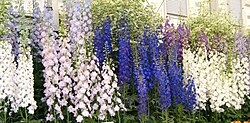
Delphiniums displayed at the Chelsea Flower Show
Hybridization efforts began in the 19th century, led by Victor Lemoine in France. Since then, various groups have emerged, including the 'Pacific Giant' hybrids developed by Reinelt in the United States, which are known for their height and deer tolerance. In New Zealand, Dowdeswell's has bred 'Millennium' hybrids, which are reported to perform better in warmer climates.
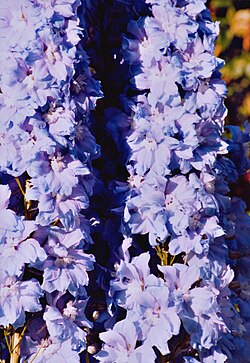
A Delphinium cultivar
Cultivars are available in a variety of colors, including white, pink, purple, and blue. They are also popular in the floristry industry as cut flowers. In the United Kingdom, the National Collection of delphiniums is held by Colin Parton, who manages over 100 cultivars, some of which are listed as endangered.
Summary of Notable Delphinium Characteristics
| Category | Key Feature | Example/Detail |
|---|---|---|
| Common Name | Larkspur | Shared with Consolida species |
| Flower Colors | Wide Spectrum | Blue, pink, purple, white, red, orange |
| Plant Height | Variable | 10 cm to 2 meters |
| Toxicity Level | High | Contains alkaloids (up to 1.4% in seeds) |
| Primary Use | Ornamental | Garden borders and cut flowers |
Frequently Asked Questions
Are Delphiniums safe for pets and livestock?
No. All parts of the Delphinium plant are toxic to humans and livestock. The seeds are particularly potent, containing high concentrations of alkaloids.
What is the difference between Delphinium and Consolida?
While they share the common name "larkspur," molecular data shows that Consolida is actually embedded within the Delphinium genus. Consequently, Consolida is now considered a synonym of Delphinium.
Which pollinators are attracted to Delphinium flowers?
Delphiniums are primarily pollinated by butterflies and bumble bees.
Can Delphiniums be used for making ink?
Yes. Historically, the juice from the flowers, specifically from D. consolida, can be mixed with alum to produce a blue ink.
What are 'Pacific Giant' Delphiniums?
'Pacific Giant' is a group of hybrids developed by Reinelt in the United States. They are characterized by long stems, growing between 1.2–1.8 m tall and 60–90 cm wide, and are noted for their ability to tolerate deer.