Déjà Vu: The Science and Production of Tony Scott's Sci-Fi Thriller
Released in 2006, Déjà Vu is a high-stakes science fiction action thriller that blends the urgency of a crime procedural with the mind-bending possibilities of temporal physics. Directed by Tony Scott and produced by Jerry Bruckheimer, the film follows an ATF agent who utilizes experimental technology to travel back in time, attempting to thwart a domestic terrorist attack in New Orleans and save a woman he loves.
Key Facts
- Director: Tony Scott
- Lead Actors: Denzel Washington and Paula Patton
- Budget: $75 million
- Worldwide Box Office: $180.6 million
- Scientific Consultant: Brian Greene (Columbia University)
- Release Date: November 22, 2006
Plot Overview
The story begins with a devastating explosion on a ferry crossing the Mississippi River during Mardi Gras, resulting in 543 deaths. ATF Special Agent Doug Carlin (Denzel Washington) is tasked with investigating the tragedy. During his investigation, he discovers the body of Claire Kuchever (Paula Patton), who appears to have been killed shortly before the blast occurred.
As Carlin digs deeper, he discovers that Claire had contacted his office the morning of the bombing. He eventually determines that she was abducted and murdered by the bomber hours before the ferry explosion, setting the stage for a race against time to prevent the catastrophe.
The Science of Time Travel
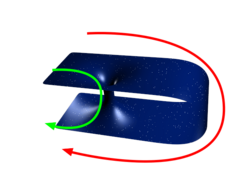
To ensure the film had a scientifically plausible feel, the production hired Brian Greene, a professor from Columbia University, as a consultant. The script incorporates concepts from superstring theory and the theoretical existence of wormholes—shortcuts through space-time.
Greene contributed a specific topological explanation for wormholes, using the analogy of bending a piece of paper to connect two distant corners, a visual representation that was ultimately integrated into the film's narrative.
Production and Filming in New Orleans
While the script was originally intended to be set on Long Island, Tony Scott relocated the production to New Orleans, Louisiana. The filming process was significantly impacted by the devastation of Hurricane Katrina. Principal photography was delayed due to the collapse of levees and general city destruction.
Despite the logistical challenges, the production continued in the city. Denzel Washington expressed support for filming in the region to provide employment for local residents. The filmmakers even integrated real-world post-Katrina imagery, including scenes from the Lower 9th Ward, into the movie's plot.
Visual Effects and Innovation
The film utilized approximately 400 visual effects scenes. To achieve a unique look, the team used a LIDAR (Light Detection and Ranging) device, which uses lasers to map physical regions in high detail. This technology was used to scan the ATF office, the ferry, and actress Paula Patton.
Additionally, the production employed the Panavision Genesis high-definition camera to capture the "past" sequences and various night scenes, which were then blended with computer-generated graphics to simulate the experience of time travel.
Cast and Character Parallels
The film features a strong ensemble cast, with Denzel Washington as Agent Carlin and Jim Caviezel as the antagonist, Carroll Oerstadt. Both the director and Caviezel acknowledged that the character of Oerstadt was partially based on Timothy McVeigh, the domestic terrorist responsible for the 1995 Oklahoma City bombing.
| Actor | Character | Role Description |
|---|---|---|
| Denzel Washington | Doug Carlin | ATF Special Agent |
| Paula Patton | Claire Kuchever | Victim of the bombing |
| Jim Caviezel | Carroll Oerstadt | Domestic Terrorist |
| Val Kilmer | Paul Pryzwarra | FBI Special Agent |
| Bruce Greenwood | Jack McCready | FBI Special Agent-in-Charge |
| Adam Goldberg | Dr. Alexander Denny | Scientist/Technical Expert |
Reception and Legacy
Déjà Vu received mixed reviews from critics. On Rotten Tomatoes, it holds a 55% approval rating, with critics praising the technical execution while questioning the plausibility of the time-travel plot. Audiences were more receptive, awarding the film an "A-" grade via CinemaScore.
Internally, the film faced some tension. Screenwriters Terry Rossio and Bill Marsilii suggested that Tony Scott focused too heavily on action sequences at the expense of the screenplay's more meaningful plot points. Despite this, the film was a commercial success, ranking as the 23rd most successful film worldwide in 2006.
Frequently Asked Questions
What is the scientific basis for time travel in the movie?
The film uses the concept of wormholes and superstring theory, with guidance from physicist Brian Greene to create a plausible feeling of bending space-time to look into the past.
How did Hurricane Katrina affect the production?
Filming was delayed due to the storm's devastation and levee collapses. However, the production chose to stay in New Orleans to support the local economy and incorporated real post-storm imagery into the film.
Who was the villain based on?
The character of Carroll Oerstadt was partly based on Timothy McVeigh, the domestic terrorist who bombed the Alfred P. Murrah Federal Building in 1995.
What special technology was used for the visual effects?
The production used LIDAR (laser scanning) to map environments and people, along with the Panavision Genesis HD camera to create the time-travel sequences.
Was the film a financial success?
Yes, it grossed $180.6 million worldwide against a production budget of $75 million, making it one of the top 25 most successful films of 2006 globally.