Deborah Zlotsky: The Intersection of Abstraction, Memory, and Materiality
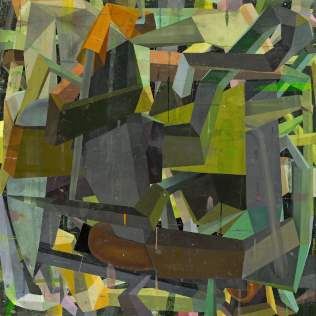
Deborah Zlotsky creates a visual dialogue between the planned and the spontaneous. Her work is characterized by a sophisticated fusion of incongruities, blending geometric precision with biomorphic forms (shapes reminiscent of living organisms) and contrasting flat surfaces with trompe-l'oeil (an art technique that uses realistic imagery to create the optical illusion that the depicted objects exist in three dimensions).
Critics often describe her paintings as monumental and dramatic. These works frequently feature projecting blocky forms and bands of color that create receding spaces, evoking an architectural quality similar to the works of Cubists or M.C. Escher. While the overall composition may seem structured, a closer look reveals a tactile history: the canvases are dense with drips, smears, tape marks, and abrasions that document the physical process of creation.
Key Facts
- Artistic Style: A blend of hard-edged abstraction, organic passages, and sculptural illusions.
- Core Themes: Family dynamics, identity, cultural inheritance, gender, and the fluidity of time.
- Signature Techniques: Use of pentimenti (visible traces of earlier painting layers) and repurposed vintage textiles.
- Notable Series: The "LifeLike" graphite drawings and the "Diaspora" paintings.
- Mediums: Oil on canvas, graphite on mylar, and assembled vintage silk scarves with crochet.
The Creative Process and Visual Language
Zlotsky employs an intuitive approach to her work. She begins with initial marks, shapes, and colors that serve as catalysts for further discovery. This responsive method allows her to accumulate and revise relationships between elements, searching for unexpected anomalies or anthropomorphic possibilities that link abstract language to lived human experience.
To enhance the sense of depth, Zlotsky occasionally uses subtle shadowing to suggest pseudo-structural supports, such as rods or brackets. This creates a tension between graphic flatness and the illusion of sculptural relief, allowing the work to shift between pure abstraction and quasi-figuration.
Thematic Explorations of Identity
Beyond the formal elements, Zlotsky's work delves into deeply personal and cultural narratives. In her 2023 exhibition, "Today Is Yesterday and Tomorrow" at McKenzie Fine Art, she explored Jewishness and assimilation. Her "Diaspora" paintings use shifting abstract shapes to evoke the movement of people across time. These works incorporate symbols of Judaica, such as the number seven, the word chai ("life"), and the striped tallit (prayer shawl). Additionally, her "Ill-fated ancient symbol" series confronts the swastika, rendering and revising the symbol into a state of disorder.
Drawings and Textile Works
Zlotsky's versatility extends beyond the canvas into drawing and fiber arts. Her earlier drawings, specifically the "LifeLike" series begun in 2005, utilize powdered graphite on mylar. By spreading, blowing, erasing, and smudging the graphite, she created vaporous, organic forms that suggest alien creatures, exotic plants, or the interior of porous bodies.
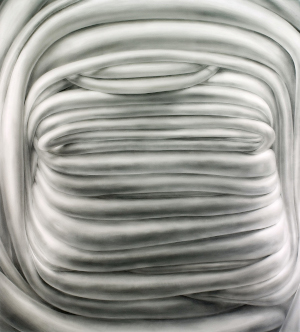
These drawings are often paired with fabricated titles based on sound fragments, such as "Manklewee" or "Primblurter," bridging the gap between the anatomical and the metaphysical. While her early drawings were limited in color, her more recent work aligns more closely with the palette of her paintings.
Assemblage and Craft
Beginning in 2020 during COVID-19 sheltering, Zlotsky began creating textile works. These pieces are assemblages of repurposed vintage silk scarves integrated with crocheted passages. These works mirror the accumulating logic of her paintings while exploring gender, cultural history, and the design sensibilities of the 1960s and 1970s, highlighting the value of craft impulses.
| Medium | Key Characteristics | Primary Themes/Focus |
|---|---|---|
| Oil Painting | Geometric/biomorphic fusion, trompe-l'oeil, textured surfaces | Identity, family, time, and cultural inheritance |
| Graphite on Mylar | Vaporous forms, smudged/blown powder | Anatomical and metaphysical "between-zones" |
| Textiles | Vintage silk scarves and crochet | Gender, 60s/70s design, and craft history |
Frequently Asked Questions
What is the primary focus of Deborah Zlotsky's abstract paintings?
Her paintings focus on the coexistence of opposites, such as geometric and biomorphic forms, intentional marks and accidental smudges, and the interplay between flat surfaces and three-dimensional illusions.
What are pentimenti in the context of Zlotsky's work?
Pentimenti are the visible traces of earlier marks or adjustments made by the artist during the painting process, which Zlotsky leaves exposed to reveal the history of the work's creation.
How does Zlotsky address her Jewish heritage in her art?
She explores Jewishness and assimilation through the "Diaspora" series and the use of Judaica symbols like the tallit and the word chai, as well as by revising the swastika into disorder in her "Ill-fated ancient symbol" series.
What distinguishes the "LifeLike" drawing series?
The "LifeLike" series is distinguished by its use of powdered graphite on mylar and its focus on strange, organic forms that blend the anatomical with the metaphysical, accompanied by invented, sound-based titles.
What inspired Zlotsky's textile works?
Started during the 2020 COVID-19 lockdowns, these works were inspired by vintage silk scarves and 1960s-70s design, aiming to elevate undervalued craft impulses and explore gender and cultural history.