Daniel Schorr: The Journalist Who Challenged the Nixon Administration
In the turbulent landscape of 1970s American journalism, few figures were as provocative or persistent as Daniel Schorr. A seasoned reporter known for his tenacity, Schorr became a central figure in the clash between executive power and the freedom of the press, frequently finding himself at odds with the highest levels of the U.S. government.
The Nixon Era and the Enemies List
During the early 1970s, Schorr's reporting drew the ire of President Richard Nixon's White House. This tension escalated in 1971 when the Federal Bureau of Investigation (FBI) began questioning Schorr's neighbors, friends, and colleagues regarding his personal habits. Under the guise of vetting him for a high-level environmental position—a claim Schorr was entirely unaware of—the administration sought to gather intelligence on the journalist.
The true nature of this surveillance came to light during the Watergate hearings. It was revealed that White House aides, specifically Charles Colson and George T. Bell, had compiled a document known as Nixon's Enemies List. In a moment of televised history, Schorr read the list aloud on live television, discovering in real-time that he had been officially categorized as an enemy of the state.
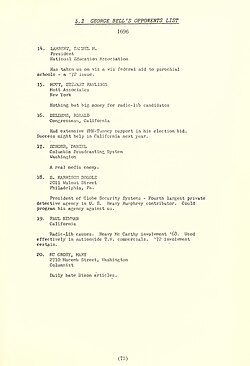
Despite the political pressure, Schorr's professional excellence remained recognized by his peers, earning him Emmy Awards for news reporting in 1972, 1973, and 1974.
The Pike Committee Controversy
In 1976, Schorr sparked a national firestorm when he obtained and publicized the secret Pike Committee report. This document detailed illegal activities conducted by the Central Intelligence Agency (CIA) and the FBI. When called to testify before Congress, Schorr invoked the First Amendment—the section of the U.S. Constitution protecting freedom of speech and press—to refuse to identify his source, even though he faced the risk of imprisonment.
While former CIA director Richard Helms initially criticized the report, the actual text of the documents vindicated Schorr's reporting. However, the fallout within his own organization was severe. CBS executives were displeased with his actions, leading to Schorr's resignation from the network in September 1976.
Internal Conflict and Ethical Disputes
The Pike report incident also led to a bitter internal dispute at CBS. While Schorr remained publicly silent regarding suspicions that colleague Lesley Stahl had leaked the report to The Village Voice, other accounts suggest a more contentious relationship. In her autobiography, Stahl expressed shock at accusations from Schorr, while Roger Mudd claimed in his own autobiography that Schorr had personally spread rumors about Stahl's involvement. The tension was so high that Nora Ephron reported Stahl had considered a slander suit against him.
In a gesture toward journalistic integrity, Schorr eventually donated the profits he earned from the sale of the Pike papers to the Reporters' Committee for Freedom of the Press.
Later Revelations on CIA Activities
Years later, Schorr continued to shed light on the intersection of government secrecy and intelligence. In a 2006 appearance on NPR's Weekend Edition, he recounted a meeting with President Gerald Ford and colleague A. M. Rosenthal. During this meeting, Ford acknowledged that the Rockefeller Commission had access to CIA documents that referred to political assassinations.
Key Facts
- Nixon's Enemies List: Compiled by Charles Colson and George T. Bell; included Daniel Schorr.
- Professional Accolades: Won three consecutive Emmys for news reporting (1972–1974).
- The Pike Report: A secret document exposing illegal CIA and FBI activities.
- First Amendment Stand: Schorr refused to reveal his source for the Pike report to Congress.
- CBS Departure: Resigned in September 1976 following the Pike Committee controversy.
| Event/Entity | Nature of Conflict | Outcome |
|---|---|---|
| Nixon Administration | FBI surveillance and inclusion on "Enemies List" | Public exposure during Watergate hearings |
| Pike Committee Report | Leak of secret CIA/FBI illegal activities | Vindication by report text; resignation from CBS |
| CBS Executives | Disagreement over source protection | Resignation in September 1976 |
| Lesley Stahl | Dispute over who leaked the Pike report | Internal turmoil and potential slander suit |
Frequently Asked Questions
Why was Daniel Schorr on Richard Nixon's Enemies List?
Schorr was targeted by the Nixon White House due to his critical reporting and disputes with White House aides, leading the administration to monitor his habits via the FBI.
What was the Pike Committee report?
The Pike Committee report was a secret government document that detailed illegal activities carried out by the CIA and the FBI.
Why did Daniel Schorr resign from CBS?
Schorr resigned in September 1976 after CBS executives were dissatisfied with his decision to publicize the Pike Committee report and his refusal to name his source before Congress.
How did Schorr handle the profits from the Pike papers?
He donated the profits from the sale of the papers to the Reporters' Committee for Freedom of the Press.
What did President Gerald Ford reveal to Schorr?
President Ford mentioned that the Rockefeller Commission had access to CIA documents that referred to political assassinations.