Dame: The History and Protocol of the British Honorific Title
In the complex world of British honors, the title Dame serves as the female equivalent of "Sir." It is a prestigious honorific granted to women who have been admitted into specific orders of chivalry—societies traditionally established to honor bravery, service, or significant contributions to society. While often associated with modern achievements, the concept of female chivalry has deep historical roots that stretch far beyond the formal titles used today.
Key Facts
- Dame is the female equivalent of the title Sir.
- The title is used with the recipient's given name or full name, but never the surname alone.
- Women in the Order of the Garter or the Order of the Thistle are titled Lady rather than Dame.
- The official use of Dame as a knight's equivalent began in 1917 with the Order of the British Empire.
- Lydia Ko is the youngest person appointed a Dame (age 27), and Olivia de Havilland is the oldest (appointed shortly before age 101).
The Mechanics of Damehood
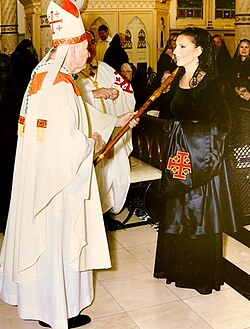
A woman becomes a dame when she is appointed to specific grades—such as Dame Commander or Dame Grand Cross—within several recognized orders. These include the Order of the British Empire, the Order of the Bath, the Royal Victorian Order, the Order of Saint Michael and Saint George, the Order of Saint John, and the Order of the Holy Sepulchre. Additionally, the Order of Saint George in Central Europe grants the rank of Dame to its female members.
Because there is no female equivalent to a Knight Bachelor (a knight who is not a member of a specific order), women are always appointed directly to an order of chivalry. It is important to note that while men are "knighted," there is no specific female verb for this process; women receive their honors in the same manner as any other decoration or medal.
Usage and Protocol
The application of the title follows strict etiquette. Like the title "Sir," Dame must be paired with the holder's first name or their full name. For example, it is correct to say "Dame Jane" or "Dame Jane Doe," but incorrect to say "Dame Doe." Baronetesses in their own right also utilize the title Dame.
Historical Evolution of Female Chivalry
While the formal title of Dame is relatively modern, women have occupied roles of chivalry for centuries. The Order of the Ermine, founded in France in 1381 by John V, Duke of Brittany, was the first order of chivalry to officially accept women. Long before this, female knights existed globally, often distinguished by their own coats of arms and the flying of colored banners.
Historically, women's participation in chivalry varied. Some, like Joane Agnes Hotot (born 1378), participated in tournaments. Others broke societal norms by entering the battlefield. Notable examples include Joan of Arc and the Welsh princess Gwenllian ferch Gruffydd. Duchess Gaita of Lombardy (Sikelgaita) famously wore full armor and rode alongside her husband, Robert Guiscard, as a knight in her own right. Similarly, Petronilla de Grandmesnil, Countess of Leicester, defended her lands against Henry II of England wearing a mail hauberk and wielding a sword and shield.
The Transition of Titles
The terminology surrounding these honors has shifted over time. Until the 17th century, the wife of a knight was referred to as Dame; however, this was eventually replaced by the title Lady. The modern era of the title began in 1917 with the creation of the Order of the British Empire. This was later extended to the Royal Victorian Order (1936), the Order of St Michael and St George, and the Order of the Bath (1971).
Alternative Uses of the Title
Beyond the British honors system, the term "Dame" has appeared in other cultural and religious contexts:
- Religious: Nuns within the English Benedictine order use the title Dame instead of Sister.
- French Louisiana: From the 17th to 19th centuries, the title was used for women of significant local substance or position.
- France: By 1889, it was used as a title of respect for widows or to distinguish high-born ladies from the general population.
| Order | Eligible Grades for 'Dame' Title |
|---|---|
| Order of the British Empire | Dame Commander / Dame Grand Cross |
| Order of the Bath | Dame Commander / Dame Grand Cross |
| Royal Victorian Order | Dame Commander / Dame Grand Cross |
| Order of St Michael and St George | Dame Commander / Dame Grand Cross |
| Order of Saint John | Dame Commander / Dame Grand Cross |
| Order of the Holy Sepulchre | Dame Commander / Dame Grand Cross |
Frequently Asked Questions
Is a Dame the same as a Lady?
Not necessarily. While both are honorifics, "Dame" is specifically the female equivalent of "Sir" for those appointed to certain orders of chivalry. However, women appointed to the Order of the Garter or the Order of the Thistle are titled "Lady" rather than "Dame." Historically, "Lady" also replaced "Dame" as the title for a knight's wife.
Can a woman be a "Knight Bachelor"?
No. There is no female equivalent to a Knight Bachelor. Consequently, women are always appointed to a specific order of chivalry to receive a title.
How is the title Dame correctly addressed?
The title is used with the person's first name or full name (e.g., Dame Lydia or Dame Lydia Ko). It is never used with the surname alone.
Who is the youngest person to become a Dame?
Golfer Lydia Ko is the youngest person to be appointed a Dame, receiving the honor at the age of 27.
Who is the oldest person to receive a damehood?
Olivia de Havilland holds the record, having been appointed a Dame two weeks before her 101st birthday.