Crossing in Football: Techniques, Types, and Tactical Evolution
In association football, a cross is a medium- to long-range pass delivered from a wide area of the pitch toward the center of the field, specifically targeting the area near the opponent's goal. The primary objective of a cross is to place the ball into the penalty box from an angle that allows attacking forwards to more easily direct the ball toward the goal using either their head or feet.
While most crosses are airborne (floated) to bypass defenders, they can also be hit with significant force along the ground, a technique known as a drilled cross. This maneuver is a quick and effective way to create immediate goal-scoring opportunities.
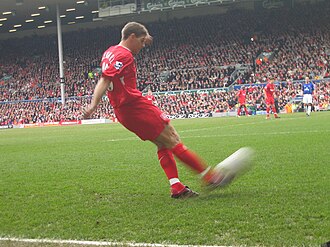
Key Facts
- Purpose: To deliver the ball into the box for forwards to score via headers or volleys.
- Primary Users: Wingers, wing-backs, and full-backs.
- Delivery Styles: Can be floated (airborne) or drilled (grounded).
- Tactical Shift: Modern football has seen a move from traditional crossing wingers to inverted wingers who cut inside.
- Key Attributes: Success depends on the crosser's kicking technique and the receiver's physical presence and positioning.
The Mechanics of Crossing
Crosses are indispensable for players occupying wide positions. By centering the ball from the wings into the penalty box, these players provide forwards with the chance to deflect the ball into the net. If the delivery is high, forwards typically use a volley or a header to score.
From a technical standpoint, players running toward the goal line often use the insole of their "outside" foot (the foot corresponding to the side of the field they are on) to deliver the ball. This is why conventional wingers typically play on the side of their dominant foot. Conversely, inverted wingers play on the opposite wing, often using feints or maneuvers, such as the Cruyff turn, to position themselves to cross with their dominant foot's insole.
Types of Crosses
The choice of cross depends on the player's skill, the positioning of teammates, and the defensive layout. A crosser may initiate the move from a deeper position to ensure a quicker attack or from a forward position to put the teammate in a better scoring angle, despite increased defensive pressure.
Chipped Cross
A chipped cross is used in congested penalty boxes to loft the ball above defenders. This is achieved by slicing the bottom of the ball with the insole or striking it against the ground to create a bounce. While effective for bypassing defenders, it sacrifices momentum, giving goalkeepers more time to gather the ball.
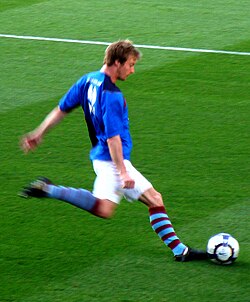
Inswinging Cross
An inswinger occurs when a player applies curl to the ball, causing it to curve toward the goal. This typically happens when a right-footed player is on the left wing (or vice versa). These are common during set-plays and are usually aimed at heading height to maximize the chance of a goal-bound deflection, though the curve can also make it easier for the goalkeeper to intercept.
Outswinging Cross
Commonly used by conventional wingers, the outswinger curves slightly away from the goal. This versatility allows the crosser to pull the ball away from defenders, giving the attacker more space to run onto the ball or execute a more accurate header.
Grounded Cross
Also known as a drilled cross or a cutback, this delivery travels along the ground. It is an ideal option for teams with high technical skill but lacking physical aerial presence. Pacy wingers often outrun the defense to the goal line before delivering a precise ground pass into the box.
| Cross Type | Trajectory | Primary Advantage | Primary Risk |
|---|---|---|---|
| Chipped | High Arc | Bypasses congested defenses | Slow delivery speed |
| Inswinging | Curving Inward | High deflection potential | Easier for GK to gather |
| Outswinging | Curving Outward | Creates space for attacker | Moves away from goal |
| Grounded | Low/Flat | Fast and technically precise | Easily intercepted on ground |
Tactical Evolution in Modern Football
Crossing is a fundamental part of wide-play, used to stretch defenses and initiate aerial duels. However, the rise of statistical analysis and possession-based football has led some to view heavy reliance on crossing as inefficient. Tactics that use crossing as a primary "Plan A" are sometimes criticized as primitive compared to intricate passing games.
In the modern era, the role of the winger has shifted. Traditional crossers like David Beckham and Garrincha have been largely replaced by modern wingers—such as Eden Hazard, Alexis Sánchez, and Lorenzo Insigne. These players are often inverted, focusing on dribbling, creativity, and cutting inside to shoot rather than crossing from the flank. In contemporary formations like the 4-3-3 or 4-2-3-1, crossing duties are frequently shifted to attacking full-backs or overlapping wing-backs. In 3-5-2 systems, wing-backs are utilized specifically to maintain the team's width.
Frequently Asked Questions
What is the difference between a conventional winger and an inverted winger?
A conventional winger plays on the side of their dominant foot to deliver outswinging crosses. An inverted winger plays on the opposite side, allowing them to cut inside toward the center of the pitch to shoot or create plays with their stronger foot.
When is a chipped cross most effective?
A chipped cross is most effective in congested penalty areas where defenders are tightly marking attackers, as it allows the ball to be lofted over the defense to a tall teammate.
Why has crossing become less common in some modern tactics?
Many modern managers prefer possession-based football, which emphasizes high ball-retention rates. Because crosses are medium-to-long range passes into crowded areas, they have a higher risk of loss of possession and a lower conversion ratio compared to intricate passing.
What is a "cutback" in football?
A cutback is a type of grounded or drilled cross delivered from the goal line back toward the center of the penalty box, often catching the defense moving in the wrong direction.
Which players are typically responsible for crossing in a 4-3-3 formation?
While wingers can cross, in many modern 4-3-3 setups, the responsibility often falls to the attacking full-backs or overlapping wing-backs who provide the width while the wingers cut inside.