Cranberries: Botany, Cultivation, and Global Production
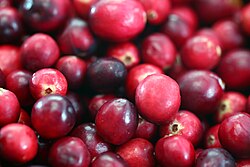
Cranberries are distinctive tart berries belonging to the genus Vaccinium. Known for their deep red hue and association with autumn harvests, these fruits grow on low-lying vines in acidic bog environments. From their complex botanical classification to the industrial-scale flooding used during harvest, cranberries represent a unique intersection of natural ecology and agricultural engineering.
Key Facts
- Primary Producers: The United States (65%) and Canada (34%) account for 99% of global production.
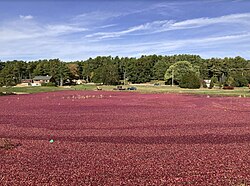
- Harvest Method: Often harvested via "wet-picking," where beds are flooded to float the berries.
- Nutritional Highlight: High in Vitamin C, manganese, and dietary fiber.
- Major Species: Includes the American cranberry (Vaccinium macrocarpon) and the common cranberry (Vaccinium oxycoccos).
- Global Output: World production reached 621,495 tonnes in 2024.
Botanical Classification and Species
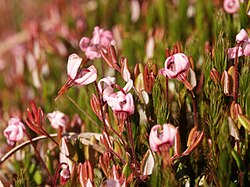
Cranberries are classified under the family Ericaceae and the subgenus Oxycoccus. There are four to five primary species, divided into two main sections based on their characteristics and distribution.
Subgenus Oxycoccus
This group contains the most commercially recognized species:
- Vaccinium macrocarpon: The large or American cranberry, also known as bearberry.
- Vaccinium oxycoccos: The common or northern cranberry.
- Vaccinium microcarpum: The small cranberry.

Subgenus Oxycoccus, sect. Oxycoccoides
These species are typically found in alpine areas between 1,000 and 2,600 meters (3,300–8,500 ft):
- Vaccinium erythrocarpum: The southern mountain cranberry, native to high altitudes in the southern Appalachian Mountains of the southeastern United States.
- Vaccinium japonicum: Native to the Korean Peninsula, the Japanese archipelago, Taiwan, and Southern China.
Cultivation and Farm Management
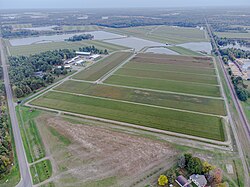
Cranberry cultivation requires specific environmental conditions, typically involving sandy beds and precise water management. Propagation is achieved by moving vines from established beds to new ones, where they are spread on the sand and pushed in with a blunt disk. During the first year, these vines require frequent watering and light applications of nitrogen fertilizer.
The cost of renovating these beds is significant, estimated between $74,000 and $124,000 per hectare ($30,000 to $50,000 per acre).
Ripening and the Harvest Process
Harvesting typically occurs from September through early November, ideally after the first frost. While sun-exposed berries turn deep red, those in the shade may remain pale pink or white. Interestingly, berries can be harvested while still white to produce white cranberry juice, though this results in lower yields and potential vine damage.
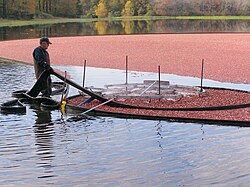
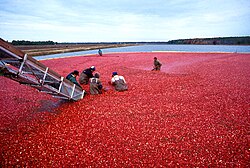
The most common commercial method is wet-picking. Farmers flood the beds with 15 to 20 centimeters (6 to 8 inches) of water. Since cranberries float, mechanical harvesters can easily remove the fruit from the vines. The berries are then corralled and pumped to receiving stations for cleaning and sorting.
Pests and Disease Management
Cranberry growers must manage various biological threats to ensure crop viability. The most common diseases include cranberry fruit rot and cranberry root rot.
Insect pests are numerous and varied, including:
- Moths: Such as the Sparganothis fruitworm, cranberry fruitworm, blackheaded fireworm, and spotted fireworm.
- Beetles: Including the red-headed flea beetle, black vine weevil, and the invasive oriental beetle.
- Other Pests: The blunt-nosed leafhopper, spongy moth, cranberry tipworm, and cranberry weevil.
Production and Global Economics
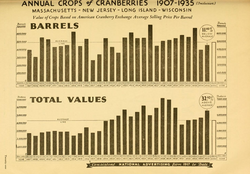
The cranberry industry is heavily concentrated in North America. In the United States, Wisconsin is the leading producer (59% of US total), followed by significant production in Massachusetts, New Jersey, Oregon, and Washington. In Canada, Quebec leads production (60% of Canadian total), with British Columbia contributing 33%.
The Role of Cooperatives
The U.S. industry is characterized by a long history of cooperative marketing. In 1930, the Ocean Spray cooperative was formed through the merger of three processing companies. By 2006, Ocean Spray represented approximately 65% of the North American industry. To maintain market stability, the Cranberry Marketing Committee was established in 1962 as a Federal Marketing Order to regulate supply and quality.

Nutritional Profile
Raw cranberries are composed of 87% water and 12% carbohydrates, with very low levels of protein and fat. They are particularly rich in Vitamin C and manganese.
| Nutrient | Amount | % Daily Value (DV) |
|---|---|---|
| Energy | 46 kcal | - |
| Carbohydrates | 12 g | - |
| Dietary Fiber | 3.6 g | 16% |
| Vitamin C | - | 16% |
| Manganese | - | 16% |
| Vitamin E | - | 9% |
| Pantothenic acid (B5) | - | 6% |
Frequently Asked Questions
Why are cranberry bogs flooded during harvest?
Bogs are flooded because cranberries float. This allows farmers to use mechanical harvesters to shake the berries off the vines and then easily collect them from the surface of the water.
Which countries produce the most cranberries?
The United States and Canada dominate the market, together accounting for 99% of global production, with the U.S. producing 65% and Canada 34%.
Can cranberries be harvested in a color other than red?
Yes. Cranberries can be harvested while they are still white. This is the specific method used to produce white cranberry juice, although it results in lower yields.
What are the main nutritional benefits of cranberries?
Cranberries provide a significant amount of Vitamin C, manganese, and dietary fiber, each contributing 16% of the Daily Value per 100g serving.
What is the difference between the American cranberry and the common cranberry?
The American cranberry (Vaccinium macrocarpon) is a larger species primarily used in commercial production, while the common cranberry (Vaccinium oxycoccos) is a different species within the same subgenus.