Covington, Louisiana: A Historic Hub of the Northshore
Nestled at the fork of the Bogue Falaya and Tchefuncte rivers, Covington serves as the parish seat of St. Tammany Parish, Louisiana. Known for its blend of small-town charm and strategic growth, this city is a key part of the Slidell-Mandeville-Covington statistical area. From its early European settlements to its modern role as a residential haven for those commuting to New Orleans, Covington offers a rich tapestry of Southern history and natural beauty.
Key Facts
- Founded: 1813 by John Wharton Collins.
- Population: 11,564 (2020 Census).
- Geography: Total area of 8.15 square miles, located in St. Tammany Parish.
- Key Landmark: Home to the world's largest statue of Ronald Reagan.
- Recreation: The starting point of the 31-mile Tammany Trace bike trail.
A Journey Through History
The European presence in the area dates back to 1800, when Jacques Drieux settled during the British West Florida period. However, the formal establishment of the town occurred in 1813, when John Wharton Collins founded a settlement originally named Wharton. The town was renamed Covington on March 11, 1816.
The origin of the name "Covington" is a subject of local debate. Many historians believe it honors General Leonard Covington, a hero of the War of 1812 who resided in the Mississippi Territory. Conversely, local historian Judge Steve Ellis suggests the name may have been inspired by the Blue Grass whiskey produced in Covington, Kentucky, which was favored by town officials at the time.
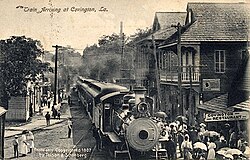
Commerce originally thrived via boat travel, using the Bogue Falaya River and the Tchefuncte River to access Lake Pontchartrain. The arrival of the railroad in 1888 transformed the local economy and infrastructure.
In the late 20th century, the expansion of the interstate system and the construction of the Lake Pontchartrain Causeway led to a population boom. Many professionals working in New Orleans relocated to the "Northshore" in search of larger lots, more affordable housing, and a quieter lifestyle, a trend often associated with white flight from the city.
Geography and Demographics
Covington covers approximately 8.15 square miles, with a small portion (0.14 square miles) consisting of water. The city is characterized by various residential subdivisions, including Downtown Covington, River Forest, Ozone, Covington Point, Barkley Parc, and the West 20s and 30s.
The city's population has seen steady growth over the last century, rising from just 585 residents in 1870 to 11,564 by 2020. According to the 2020 census, the racial composition is approximately 70.98% White (non-Hispanic), 16.78% Black or African American (non-Hispanic), 6.68% Hispanic or Latino, and smaller percentages of Asian, Native American, and mixed-race residents.
| Year | Population | Change (%) |
|---|---|---|
| 1870 | 585 | — |
| 1920 | 2,942 | 13.1% |
| 1970 | 7,170 | 6.2% |
| 2010 | 8,765 | 3.3% |
| 2020 | 11,564 | 31.9% |
Economy, Education, and Culture
Covington's economy is supported by a mix of industrial and corporate entities. Notable employers include Globalstar, a satellite communications company, Zen-Noh Grain Corporation (a Japanese cooperative subsidiary), and Bevolo Gas and Electric Lights.
Education
Public education is managed by St. Tammany Parish Public Schools, with facilities including Covington High School, Pitcher Junior High, Pine View Middle, and the Lyon and Covington Elementary schools. Private options include Saint Paul's School, Saint Scholastica Academy, and St. Peter Catholic School.
Arts and Recreation
The city is a hub for outdoor enthusiasts, specifically through the Tammany Trace. This 31-mile paved rails-to-trails path—a trail converted from a former railroad right-of-way—connects Covington to Mandeville, Abita Springs, Lacombe, and Slidell.
Covington has also served as a backdrop for several films, including Eve's Bayou (1997), Local Color (2005), American Ultra (2014), and The Highwaymen (2019).
Notable Residents
The city has been home to a diverse array of influential figures, including:
- Arts & Literature: Author Walker Percy, science-fiction writer Daniel F. Galouye, and musician Stephen Stills.
- Entertainment: Actor Ian Somerhalder and comedian Theo Von.
- Sports: NBA all-star Pete Maravich, NFL Hall of Fame coach Hank Stram, and UFC fighter Brendan Allen.
- Public Service: U.S. District Court judge Frank Burton Ellis and Coast Guard Master Chief Petty Officer Heath B. Jones.
Frequently Asked Questions
Who founded Covington?
The town was established in 1813 by John Wharton Collins, originally under the name Wharton, before being renamed Covington in 1816.
What is the Tammany Trace?
The Tammany Trace is a 31-mile paved rails-to-trails path used for hiking and bicycling that connects Covington with several other Northshore communities.
Why is Covington known for its Ronald Reagan statue?
Covington is home to a 10-foot-tall statue of Ronald Reagan on a 6-foot base, which is reputed to be the largest statue of the former president in the world.
How did the city's population grow so rapidly in the late 20th century?
Growth was driven by the expansion of the interstate system and the Lake Pontchartrain Causeway, allowing people to live in the Northshore while commuting to work in New Orleans.
What are the primary rivers that define Covington's location?
The city is situated at the fork of the Bogue Falaya and the Tchefuncte rivers.