Cosmological Parameters and the Age of the Universe
Determining the age of the universe is one of the most profound challenges in astrophysics. This calculation is not a simple measurement but is deeply intertwined with the values of cosmological parameters—the fundamental constants that describe the composition and evolution of the cosmos.
Most modern calculations are performed within the framework of the ΛCDM model. This model assumes the universe is composed of baryonic (normal) matter, cold dark matter, radiation (including neutrinos and photons), and a cosmological constant (represented by the Greek letter Lambda, Λ).
The Role of Density Parameters
To understand the universe's age, scientists look at the fractional contribution of different components to the total energy density. These are expressed as density parameters:
- Ωm: The fractional matter density.
- Ωr: The fractional radiation density.
- ΩΛ: The cosmological constant density.
While the full ΛCDM model involves several other variables, these three parameters, combined with the Hubble parameter (H0), are the primary drivers for computing the age of the universe.
Calculating Age via the Friedmann Equation
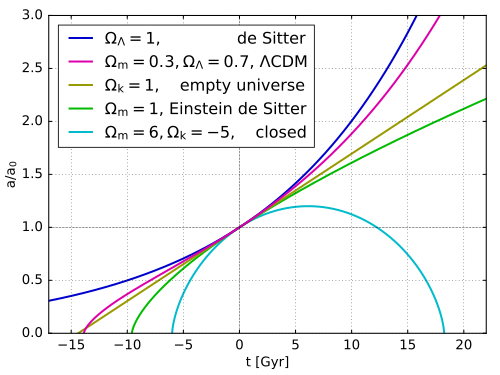
The mathematical bridge between these parameters and time is the Friedmann equation. This equation relates the rate of change in the scale factor a(t)—which describes how the universe expands—to its matter and energy content. By integrating this relation, scientists can determine the total age of the universe (t0) using the following expression:
t0 = (1 / H0) * F(Ωr, Ωm, ΩΛ, …)
In this formula, 1/H0 is known as the Hubble time. It provides a rough first estimate of the universe's age. For example, with a Hubble parameter (H0) of approximately 69 km/s/Mpc, the Hubble time is roughly 14.5 billion years. The function F serves as a correction factor based on the universe's specific energy content.
The Impact of the Correction Factor (F)
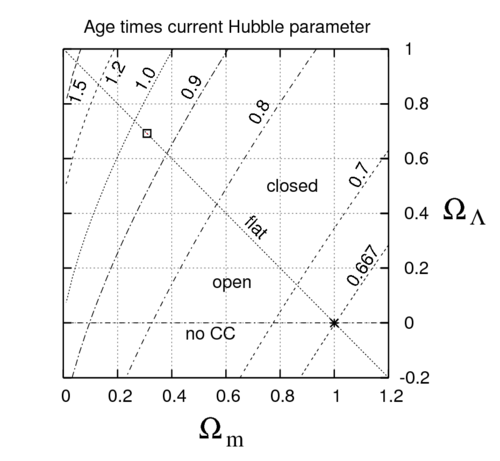
The value of the correction factor F significantly alters the final age. For instance, using Planck satellite values where (Ωm, ΩΛ) = (0.3086, 0.6914), the correction factor is approximately 0.956. Conversely, in a flat, matter-dominated universe without a cosmological constant, F is much smaller (2/3), resulting in a significantly younger universe for the same Hubble parameter.
Measuring the Cosmos: Tools and Evidence
Establishing these values requires data from multiple astronomical sources. The Planck satellite and the Wilkinson Microwave Anisotropy Probe (WMAP) have been essential in constraining the matter content (Ωm) and the curvature parameter (Ωk) through measurements of the Cosmic Microwave Background (CMB).
However, the CMB is less sensitive to the cosmological constant (ΩΛ) because its effects are most prominent at low redshift (more recent cosmic time). To refine the Hubble parameter (H0), astronomers rely on the measured brightness and redshifts of Type Ia supernovae. Combining these diverse datasets allows for the generally accepted calculation of the universe's age.
Key Facts
- The Hubble time (1/H0) provides the baseline estimate for the age of the universe.
- The ΛCDM model includes baryonic matter, cold dark matter, radiation, and a cosmological constant.
- The cosmological constant effectively makes the universe "older" for a fixed set of other parameters.
- Type Ia supernovae are primary tools for determining the Hubble parameter.
- The Planck satellite provides critical data for matter density and curvature.
| Parameter | Symbol | Description | Primary Measurement Source |
|---|---|---|---|
| Hubble Parameter | H0 | Rate of cosmic expansion | Type Ia Supernovae |
| Matter Density | Ωm | Fraction of energy from matter | CMB (Planck/WMAP) |
| Cosmological Constant | ΩΛ | Fraction of energy from dark energy | Combined Data/Supernovae |
| Radiation Density | Ωr | Fraction of energy from photons/neutrinos | CMB Temperature |
Frequently Asked Questions
Why is the cosmological constant important for the age of the universe?
The cosmological constant increases the calculated age of the universe. This solved a major scientific conflict where globular clusters in the Milky Way appeared older than the universe itself under older, matter-only models.
What is the difference between the Hubble time and the actual age of the universe?
The Hubble time is a simple inverse of the expansion rate (1/H0). The actual age is the Hubble time multiplied by a correction factor (F) that accounts for the specific density of matter, radiation, and dark energy.
Which satellites helped determine these parameters?
The Planck satellite and the Wilkinson Microwave Anisotropy Probe (WMAP) were instrumental, particularly in measuring the Cosmic Microwave Background to constrain matter density and curvature.
How do Type Ia supernovae contribute to these calculations?
Type Ia supernovae provide some of the most accurate measurements of the Hubble parameter (H0) by allowing astronomers to compare their known brightness with their observed redshift.