Corah of Leicester: The Rise and Fall of a Textile Giant
For over a century, N. Corah and Sons stood as a titan of the British textile industry. Based in Leicester, England, the company evolved from a modest trading operation into one of Europe's largest producers of knitted fabrics. Its influence extended far beyond the factory walls, shaping the retail strategies of some of Britain's most famous stores and providing a livelihood for thousands of workers.
Key Facts
- Founded: 1815 by Nathaniel Corah in Leicester.
- Peak Employment: 6,800 workers by 1969.
- Primary Brand: St Margaret's.
- Major Partner: Marks & Spencer (M&S).
- Global Reach: Supplied international sports teams and expanded to Canada.
- Closure: Defunct in the 1990s following an acquisition by Charterhall.
The Foundation and Early Growth
The company began in 1815 when Nathaniel Corah established his business at the Globe Inn on Silver Street, Leicester. At the time, the area was a hub for stockingers (specialists in knitting stockings). Corah's initial business model was simple: he purchased completed stockings within Leicester and sold them for a profit elsewhere, primarily in Birmingham.
The business expanded rapidly, moving to its own premises on Union Street in 1824. By 1830, Nathaniel brought his three sons—John, Thomas, and William—into the partnership, renaming the firm Nathaniel Corah & Sons.
The St Margaret's Works Era
By 1855, the firm operated 2,000 knitting frames, but its Granby Street premises soon became inadequate. In 1865, the company moved to a massive new site in the parish of St Margaret, near the River Soar. This facility, known as the St Margaret's Works, featured a warehouse 160 feet long and a factory building measuring 294 by 80 feet, powered by a massive steam-powered beam engine.
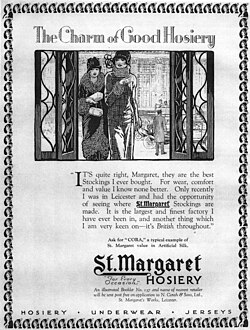
While hosiery remained a core product, Corah diversified in the 1870s to include men's and women's garments, as well as rugby and football jerseys. This diversification brought international fame; for example, the Argentine football team River Plate, along with clubs like Boca Juniors and Racing, wore St Margaret's shirts.
![Argentine football team River Plate wearing St. Margaret's shirts in 1920[12][13] Other Argentine clubs such as Boca Juniors[14] and Racing[15] also wore St Margaret's](/images/b3/7e/b37e0d15713b87cecdf6299a80f3f9cdf1bbf83ee677f6dc2e6108adef90c428.jpg)
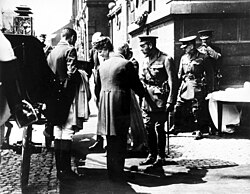
The prestige of the works attracted high-profile visitors, including King George V and Queen Mary in 1919, and later Queen Elizabeth II in 1958.
A Strategic Partnership with Marks & Spencer
Corah played a pivotal role in the growth of the retailer Marks & Spencer (M&S). The two companies formed a direct relationship that bypassed wholesalers, allowing for longer, more profitable production runs and higher quality control. This partnership was so influential that M&S's own "St Michael" brand, used from 1928 to 2000, was inspired by Corah's "St Margaret" label.
This direct-to-retailer model was initially controversial. The Wholesale Textile Association (WTA) blacklisted Corah for bypassing wholesalers, forcing the company to use coded language in its accounts to hide the relationship. Despite this, the partnership flourished, reaching a trade value of £20 million per annum by the 1970s.
Life at the Factory
The St Margaret's Works was more than just a place of business; it was a community. By 1900, the factory employed over a thousand people, many of whom were women. The company's impact was felt deeply during the World Wars: 330 male employees served in WWI (40 of whom were killed), and 70% of the company's output was dedicated to the war effort.
Post-WWII, a shortage of female workers led Corah to introduce specialist training for the first time. The company also fostered a strong social culture, maintaining competitive sports teams and celebrating employee milestones together.
Industrial Decline and Closure
The 1970s and 1980s brought severe challenges to the UK hosiery industry. Corah faced a combination of shifting consumer tastes, fierce foreign competition, and high inflation, which drove up labor costs. At its peak in 1969, the company employed 6,800 people and produced massive quantities of goods, including 100,000 dozen pairs of gents' half hose per week.
The end came in 1989 when the company was sold to the Australian firm Charterhall. The acquisition ended in disaster; Charterhall suffered a $26.5 million loss, leading to the collapse of both firms and the closure of the factory in the 1990s.
The Legacy of the Corah Building
Today, the historic building complex remains a Local Heritage Asset next to Abbey Park. While the boiler house chimney has been demolished and some workshops removed, the main monumental factory still stands. Though parts are used for small-scale manufacturing or light industry, much of the site is derelict and has become a popular destination for urban explorers.
| Period/Metric | Details |
|---|---|
| Founded | 1815, Leicester |
| Key Brand | St Margaret's |
| Peak Workforce | 6,800 (1969) |
| Major Retail Partner | Marks & Spencer |
| Fate | Acquired by Charterhall (1989); closed 1990s |
Frequently Asked Questions
What was the relationship between Corah and Marks & Spencer?
Corah was the first company to develop a direct supply relationship with Marks & Spencer, bypassing wholesalers. This partnership allowed for higher quality and more efficient production, and Corah's "St Margaret" label inspired the creation of the "St Michael" brand.
Which famous sports teams wore Corah clothing?
The Argentine football team River Plate wore St Margaret's shirts in 1920. Other Argentine clubs, including Boca Juniors and Racing, also wore the brand.
Why did the company eventually close?
The closure was caused by a combination of factors: the decline of the UK hosiery industry due to foreign competition, changing fashion tastes, and a disastrous acquisition by the Australian firm Charterhall in 1989.
What happened to the St Margaret's statue?
The statue of St Margaret, which originally stood above the main entrance of the factory, was moved to the nearby St Margaret's church in 1995.
How did the World Wars affect the company?
During WWI, 70% of output went to the war effort and 330 employees served. In WWII, the loss of female workers to the war effort created a skills shortage that forced the company to implement specialist training in the post-war era.