Coppermill and Marine Engine House: Victorian Industrial Heritage
The industrial landscape of Walthamstow is anchored by two significant Victorian structures: the Coppermill and the Marine Engine House. These buildings stand as testaments to the region's evolution from early milling and gunpowder production to the sophisticated water management systems of the 19th century. Together, they reflect the architectural and economic shifts of the Lower Lee Valley.
The Marine Engine House
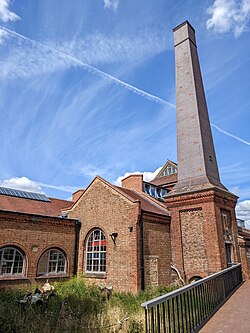
Constructed in 1894, the Marine Engine House was originally known as the Ferry Lane Pumping Station. It was built as part of the broader development of the local reservoir complex. Architecturally, the building follows the simplified Italianate style—a popular choice for Victorian industrial sites—characterized by semi-circular heads on all primary door and window openings.
The structure features a complex layout, consisting of a primary two-storey building with a single-storey attachment to the north. To the west lies another single-storey section, which contains the base of a chimney stack that has since been demolished. The building is constructed entirely of brick, with roofs finished in plain clay tiles. The single-storey sections utilize patent glazed roof-lights and ridge lights for illumination, while the main Engine House roof is half-hipped at the north and south ends with a pitch of approximately 45 degrees.
Despite the loss of its chimney and various external modifications, the building remains an imposing example of industrial design. Today, it has been repurposed as a visitor centre, housing a café, a shop, and an exhibition space.
The Coppermill
The Coppermill is a Grade II Listed building that has evolved through numerous iterations over several centuries. Its history is deeply intertwined with the Coppermill Stream, a diversion from the River Lea. As early as the 14th century, the mill was used for grinding corn, and by 1611, records indicate that four mills were associated with the Manor of Walthamstow.
The mill's purpose shifted frequently between the 17th and 18th centuries. From 1659 to 1703, it operated as a paper mill, leading the adjacent stream to be called the Paper-mill River. However, references to "Powder Mill Marsh" in 1699 suggest the site may have produced gunpowder during the English Civil War (1642–1651), aligning with other gunpowder mills found in the Lower Lee Valley.
By the early 18th century, the mill transitioned into leather production. Records from 1703 to 1718 identify skin-dressers such as Pierre Montier, Peter Lefevre, and Daniel Lefevre as the millers. After a period as an "oyl mill," the structure was rebuilt in 1806 and purchased by the British Copper Company in 1808.
During the copper era, smelted copper ingots were transported by barge from Landore, Swansea, Wales, via the Thames. These materials were used to mint penny and halfpenny coins. Copper production ended in 1857, and in 1859, the East London Waterworks Company acquired the mill, modifying it to drive a water pump for reservoir construction. An Italianate tower was added to the structure in 1864.
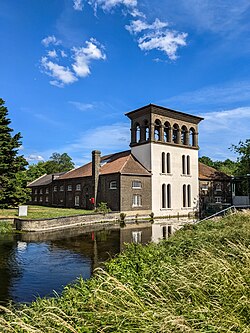
Currently, the Coppermill serves as an operational hub for Thames Water.
Key Facts
- Marine Engine House: Built in 1894; originally the Ferry Lane Pumping Station.
- Coppermill Status: Grade II Listed building.
- Coin Production: The British Copper Company used the mill to produce penny and halfpenny coins from Swansea copper.
- Diverse History: The Coppermill has served as a corn mill, paper mill, potential gunpowder mill, leather mill, and oil mill.
- Current Use: The Marine Engine House is a visitor centre; the Coppermill is a Thames Water operational hub.
Industrial Site Summary
| Feature | Marine Engine House | The Coppermill |
|---|---|---|
| Original Purpose | Pumping Station | Corn/Paper/Leather/Copper Mill |
| Construction/Key Date | 1894 | 14th Century (Origins); 1864 (Tower) |
| Architectural Style | Simplified Italianate | Mixed / Italianate Tower |
| Current Function | Visitor Centre & Café | Thames Water Operational Hub |
Frequently Asked Questions
What was the Marine Engine House originally used for?
It was originally constructed in 1894 as the Ferry Lane Pumping Station to support the development of the reservoir complex.
What types of coins were produced at the Coppermill?
Under the ownership of the British Copper Company, the mill produced penny and halfpenny coins using copper ingots brought from Swansea, Wales.
Is there evidence that the Coppermill produced gunpowder?
While not explicitly confirmed as a primary use, the name "Powder Mill Marsh" appearing in 1699 and the presence of other gunpowder mills in the Lower Lee Valley suggest it may have been used for gunpowder production during the English Civil War.
What is the current status of the Coppermill building?
The Coppermill is a Grade II Listed building and currently functions as an operational hub for Thames Water.
What architectural style is the Marine Engine House?
The building is designed in the simplified Italianate style, which was common for Victorian industrial architecture, featuring semi-circular heads on doors and windows.