Congressional Office Buildings: The Infrastructure of U.S. Legislative Power
While the United States Capitol serves as the iconic center of American democracy, the daily operations of the legislative branch extend far beyond the Capitol dome. To accommodate the vast needs of lawmakers and their staff, the Capitol Complex includes a series of dedicated congressional office buildings. These structures provide the essential workspace required for the U.S. House of Representatives and the U.S. Senate to function effectively.
These buildings are managed under the authority of the Architect of the Capitol and are secured by the United States Capitol Police. Beyond individual member offices, these facilities house committee hearing rooms, staff workspaces, cafeterias, and various maintenance and support areas.
Connecting the Complex
To ensure efficient movement between the legislative chambers and their respective offices, the buildings are linked by a network of underground pedestrian tunnels. Some of these tunnels feature a specialized Capitol subway system, utilizing small railcars to shuttle personnel quickly across the complex.
Historically, congressional pages—student assistants—were tasked with delivering messages and packages between the chambers and the office buildings. While the Senate pages program continues today, the House of Representatives pages program was discontinued in 2011 after 180 years following a series of scandals.
Senate Office Buildings
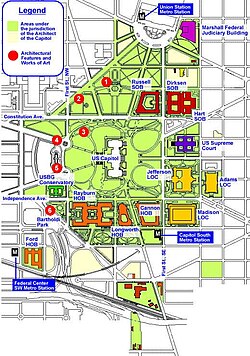
Located along Constitution Avenue, north of the Capitol, are the three primary office buildings for the U.S. Senate:
- Russell Senate Office Building (RSOB): Built between 1903 and 1908 and opened in 1909, it was named in 1972 after Senator Richard Russell Jr. of Georgia.
- Dirksen Senate Office Building (DSOB): Opened in 1958, this building was originally known as the new Senate Office Building before being renamed for Senator Everett Dirksen of Illinois.
- Hart Senate Office Building (HSOB): Completed in 1982 after construction from 1971 to 1980, it is named for Senator Philip A. Hart of Michigan.
House of Representatives Office Buildings
The House of Representatives utilizes several buildings located primarily along Independence Avenue on the south side of the Capitol.
Primary House Buildings
The three main structures are named after influential Speakers of the House:
- Cannon House Office Building (CHOB): Built from 1904 to 1908 and dedicated in 1908, named for Speaker Joseph Cannon.
- Longworth House Office Building (LHOB): Built between 1930 and 1933 and dedicated in 1933, named for Speaker Nicholas Longworth of Ohio.
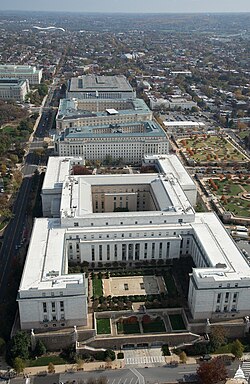
- Rayburn House Office Building (RHOB): Built from 1962 to 1965 and dedicated in 1965, named for Speaker Sam Rayburn of Texas. This is the largest of the House office structures.
Additional House Facilities
The House also utilizes the Ford House Office Building, named for the 38th President, Gerald R. Ford. Built in 1939 by the Works Progress Administration (WPA) during the New Deal, it previously housed the U.S. Bureau of the Census and the FBI's fingerprint records. Formerly known as House Annex-2, it now hosts administrative offices and committee staff.
Additionally, the O'Neill House Office Building (named for Speaker Thomas "Tip" O'Neill) serves House staff. The original building, known as House Annex-1, was demolished in 2002. In 2012, Federal Office Building No. 8—formerly the FDA headquarters—was renovated and renamed as the replacement O'Neill building. Transferred to the Architect of the Capitol in 2017, it currently houses House administrative staff and offices shared with the U.S. Department of Health and Human Services.
Key Facts
- Management: All buildings are under the authority of the Architect of the Capitol and protected by the U.S. Capitol Police.
- Transport: An underground tunnel system and a small railcar subway connect the offices to the Capitol.
- Largest House Building: The Rayburn House Office Building is the largest structure for House offices.
- Senate Hubs: The Russell, Dirksen, and Hart buildings serve as the primary Senate workspaces.
- Supporting Infrastructure: The complex includes the Capitol Power Plant and the Daniel Webster Senate Page Residence.
| Building Name | Chamber | Construction Period | Named After |
|---|---|---|---|
| Russell | Senate | 1903-1908 | Senator Richard Russell Jr. |
| Dirksen | Senate | 1956-1958 | Senator Everett Dirksen |
| Hart | Senate | 1971-1980 | Senator Philip A. Hart |
| Cannon | House | 1904-1908 | Speaker Joseph Cannon |
| Longworth | House | 1930-1933 | Speaker Nicholas Longworth |
| Rayburn | House | 1962-1965 | Speaker Sam Rayburn |
Frequently Asked Questions
Who is responsible for the maintenance and security of these buildings?
The buildings are under the authority of the Architect of the Capitol and are protected by the United States Capitol Police.
How do members of Congress travel between their offices and the Capitol?
They use a system of underground pedestrian tunnels, some of which include a subway system with small railcars.
What is the history of the Ford House Office Building?
Built in 1939 by the Works Progress Administration, it previously served as the U.S. Bureau of the Census and housed FBI fingerprint records before becoming a House office building.
Is there still a page program for both the House and Senate?
No. While the Senate pages program continues and includes the Daniel Webster Senate Page Residence, the House of Representatives pages program was discontinued in 2011.
Which House office building is the largest?
The Rayburn House Office Building is the largest structure used for House offices.