Condensation: The Science of Phase Transitions and Its Real-World Impact
Condensation is a fundamental physical process where matter changes from a gas phase into a liquid phase. As the reverse of vaporization, this transition plays a critical role in the Earth's water cycle and various industrial applications. While we most commonly associate condensation with water vapor turning into liquid droplets, the phenomenon describes any substance undergoing this specific state change.
When a gas transitions directly into a solid phase without becoming a liquid first, the process is known as deposition. Understanding how these transitions occur is essential for everything from meteorology to modern building construction.
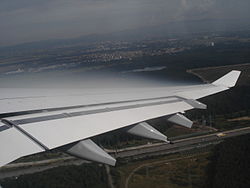
How Condensation Begins
The process of condensation is initiated by the formation of atomic or molecular clusters within a gaseous volume. This can lead to the creation of raindrops or snowflakes within clouds. This process often occurs at the contact point between a gas and a liquid or solid surface.
In the atmosphere, condensation can be catalyzed by cloud condensation nuclei—tiny particles that provide a surface for water to gather. Interestingly, some atmospheric microbes produce water-nucleating proteins that help bind gaseous or liquid water molecules, facilitating cloud formation.
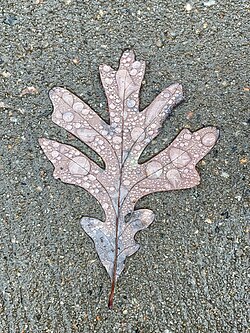
Reversibility and Surface Interaction
The way condensation behaves depends heavily on the nature of the surface it encounters. There are three primary scenarios regarding how these states can reverse:
- Absorption: When a liquid is absorbed into a surface (or a solvent), it is reversible through evaporation.
- Adsorption (High Temperature/Pressure): When droplets form on a solid surface at pressures and temperatures above the species' triple point, the process is reversible via evaporation.
- Adsorption (Low Temperature/Pressure): When supplemental solid layers form on a surface at levels below the triple point, the process is reversible through sublimation.
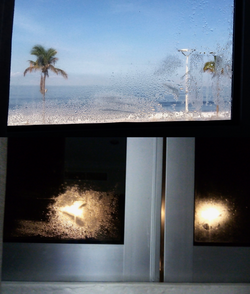
Common Scenarios and Measurement
Condensation typically occurs when a vapor is cooled or compressed until it reaches its saturation limit. This is the point where the molecular density in the gas phase reaches its maximum threshold. In industrial settings, specialized equipment called a condenser is used to cool and compress vapors to collect the resulting liquids.
To study these transitions, scientists use psychrometry, which measures the rates of condensation and evaporation into air moisture across various atmospheric pressures and temperatures.
Practical Applications of Condensation
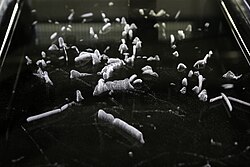
Condensation is not merely a weather phenomenon; it is a vital tool in science and industry. In laboratory settings, it is a crucial component of distillation. In particle physics, cloud chambers utilize condensation to visualize radiation; ions produced by incident particles act as nucleation centers, creating visible "cloud" trails as vapor condenses around them.
Natural and Commercial Uses
Nature has adapted to utilize condensation for survival. Animals such as the Australian thorny devil and Namibian darkling beetles, as well as the coast redwoods of the United States, have evolved to access water made available through condensation. Humans mimic this through structures like air wells and fog fences to harvest water in arid regions.
On a commercial scale, condensation processes are integral to:
- Power generation and water desalination
- Thermal management and refrigeration
- Air conditioning systems
Condensation in Building Construction
While beneficial in nature, condensation inside buildings is often an unwanted issue. It can lead to dampness, mold growth, wood rot, corrosion, and the weakening of masonry. It can also cause energy penalties by increasing heat transfer through walls.
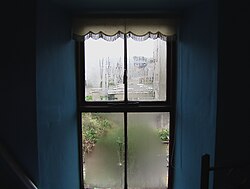
Most indoor condensation occurs when warm, moisture-heavy air contacts a cool surface. As the air cools, its ability to hold water vapor decreases, leading to the deposition of liquid on the surface. This is frequently seen in winter when central heating is used alongside single-glazed windows.
To prevent these issues, it is important to:
- Improve air ventilation (using extractor fans or opening windows)
- Use dehumidifiers to lower indoor humidity
- Address thermal bridges and improve insulation
- Utilize insulated glazing to prevent cool surfaces
Key Facts
- Condensation is the phase change from gas to liquid.
- Deposition is the direct change from gas to solid.
- Cloud condensation nuclei are essential for forming clouds in the atmosphere.
- Psychrometry is the science used to measure condensation and evaporation rates.
- In buildings, condensation is often caused by warm air hitting cool surfaces.
Phase Transition Summary
| From | To | Process Name |
|---|---|---|
| Solid | Liquid | Melting |
| Liquid | Solid | Freezing |
| Liquid | Gas | Vaporization |
| Gas | Liquid | Condensation |
| Gas | Solid | Deposition |
| Solid | Gas | Sublimation |
| Gas | Plasma | Ionization |
| Plasma | Gas | Recombination |
Frequently Asked Questions
What is the difference between condensation and deposition?
Condensation is the transition from a gas directly into a liquid, whereas deposition is the transition from a gas directly into a solid.
How can I prevent condensation in my home?
You can prevent condensation by improving ventilation, using dehumidifiers, ensuring proper insulation to eliminate thermal bridges, and managing indoor humidity by covering pots while cooking or drying clothes outside.
What causes condensation in clouds?
Condensation in clouds is often triggered by water-nucleating proteins from microbes or other particles acting as cloud condensation nuclei, which allow water vapor to cluster into droplets.
What is a condenser used for?
A condenser is a piece of equipment used to cool and compress vapor to collect the resulting liquid, which is a common requirement in various industrial and laboratory processes.
How do animals use condensation?
Certain species, such as the Australian thorny devil and Namibian darkling beetles, have biological adaptations that allow them to collect and use water produced through natural condensation.