Comrat: A Journey Through the History of the Gagauz Capital
Comrat serves as the heart of the Gagauz people, blending a rich archaeological past with a complex political history. From ancient burial mounds to its current status as a regional capital, the city reflects the diverse migrations and cultural shifts of the Budjak region.
Ancient Roots and Early Settlements
Long before the modern city existed, the area around Comrat was a hub of prehistoric activity. Archaeological evidence reveals the presence of the Yamnaya culture, known for its distinct burial mounds, and the Chernyakhov culture. Additionally, sites from the Bronze Age have been linked to the Noua-Sabatinovka-Coslogeni complex, indicating that the region has been inhabited for millennia.
The Budjak Horde and the Origin of the Name
During the era of the Budjak Horde (a political entity of Nogai Tatars), Comrat emerged as a major settlement alongside Udobne and Căușeni. The city's name is derived from the Gagauz words Kömür at, meaning "black horse." For the Nogai-Tatars, the black horse was not only a symbol of the town but a significant marker of wealth.
The settlement's existence was documented as early as 1775, when a map of Moldova created by F. W. Bauer depicted a location called "Cumrad" in the area.
The Russian Period and Ethnic Resettlement
The geopolitical landscape shifted following the Russo-Turkish War (1806–1812), which led to the Russian annexation of the region. The Russian government expelled the local Turks and Tatars, issuing a decree in 1819 to resettle the land with various nationalities from across the Danube.
The majority of these new settlers were Bulgarians and Gagauz refugees fleeing the Ottoman Empire, particularly from the Varna region and southern Bulgaria. They were joined by minorities of Greeks, Ukrainians, and Moldovans. Because the reorganized Bessarabia Governorate was part of the Pale of Settlement (the region of the Russian Empire where Jews were permitted to reside), a small Jewish community also established itself in Comrat.
By the late 19th century, Comrat was a thriving trading village. In 1892, the Jewish community requested that the settlement be granted the status of a shtetl (a small Jewish town), though the request went unanswered. Russian ethnographer A. V. Moshkov described the village at the time as a center for all Gagauz colonies with 10,000 residents, noting that locals jokingly referred to it as the "capital of the Gagauz."
The Turbulent 20th Century
The early 1900s brought political unrest. In 1906, the village revolted against Russian rule and proclaimed the autonomous Comrat Republic. Following World War I, the area became part of the Kingdom of Romania within Tighina County. It was officially granted town status in 1926.
With its new status as a town, Comrat required an official seal. This seal was designed by Emmanuel Hadji-Mosco and Dionisie Pecurariu and adopted on September 30, 1932.
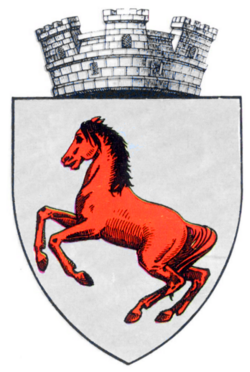
The mid-century was marked by shifting borders. The Soviet Union occupied the town in 1940, followed by a brief Romanian recapture in 1941. Under the Moldavian SSR, a 1941 decree split Comrat into three village councils: Comrat, New-Comrat, and Yalpug. These were eventually reunited on September 13, 1957. During the Soviet era, the local economy focused on the production of wine, butter, and rugs featuring traditional Moldavian motifs.
Comrat in the Modern Era
The collapse of the Soviet Union led to a period of political transition. Between 1989 and 1995, Comrat served as the capital of the self-proclaimed, though unrecognized, Gagauz Republic.
Today, Comrat is the official capital of the Autonomous Territorial Unit of Gagauzia (Gagauz-Yeri) and houses the Executive Committee of Gagauzia. The city continues to grow as an educational hub, highlighted by the establishment of Comrat State University in 2002.
Key Facts
- Etymology: Named after the Gagauz words for "black horse" (Kömür at).
- Ancient History: Home to remains of the Yamnaya and Chernyakhov cultures.
- Demographics: Historically settled by Gagauz and Bulgarian refugees from the Ottoman Empire.
- Political Status: Current capital of the Autonomous Territorial Unit of Gagauzia.
- Education: Home to Comrat State University, founded in 2002.
| Period/Year | Key Event | Significance |
|---|---|---|
| 1775 | Bauer Map | First depiction of "Cumrad" in the area. |
| 1819 | Russian Decree | Resettlement of Gagauz and Bulgarians. |
| 1906 | Comrat Republic | Proclamation of autonomy from Russia. |
| 1926 | Town Status | Official transition from village to town under Romania. |
| 1989–1995 | Gagauz Republic | Capital of the unrecognized self-proclaimed republic. |
Frequently Asked Questions
What does the name Comrat mean?
The name is believed to come from the Gagauz words Kömür at, which translates to "black horse," a symbol of wealth for the Nogai-Tatars.
Who were the primary settlers of Comrat in the 19th century?
The majority of settlers were Gagauz and Bulgarians who arrived as refugees from the Ottoman Empire, specifically from southern Bulgaria and the Varna region.
What was the Comrat Republic of 1906?
The Comrat Republic was an autonomous (but not independent) entity proclaimed by the village during a revolt against the Russian authorities.
What industries were prominent in Comrat during the Soviet period?
The city's industry was primarily focused on the production of wine, butter, and rugs decorated with Moldavian motifs.
What is the current administrative role of Comrat?
Comrat is the capital of the Autonomous Territorial Unit of Gagauzia (Gagauz-Yeri) and serves as the seat of the Executive Committee of Gagauzia.